Think.NXT: Can Discovery Of Rare Earth Metals In India Cut Its China Dependence?
“India still imports 90% of its requirement of rare earth metals from China. Now that is a recipe for disaster."
advertisement
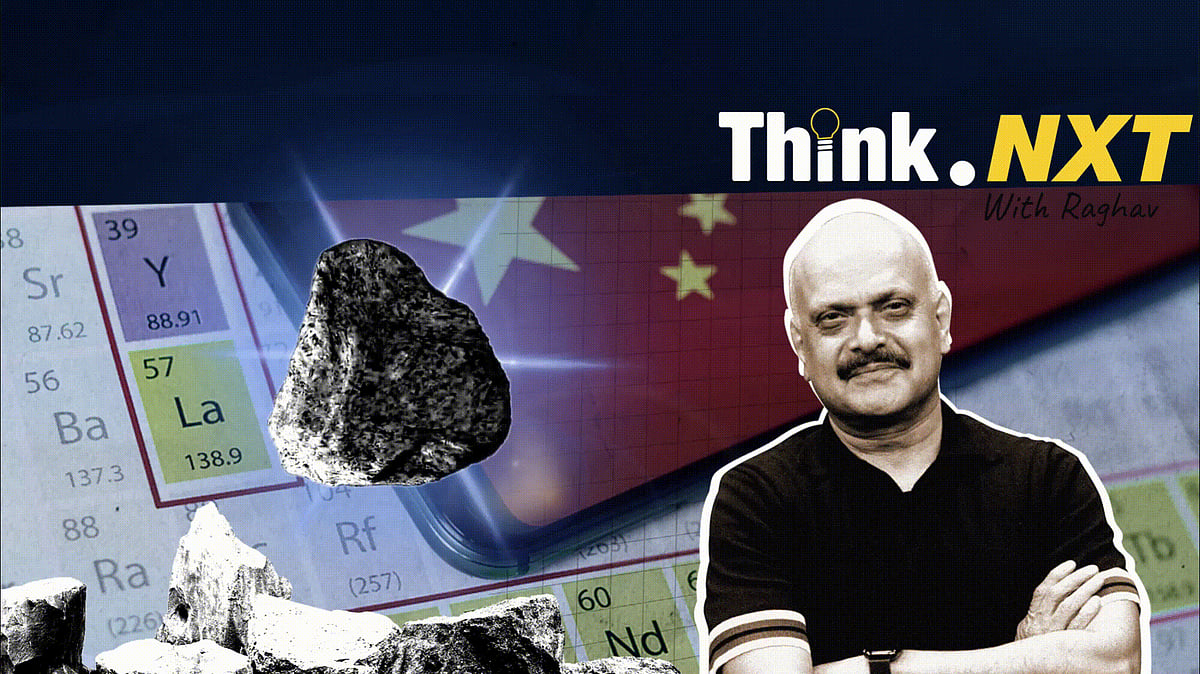
In this episode of Think.Nxt Shorts, The Quint’s Editor-in-Chief Raghav Bahl talks about rare earth metals. Why, you ask? Well, because:
Rare earth metals have recently been discovered in India
Currently, China has the monopoly of supplying rare earth metals to the world and hence controls the price of the commodities
And so, in this episode, Bahl explores how the latest discovery can be a potential opportunity for India, which despite having six percent of the world’s reserves of rare earth metals imports 90 percent of its requirements from China.
Click here to read the full multimedia immersive of Think.Nxt Shorts 02.
But First, What are Rare Earth Metals?
There are 17 rare earth metals in the periodic table – 15 Lanthanides, and Yttrium and Scandium. Although they are called ‘rare earth metals’, they are not actually that rare. In fact, they are quite widespread in the Earth’s crust.
“Rare earth metals are rare in one sense. It’s very difficult to extract them because of two reasons – one, they are very sparsely spread out and second, they are very closely packed with radioactive elements such as Uranium and Thorium,” Bahl explained.
He added that the several checks and balances as well as environmental safeguards need to be ensured before these rare earth metals are extracted – which in itself is an expensive process.
Rare earth metals have unique electro-magnetic and luminescent properties and thus find usage in many consumer electronics, computers and networks, as well as clean energy technologies.
Where are Rare Earth Metals located?
Between the '60s and the ‘80s, the US was the dominant player in the rare earth industry.
It was in 1986 that Chinese Premier Deng Xiaoping realised that China has the largest reserves of rare earth metals in the world. In fact, 30 percent of global reserves came from China at the time.
“Deng Xiaoping said so in as many words – what oil is to the Middle East, rare earth metals will be for China,” Bahl recalled. He added that Xiaoping put the might of the state to push China to become a global leader in rare earth metals.
It is pertinent to note here that China at the time gave very low wages to its workers, the working conditions in the mines were dreadful, and China gave little importance to environmental safeguards.
“As a result of all of this, the Chinese cost of production was very low. Co-incidentally, the US suffered a radioactive leak and contamination in one of its biggest mines at the same time. So, the US government came in stronger with environmental safeguards.” ~ Raghav Bahl
This led to most of the countries in the world opting to not extract rare earth metals themselves, and instead choose to import them from China, which was offering the most competitive prices.
How did China Monopolise Rare Earth Metals?
In the early 2000s, China joined the World Trade Organisation (WTO), which instilled confidence in many of its trading partners that China will now have to play by the rulebook of the global free trade.
During this time, many countries including the US and India had shuttered their mines and facilities and had started depending on China for import of rare earth metals.
After China became a dominant player in the industry – supplying 90 percent of the global supply of rare earth metals – it increased export taxes and reduced the supply of exports.
“The move was to convince its trading partners that if they wanted low-cost access to rare earth metals, they needed to set up their factories and manufacturing facilities in China,” Bahl explained.
Not Just Economical But Coercive Political Power
Meanwhile, as export taxes went up and supplies came down, the price of rare earth metals went up tenfold. In the decade that followed, many countries were coaxed into moving their factories to China.
“This is when China realised that not only were rare earth metals giving China economic power, they were also giving it a coercive political power,” Bahl remarked. He shared an example to buttress this argument:
China dressed up its retaliation against Japan saying it would no longer supply rare earth metals to Tokyo because of a strike in one of their ports.
As expected, Japan – one of the largest producers of consumer electronics to the world – was hit hard by this move.
“If rare earth metals stopped coming in from China, then Japanese factories would incur heavy losses in production. They were, in fact, in danger of shutting down.” ~RB
Japan had to ultimately release the captain of the Chinese troller, which had collided with the Japanese vessels, Bahl said and added that China did not stop at this.
China extended this embargo on to the European Union (EU) and the US. The move was to illustrate to the world that China now held monopoly over rare earth metals.
But Did the World Learn a Lesson?
Even as China continued to increase export taxes on rare earth metals and slash their supplies, several nations – including India – realised that it was time to start their own production.
In this regard, India and Japan came together and reopened the Indian Rare Earths Ltd. The two nations also started prospecting in Kazakhstan and Afghanistan, which have large reserve of rare earth metals.
Meanwhile, several nations complained against China’s violations of free trade practices to the WTO, which, in turn, castigated Beijing for indulging in unfair trade.
What Next? What About India?
India has nearly six percent of the global reserves of rare earth metals. It, however, produces only one percent of the global supplies.
“India still imports 90 percent of its requirement of rare earth metals from China. Now that is a recipe for disaster.” ~RB
Bahl said that by playing rogue, monopoly player China has led to the breakdown of free markets. “In addition, there is increasing economic nationalism of the finite resource that rare earth metals are. This is a great case for state intervention,” he added.
Meanwhile, India discovered 5.9 million tonne of Lithium in the Reasi district of Jammu and Kashmir in February this year. Besides, large deposits of 15 rare earth elements were found in Andhra Pradesh's Anantapur district by Hyderabad-based National Geophysical Research Institute (NGRI) in April.
“For India to be able to think next and exploit this discovery economically, the government must incentivise and subsidise. It should also ensure that India comes up to potential in its production of rare earth metals and starts creating local champions that can go on to dominate the world in their trade,” Bahl concluded.