Donald Trump Declares Himself 'Acting President' Of Venezuela in Viral Post
Donamd Trump posted on social media describing himself as the “Acting President of Venezuela.”
advertisement
On 11 January 2026, United States President Donald Trump posted on social media describing himself as the “Acting President of Venezuela.” This announcement followed the capture and removal of Venezuelan President Nicolás Maduro by U.S. forces on 3 January 2026. The Venezuelan Supreme Tribunal of Justice subsequently ordered Vice President Delcy Rodríguez to assume the role of acting president, while Trump stated that the U.S. would temporarily oversee Venezuela’s administration and oil resources.
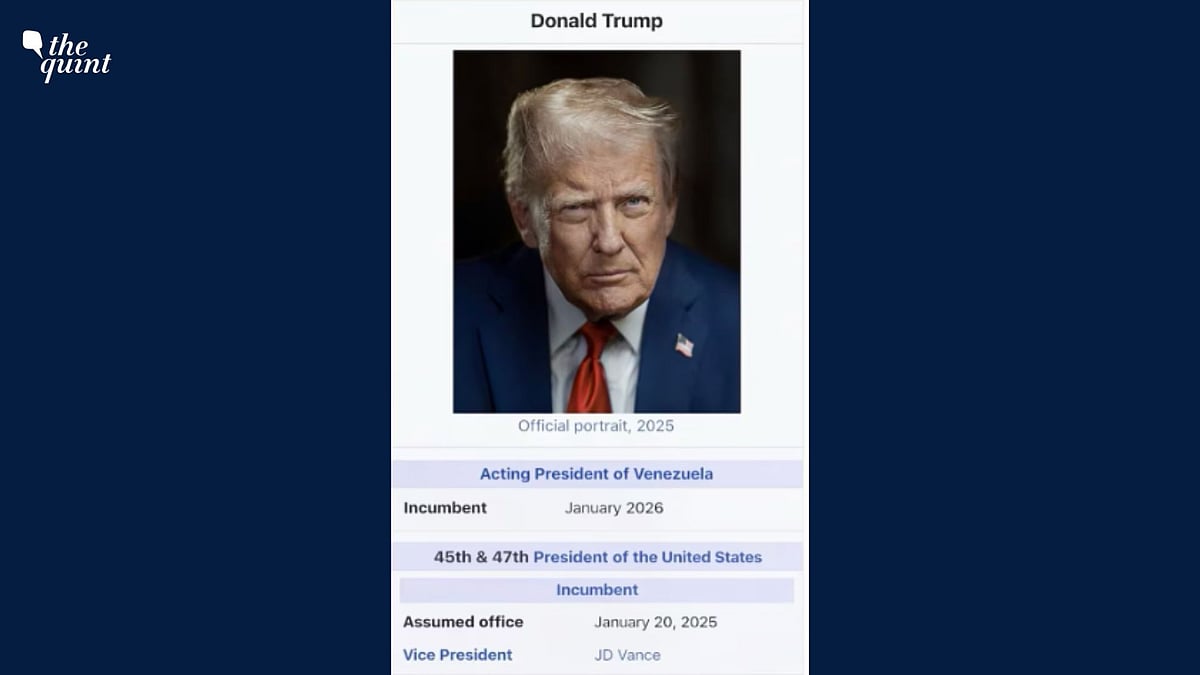
As reported by Hindustan Times, Trump’s claim was made through a digitally altered image posted on Truth Social, which labelled him as “Acting President of Venezuela.” The post appeared amid heightened international scrutiny following Maduro’s capture and the subsequent constitutional succession process initiated by Venezuelan authorities.
According to The Hindu, Trump’s Truth Social post included his official portrait and the designation “Acting President of Venezuela, Incumbent January 2026.” The post also referenced his status as the 45th and 47th President of the United States.
As noted in an article by The Indian Express, Trump’s administration has been actively engaging with U.S. oil companies regarding Venezuela’s energy sector. Trump expressed dissatisfaction with ExxonMobil’s reluctance to invest, following the company’s CEO labelling Venezuela as “uninvestable” due to legal and commercial barriers. Trump indicated he might block ExxonMobil from entering the Venezuelan market.
Coverage revealed that during a White House meeting, Trump told oil executives the U.S. would provide security guarantees for companies investing in Venezuela. However, several executives, including ExxonMobil’s Darren Woods, cited the need for significant legal reforms and investment protections before considering entry into the Venezuelan market.
Venezuelan constitutional authorities, according to official statements, ordered Vice President Delcy Rodríguez to assume the presidency to ensure administrative continuity. Rodríguez called for Maduro’s release and asserted his legitimacy as Venezuela’s leader, while the U.S. continued to enforce an oil quarantine as part of its policy strategy.
“We are going to run the country until such time as we can do a safe, proper, and judicious transition,” Trump said at a news conference, as cited in multiple reports.
Further reporting indicated that Trump’s actions have drawn both domestic and international attention. The Nobel Institute clarified that Venezuelan opposition leader Maria Corina Machado could not transfer her Nobel Peace Prize to Trump, despite her public statements praising his role in Maduro’s capture and the transition process.
On 11 January 2026, analysis showed that Trump signed an executive order to protect Venezuelan oil funds held in U.S. accounts. The order aimed to prevent the seizure of these revenues by courts or creditors, citing U.S. national security and foreign policy interests. The move followed a meeting with oil executives, where the need for reforms in Venezuela was reiterated.
Trump’s statements and actions have also affected U.S. relations with Cuba. Following recent developments, Trump suggested that Marco Rubio could become the next president of Cuba and warned that Venezuelan oil and funds would no longer flow to Havana. Cuban officials rejected these claims, asserting their sovereign right to trade and denying any dependency on U.S. policy.
In the aftermath of Maduro’s capture, further details emerged regarding the reluctance of major oil companies to re-enter Venezuela. Executives cited the need for durable investment protections and changes to hydrocarbon laws, with ExxonMobil’s CEO stating that the country remained “uninvestable” under current conditions.
Note: This article is produced using AI-assisted tools and is based on publicly available information. It has been reviewed by The Quint's editorial team before publishing.