'Justice Crying Behind Closed Doors': What Mamata Said in SC Against Bengal SIR
Mamata Banerjee personally argued in Supreme Court against West Bengal’s SIR, alleging targeted disenfranchisement.
advertisement
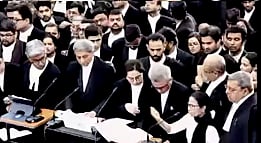
West Bengal Chief Minister Mamata Banerjee appeared in person before the Supreme Court on 4 February 2026 to argue her petition challenging the Special Intensive Revision (SIR) of electoral rolls in the state. Banerjee, a trained advocate, became the first sitting Chief Minister to present arguments directly before the apex court.
She alleged that the SIR process was leading to large-scale voter deletions and targeted disenfranchisement ahead of the upcoming Assembly elections.
According to Live Law, Banerjee argued that the SIR was “not for inclusion but for deletion,” particularly affecting women who changed surnames after marriage and those who had shifted residences.
As reported by Hindustan Times, Banerjee questioned why the SIR exercise was not conducted in Assam or other states, alleging that West Bengal was being singled out. She requested that the 2026 Assembly elections be held using the 2025 voters’ list, not the revised rolls. The Supreme Court bench, led by Chief Justice Surya Kant, heard her submissions and those of other petitioners, including Mostari Banu and Trinamool Congress MPs Derek O’Brien and Dola Sen.
As highlighted by Financial Express, Banerjee’s petition sought the cancellation of all SIR-related orders issued by the ECI on 24 June and 27 October 2025. She also requested that election officials not call people for hearings in cases of minor name differences or spelling errors, and that such corrections be made automatically using existing records. Banerjee further asked the court to direct acceptance of all valid identity documents issued by authorised authorities.
As noted in an article by Bar and Bench, Banerjee described the ECI as a “WhatsApp Commission,” alleging that instructions were being issued informally via messaging apps. She argued that the SIR process was being rushed during festival and harvest seasons, causing distress to ordinary citizens and election officials. Banerjee also highlighted the deaths and hospitalisations of Booth Level Officers (BLOs) due to the pressure of the SIR process.
During the hearing, the Supreme Court directed the ECI to send name discrepancy notices carefully and to be sensitive to local dialect differences. The bench noted that the process should not exclude genuine voters due to minor spelling variations. Banerjee reiterated that micro observers, allegedly appointed from BJP-ruled states, were targeting West Bengal and that the logical discrepancy list was not being properly disclosed.
In her interlocutory application, Banerjee sought urgent directions to halt voter deletions, arguing that over 60 lakh hearings remained pending with only four days left before the final roll publication as coverage revealed. She requested that no voter mapped with the 2002 roll and appearing under the “Logical Discrepancy” category be deleted, and that micro observers be withdrawn from the process.
Banerjee’s plea also alleged that the SIR exercise violated the Constitution and the Representation of the People Acts of 1950 and 1951 as reporting indicated. She maintained that the process was opaque, hasty, and unconstitutional, and that it posed an immediate and irreversible threat of mass disenfranchisement in West Bengal.
Note: This article is produced using AI-assisted tools and is based on publicly available information. It has been reviewed by The Quint's editorial team before publishing.