Delhi University Imposes Month-Long Ban on Protests After Unrest Over UGC Rules
'The ban undermines the democratic spirit of campuses and silences students advocating for social justice:' Students
advertisement
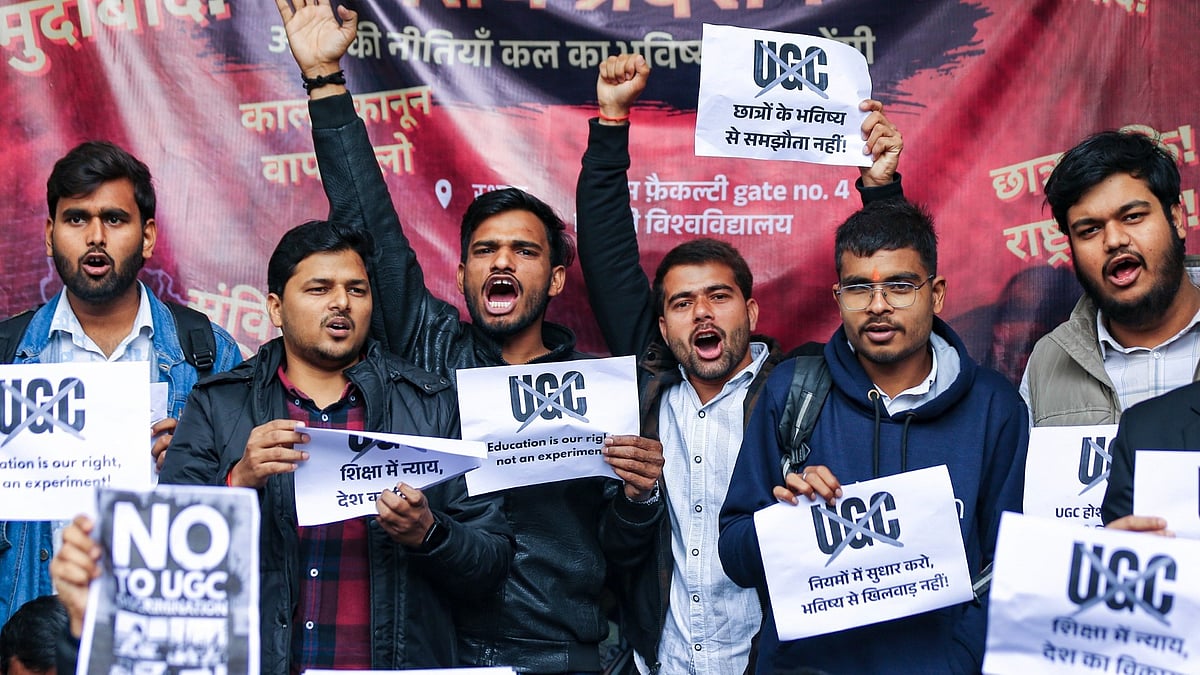
Delhi University has announced a complete ban on all protests, demonstrations, and public meetings on its campus for one month, effective from 17 February 2026.
The decision follows recent incidents of violence during student demonstrations related to the University Grants Commission’s equity regulations. The university administration cited concerns over public safety, potential threats to human life, and the need to maintain order as reasons for the temporary prohibition.
According to Hindustan Times, the order was issued by the office of the proctor and applies to all students, faculty, and staff. The directive prohibits public meetings, processions, demonstrations, and protests of any kind within the university campus for a period of one month. The administration stated that the move aims to prevent a repeat of the violent incident that occurred on 13 February 2026, which involved clashes during a demonstration against the Supreme Court’s stay on the UGC Equity Regulations.
As noted in an article by The Indian Express, the university’s notification also invoked a police order prohibiting the assembly of five or more persons, rallies, dharnas, and even the shouting of slogans. The administration justified the restrictions by referencing past instances where protests escalated and led to a deterioration of law and order on campus. The proctor, Manoj Singh, described the ban as a temporary measure intended to restore calm and prevent further division among students.
Coverage revealed that the ban has drawn criticism from several student and faculty groups. The National Students’ Union of India (NSUI) and the Students’ Federation of India (SFI) described the move as an attempt to suppress dissent and curtail freedom of speech. NSUI national president Varun Choudhary argued that the ban undermines the democratic spirit of campuses and silences students advocating for social justice and equitable implementation of UGC regulations.
Faculty members have also expressed concern, with the Democratic Teachers’ Front (DTF) labelling the order as “draconian” and “undemocratic.” The DTF stated that by imposing a blanket ban, the administration has pre-emptively criminalised peaceful assembly and violated constitutional rights. Analysis showed that the DTF accused the administration of using isolated incidents of violence as justification to stifle legitimate democratic expression.
“By imposing sweeping restrictions on assemblies and protests, the university administration appears to be exploiting this incident to curb students’ democratic rights,” stated the SFI’s Delhi state committee.
Student groups have maintained that peaceful protests are an essential part of campus life and that the recent violence should not be used as a pretext for broad restrictions. Reporting indicated that some faculty members believe reasonable restrictions would have sufficed, rather than a complete ban. The Delhi University Students’ Union (DUSU) has not issued an official statement regarding the order as of the latest updates.
The ban follows the Supreme Court’s stay on the UGC Equity Regulations, which had mandated the creation of equal opportunity centres and equity committees in universities to address complaints of discrimination. Details emerged that the Supreme Court observed the new framework could have divisive impacts if misused, prompting further debate and protest on campus.
“We do not want any issue or protest to create a divide amongst the students and a divide in the campus. Before something serious happens, we decided to issue this notification, which will be effective for one month,” said Manoj Singh, Proctor of Delhi University.
While the administration maintains that the ban is a temporary measure to ensure safety and order, student and faculty organisations continue to call for the protection of democratic rights and the restoration of peaceful avenues for dissent as further developments unfold.
Note: This article is produced using AI-assisted tools and is based on publicly available information. It has been reviewed by The Quint's editorial team before publishing.