
'PM Modi's Birthday Came & Went': Bengal Women Call Out Annapurna Bhandar Delays
Before polls, BJP had said all women receiving TMC's Lakshmir Bhandar would be eligible. That's not the case.
advertisement
“You must have made a mistake. You probably didn’t fill out the form properly, so I didn’t get the money," Imran's mother Aklima Bibi keeps telling him.
The 27-year-old is repeatedly reprimanded by his mother because the Rs 3,000 promised under the Bharatiya Janata Party (BJP)-led West Bengal government’s Annapurna Bhandar Scheme has still not been credited to her bank account. Imran and his family live in Bhangar on the outskirts of Kolkata. Aklima cooks mid-day meals at a local government high school, and her husband is a vegetable-seller.
“I filled out the Annapurna Bhandar form for my mother in June, but the portal still shows her application as ‘under processing’,” Imran tells The Quint. “Nobody around my house has received the money. But since one of my aunts has got it, my mother suspects that I must have done something wrong.”
Aklima Bibi has been waiting for Annapurna Bhandar money since June.
(Photo: The Quint)
“I applied offline once and submitted another application online. I also took all the documents to the Block Development Officer (BDO)'s office and submitted them. Still, nothing has happened,” Pompa tells The Quint.
Both Pompa and Aklima received Rs 1,500 under Mamata Banerjee's Lakshmir Bhandar Scheme.
A Rs 3,000 Promise Against Rs 1,500 Under Didi
During the Assembly election campaign, the BJP promised Rs 3,000 a month under Annapurna Bhandar, pitching it as an alternative to the Trinamool Congress (TMC) government's popular Lakshmir Bhandar Scheme. The promise was a significant part of the BJP's attempt to make inroads into Mamata's women voters.
The TMC government had launched Lakshmir Bhandar in 2021, in the aftermath of the COVID-19 pandemic, for women aged between 25 and 60. Initially, women from the general category received Rs 500 a month, while Scheduled Caste (SC) and Scheduled Tribe (ST) women received Rs 1,000. In 2024, these amounts were increased to Rs 1,000 and Rs 1,200, respectively.
In the TMC government's final interim Budget in 2026, the monthly assistance was further increased to Rs 1,500 and Rs 1,700. And in the their final full budget for 2025-26, Rs 26,700 crore was allocated for Lakshmir Bhandar. The revised estimate later stood at approximately Rs 28,615 crore, with the scheme covering 24 million beneficiaries.
At a recent press conference, Chief Minister Suvendu Adhikari said, “In August, 14.8 million women have already received the money. The next transfer will take place on Prime Minister Narendra Modi’s birthday on 17 September. We will celebrate that day as Annapurna Diwas.”
He also appealed to people to light lamps to mark the PM's birthday. Lakshmi Pailan, a domestic worker from South 24 Parganas, recalled a conversation she heard on the morning of 17 September while travelling by train to Kolkata for work.
“Some people were wondering whether lighting a lamp that evening would ensure that the Annapurna Bhandar money came through,” she said.
The government has said that 15.8 million women received the money in September. But, on the ground, The Quint met with several beneficiaries who claimed not receiving the money regularly.
Sahil Gazi, 20, whose father is a daily-wage worker in Magrahat, South 24 Parganas, says his mother Saleha received the money initially after submitting the form at the Panchayat office, but the money soon stopped coming.
His mother has stopped enquiring at the Panchayat office because, he says, nobody in their locality appears to be receiving the money regularly. Domestic worker Lakshmi Pailan, who lives in the same locality, has a similiar story.
She tells The Quint that she only received the money for one month and then stopped receiving it. “Will I get it again?” she asks.
Lakshmi Pailan at the Kolkata residence she is employed at as a domestic worker.
(Photo: The Quint)
'Want Mamata Back'
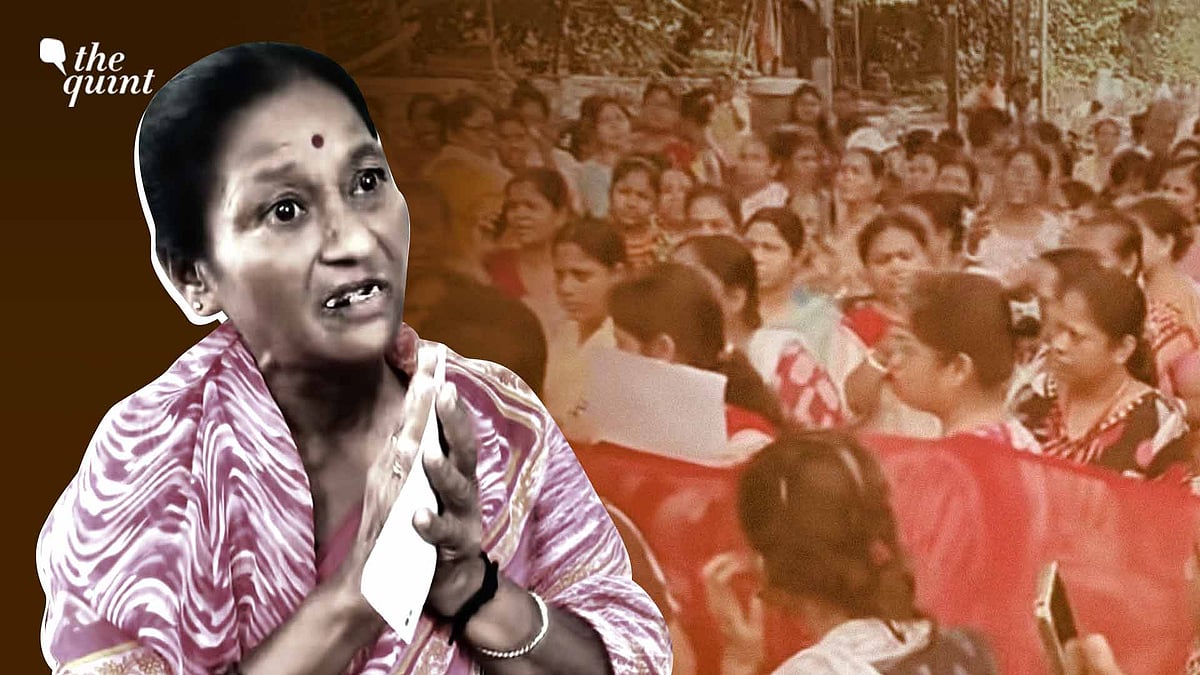
The non-payment, delays, and irregular payments have led to protests in the last few weeks, including long queues and crowds outside the BDO offices in various districts, as well as rail roko campaigns.
Last month, on 21 August, in Birati, hundreds of women stopped the Hasnabad local train from proceeding to Sealdah station in Kolkata, demanding redressal from the government and local authorities.
In another viral video from Medinipore, agitated women can be seen demanding, "We want Mamata back".
The BJP had earlier distanced itself from the issue. On 22 August, the state’s Panchayat Minister Dilip Ghosh had said,
More recently, as payments failed to arrive for many applicants on Modi's birthday, as promised by CM Adhikari, protests intensified with women accosting BDO offices in several districts.
A video published by local news outlet Din Raat Star News shows women in large numbers gheraoing the office of a BDO in Uttar Dinajpur. Chakdah residents also gheraoed the municipal office recently, after which they were told to file a written application. Similar agitations took place at Murshidabad's Raninagar, too.
The BJP's Siliguri MLA Shankar Ghosh briefly told The Quint that the "state government is ensuring all eligible candiates get the money."
The Quint also reached out to BJP ministers Agnimitra Paul, Swapan Dasgupta, and Shamik Bhattacharya over calls and messages but has not yet received a response. The Quint also reached out to the Director and Joint Director of the Department of Women & Child Development and Social Welfare in the government of West Bengal for clarifications on the process and delays, but got no response.
A Murshidabad district BDO officer, in the meantime, said the cases are being handled as fast as possible.
From Universal Benefit to an 'Eligibility Test’
One of the key differences between Lakshmir Bhandar and Annapurna Bhandar is the additional "eligibility" factor.
Lakshmir Bhandar was available to all women aged 25 to 50, and designed as a universal cash-support scheme for women in that specified age group. In June, the newly elected BJP government clarified that Annapurna Bhandar would be restricted to those deemed “eligible”.
The 12-page form introduced in June triggered controversy and protests. Applicants were asked to provide extensive information, including bank account details of other members of the household—information that critics argued had little direct connection with "eligibility" for the scheme.
This was particularly contentious because, before the election, the BJP had said that women who received Lakshmir Bhandar would be eligible for Annapurna Bhandar. Many who voted for the BJP assert that party had not made it clear before polls that the eligibility criteria would also change with the increment.
Women also complained about the form-filling process, which is a test in itself.
Amit (name changed upon request), a 20-year-old man from Bardhaman, who has helped women in his family and neighbourhood fill out their Annapurna Bhandar forms, claimed that everyone whose forms he completed initially received the benefit. According to him, there is a “trick” involved in filling out the form.
The form asks applicants whether their household has three or more rooms, and whether they own a vehicle. Those who tick “yes” are rejected, he told The Quint while requesting anonymity.
He claimed that the form can still be submitted even when those questions are left unanswered.
However, his own mother—an ICDS worker whose salary is above Rs 10,000—received Annapurna Bhandar for one month before the payments stopped.
The young man, too, confirmed that while all the women whose forms he had filled initially received the benefit, none of them had been receiving it consistently every month.
Many other women like Antara Palit, a self-employed 56-year-old resident of Shibpur, Howrah—who has not yet received any money despite filling out the form—claimed that some had to pay "third parties" to fill out the complicated form.
She also feels that questions pertaining to children's education, land ownership, and family history were a way for the government to "snoop" on the beneficiaries and politics into the kitchen and drawing rooms of the electorate. "Why should we have to tell them so much about us and the whole family to receive a benefit they had promised?" she asks.
‘Annapurna Bhandar Has Brought Back Male-Centricity’
Sudeshna Dutta Gupta, 30, describes another kind of experience. She recalls that she, her mother, and her aunt went to an Annapurna Bhandar help kiosk in Patuli, Kolkata, to register their names.
Officials there allegedly told them that husbands were the “heads of the family”—and that only the head of the family could apply for Annapurna Bhandar on behalf of the women in the household.
The women objected. “With Lakshmir Bhandar, there was no need to involve the husband or father. Why are husbands being brought into the picture now?” they asked.
According to Sudeshna, officials responded that if a household had an annual income of Rs 1 lakh, “we cannot give Annapurna Bhandar to them”.
The women pushed back. “Whatever the husband’s or father’s income may be, does the government know what the women’s situation is inside the household?” they asked. “Does the government come to help us when we are in trouble?”
After a prolonged argument, Sudeshna's mother and aunt eventually registered themselves as the heads of their respective households.
“Annapurna Bhandar has brought back male-centricity,” Sudeshna states.
Kolkata-based domestic worker Tuka Mondal, who has been living with her husband's alchoholism and domestic abuse for nearly two decades now, claims that the money from Lakshmir Bhandar empowered her to ensure a better future for her sons. "I have saved every penny from my husband. If he was involved in the process, that money would never come to me, it would be spend on alcohol. Now, they want his details. It empowers him to demand the cash."
Welfare vs Economics of Freebies
Even as women continue to agitate across several districts, the issue has brought out a larger debate over welfare schemes and the unpaid domestic labour.
Kolkata-based entrepreneur and activist Debjani Dasgupta, 34, did not apply for the scheme but believes the BJP government's exclusion of women from the scheme is in a way a blow to women's rights.
Dasgupta explains that the cash-transfer scheme in a limited, almost symbolic form, offers a recognition for the unpaid domestic labour women provide.
Ananyo Mukherjee, a researcher in Development Studies at SOAS University, London, adds that universal cash transfers to women across all classes is particularly crucial for working-class families as they provide a buffer against the pressures on women to sustain households amid today’s cost-of-living crisis, expanding precarity, and rising microfinance debt.
The debate around Annapurna Bhandar, therefore, is about more than whether Rs 3,000 reaches a woman’s bank account each month. It is also about who gets to decide which woman is “eligible”, what information the state can demand in exchange for welfare, and whether cash support to women should be treated as a conditional benefit—or as recognition of an economic contribution that has long remained invisible.
(Soumo Mondal is an independent journalist writing on news and politics in West Bengal.)
- Access to all paywalled content on site
- Ad-free experience across The Quint
- Early previews of our Special Projects
Published: undefined