
Israel-Iran War: UAE Dials Modi as it Mulls Joining US Offensive in Hormuz
PM Modi spoke to Sheikh Mohammed bin Zayed of UAE on Tuesday night about the Israel-Iran war and Strait of Hormuz.
advertisement
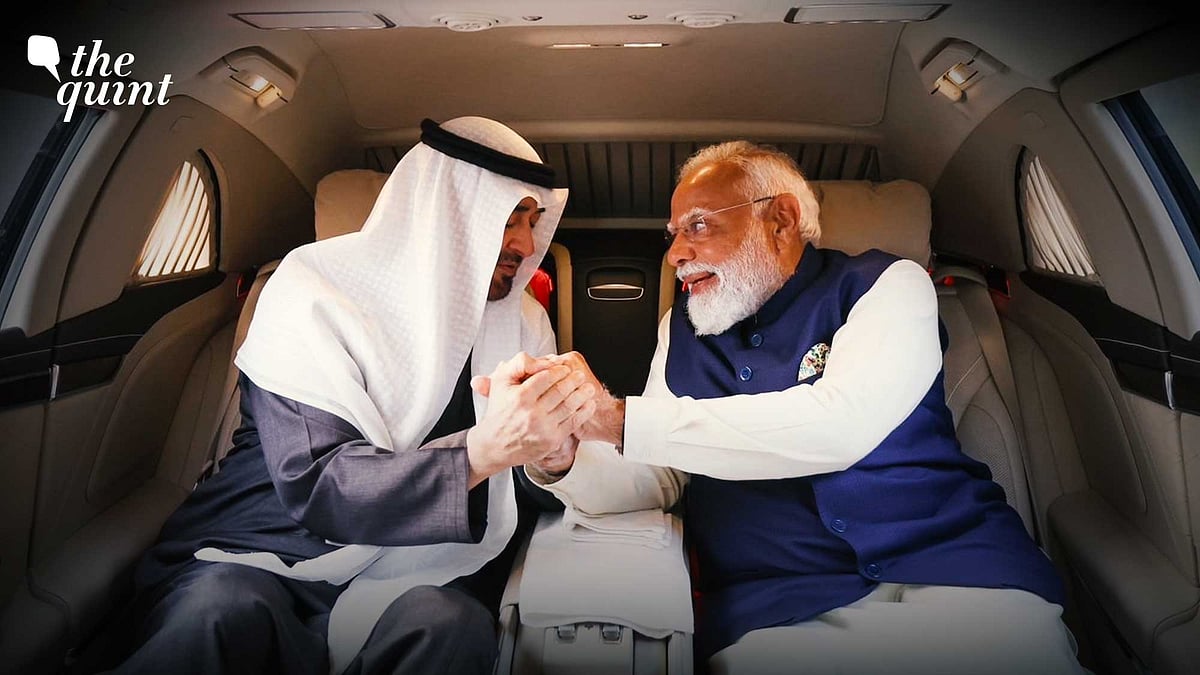
Prime Minister Narendra Modi spoke to the President of the United Arab Emirates Shaikh Mohammed bin Zayed al-Nahyan on Tuesday evening to discuss the war in West Asia. The conversation came at a hugely significant juncture in the war, with the UAE actively considering joining the US-Israel's planned offensive against Iran's control over the Strait of Hormuz.
Soon after the conversation, PM Modi posted on X, condemning the attacks on "civilian targets in the UAE" and emphasising the importance of "safe and free navigation through the Strait of Hormuz".
Why is this Significant?
UAE and India have been in close contact in the build-up to US and Israel's attack on Iran as well as during the course of the conflict. One of PM Modi's first calls after US and Israel attacked Iran was to Sheikh Zayed.
As The Quint reported earlier, this is due to multiple factors: PM Modi's personal equation with Sheikh Zayed, India's deep economic interests in the UAE and an ideological alignment between the two regimes. Read the full piece here.
The conversation between the two leaders on Tuesday came at a moment when two important things happened.
First, following the US attack on Iran's Kharg Island, Iran has intensified its strikes on key logistical hubs and infrastructure within the UAE. For instance, on 16 March, there was a drone strike at a fuel tank near Dubai international airport and a fire was reported at Fujairah Oil Industry Zone. On Tuesday, UAE claimed to have engaged 10 ballistic missiles and 45 drones allegedly fired from Iran. Iran's closure of the Strait of Hormuz is significantly harming UAE's oil exports and the attack on Fujairah is being seen as a tactic to block any alternative routes.
Second, America's allies are said to have refused to help it against Iran in the Strait of Hormuz. President Donald Trump posted on Truth Social, claiming that "most" NATO allies, along with Japan, Australia, and South Korea, informed the U.S. they would not get involved in the conflict or help secure the Strait of Hormuz. He criticised these countries, calling their alliance a "one-way street" accusing them of "doing nothing" for the US "in the time of need".
Due to these two factors, the UAE is feeling increasingly compelled to join the US-Israel offensive in the Strait of Hormuz. It is possible that UAE could have reached out to India for help for the same.
The blocking of the Strait of Hormuz has harmed oil imports to India, creating a temporary supply crisis. However, New Delhi made parleys with Tehran for allowing its ships to pass, with some success.
What is UAE's Strategy?
The UAE has bore the brunt of Iran's retaliation after the US and Israel launched a war against it. Iran's strikes in UAE haven't just been on American bases but on the UAE's economic infrastructure as well. In contrast, Iran has been much more restrained in its approach towards Saudi Arabia, Kuwait and Oman.
Oman, which was leading the mediation efforts between the US and Iran, has openly criticised the war as an effort to reshape the region to Israel's benefit.
UAE may be counting on Kuwait and Qatar to back its efforts as the two countries stand to lose the most if the Strait of Hormuz remains blocked. However, even they have not expressed any desire to join the US-Israel offensive.
There is also an element of distrust towards the UAE among some of the Gulf states. Saudi Arabia and UAE were on a collision course in Yemen over the latter's support for the secessionist Southern Transitional Council. The two countries were also on opposition sides in the civil strife in the Horn of Africa.
Presently, Saudi Arabia's may probably like to see Iran's military capability degraded but it has no inclination to join the war. It remains wary of any eventuality in which either Iran or Israel-UAE emerge as the hegemon in the region.
What Options Does India Have?
If the UAE does join US-Israel's war, it would place India in a dilemma. India has a track record of not sending its troops anywhere outside its own region, except on UN Missions. Going to the UAE's aid would be a major departure from this policy.
It would also harm India's backchannel parleys with Iran that led to the latter granting permission for Indian ships to pass the Strait of Hormuz. Recently, the Indian Navy deployed its naval warships to escort ships carrying LPG after being given clearance by Iran.
Unrestricted passage of its ships from the Strait of Hormuz is, no doubt, a priority for India. The question is whether it would rather attain this through negotiations with Iran or by joining US-Israel and possibly UAE's offensive.
The problem with the latter strategy is that it doesn't require much for Iran to retain its leverage at the Strait. Even an occasional attack on a ship from a distant location is sufficient for preventing free navigation from there.
The best course for India, therefore, may be to wait and watch and keep its options open.
- Access to all paywalled content on site
- Ad-free experience across The Quint
- Early previews of our Special Projects
Published: undefined