'What Purpose Does the Uterus Have?' How Disabled Women Lose the Right to Choose
Menstruation and life-long care can push families of disabled women towards hysterectomy, reports Rituparna Palit.
advertisement
For years, Tarini (name changed) thought having her uterus removed would make her life easier.
Blind since the age of three, Tarini grew up with little access to education and almost no formal information about menstruation or reproduction. Her first lessons on these topics did not come from her mother and four sisters either, but from listening to women in her village, who would gather in circles in their free time, chatting about family matters, childbirth, and periods.
That limited knowledge shaped how she thought about her own body.
“I thought, if I get my uterus removed, I won't have periods anymore,” she tells The Quint. For the 36-year-old resident of Harhua village in Varanasi district, fewer facilities and difficulty in period management made hysterectomy seem like a way out of the monthly inconvenience and pain.
Her sister, however, warned her against it, telling her that she might find it difficult to have a child later. “I still wondered: if I had no plans to marry or have children, what was the harm in removing my uterus?”
It was only after she began asking the right questions to the right people that her view changed. “Now that I have started learning about my body, I know uterine functions are important for a woman’s health. I don't want to have it removed,” says Tarini, who currently lives at the women's hostel of the National Association for the Blind in Delhi, where she has enrolled for a skill-based training course.
Can Disability Alone be Reason Enough?
The question came into sharper focus in June when the Karnataka High Court allowed the parents of a 23-year-old woman with developmental disability, cerebral palsy, and seizures to have her undergo a hysterectomy. A medical board had found that she was unable to independently manage menstruation and had recurring infections.
The High Court Bench said it allowed the procedure in her “best interests” after considering her condition, her inability to provide informed consent, and the absence of an equally effective, less intrusive long-term alternative.
But the court also drew a boundary. Disability alone, it said, could never justify removal of a reproductive organ, and parental inconvenience could not by itself be a reason for such a procedure.
While Section 10(2) of the Rights of Persons with Disabilities (RPwD) Act, 2016 explicitly forbids medical procedures leading to infertility without “free and informed consent”, guardians can still consent to medical interventions in the "best interest" of a person with intellectual disabilities under the National Trust Act (1999) and provisions in the Medical Termination of Pregnancy (MTP) Act.
This legal case brought into the open a dilemma that families, doctors, and disabled women may confront differently: when does menstrual management become a medical problem, and when does it become a problem of information, support and caregiving?
For Farheena’s mother, Farida Rizwan, the answer has been shaped by years of helping her daughter with disability navigate everyday life. Farheena, who lives with cerebral palsy, got her first period at 10. Like any other curious child, her first question was whether her brother also went through it. Learning to use pads was difficult, and she still needs some help from her mother. Farheena, now 32, is learning to manage periods independently with her mother’s help.
“When I used to take Farheena to doctors for a fever or any minor issue, they would ask if I had her uterus removed and advise me to do so. They would say that would relieve me from the hassle of managing her periods every month, but I never saw it as a hassle,” Rizwan, who resides with her family in Bengaluru, tells The Quint.
Farida Rizwan with her daughter Farheena, who lives with cerebral palsy. Farida shares her experiences of caregiving and the importance of supporting her daughter’s autonomy and dignity.
(Photo: Farida Rizwan/Special Arranegement/The Quint)
Despite safeguards under the RPwD Act, such procedures continue behind closed doors. This reflects how medical decisions can overlook a disabled woman’s reproductive agency and, in effect, “dis-gender” her, says Nidhi Goyal, founder of Rising Flame, an organisation working with youth and women with disabilities.
Medical Access Shaping Decisions
A Delhi study spotlighting these issues interviewed 23 caregivers, all mothers, of adolescent girls in the age group of 11-19 years with IQ of 20-50 and from varied socioeconomic backgrounds. It found that the girls were unable to change sanitary napkins due to physical constraints or communicate their physical discomforts, such as stomach cramps, to their caretakers.
Some mothers say they changed their daughters’ sanitary napkins themselves, some were trying to train the girls, and three parents opted for removal of their daughters’ uterus for stopping menstruation. All of these three families were well-educated and belonged to a high-income bracket.
“Their socio-economic status afforded these women access to medical personnel who made the families aware about the availability of such surgeries,” noted the authors of the study.
The Perils of Non-therapeutic Hysterectomy
Medically unindicated hysterectomy in girls or young women can have lifelong consequences, says Dr Kiranmai Devineni, who is a professor of obstetrics and gynaecology at Telangana government-run KN Rao University of Health Sciences.
“Disability is never an indication for opting hysterectomy. Such non-therapeutic procedures are detrimental to the entire physical, psychological and emotional functions of the girl or woman,” adds Dr Devineni, who also headed an anti-women violence committee at the Federation of Obstetric and Gynaecological Societies of India.
She also makes a very important distinction between removing the uterus with or without the ovaries, saying,
“There’ve been cases where women who had hysterectomies in their 30s and late 20s presented with psychiatric illnesses within a few years,” she recalls.
Need to Get Out of Taboo Mentality
Menstruation in India continues to be surrounded with secrecy, taboos, and stigma, with women referred to as ‘ritually unclean’ and subjected to social, religious, and cultural restrictions during their periods. Most girls with disability are not given any information or training on menstruation before menarche, since they are thought to be too naive to understand it, or assumed to need support to manage menstruation.
“Parents often don't approach us until they are already facing a difficulty—or until their daughter gets her first period,” says Madhu Grover, senior faculty at the Action for Ability Development and Inclusion (AADI), a national-level organisation working in disability, education, mental health, and social inclusion since 1978.
Meenu Mani (name changed), 51, a cerebral palsy patient from Delhi, says, “I had no idea about menstruation until my classmate got hers. Everyone said she was sick because she was bleeding.”
Born with cerebral palsy, Meenu Mani has built a life around work, independence and challenging assumptions about disability through her NGO 'Yes We Can'.
(Photo Credit: Rituparna Palit/The Quint)
The Caregivers' Burden
Meenu says she was dependent on her mother for menstrual management, from changing the cloth to washing it. She even drank little water during periods to avoid soiling her dress or going to the washroom often. She felt bad seeing her mother burdened and venting out her frustration on her siblings.
“I felt embarrassed, scared and irritated. Those five days used to be the worst days of my life every month.”
“The relationship of toileting with dignity is complex,” says Renu Anju Singh, deputy executive director, AADI, adding, “Period management becomes a deeper issue as it involves privacy, dependence and the support a woman needs to manage her body with dignity.”
“Not all families can afford a caregiver for Rs 20,000 a month. In case the mother is ill or growing old, the onus of caregiving falls on other family members, even often sisters-in-law, which can make the disabled woman with disability even more uncomfortable,” says Singh, who regularly interacts with children with disabilities and their families from cities, villages, and low-income urban communities.
The Union Cabinet, this October, lowered the disability threshold for the Pradhan Mantri Divyangjan Pension Yojana from 80 percent to 40 percent and removed the minimum age limit. It also raised monthly assistance from Rs 300 to Rs 375 for those under 80 and Rs 500 to Rs 625 for those above 80, a support that disability rights advocates say is a minute fraction of the financial costs borne by caregivers.
Caregiver burden is not just financial or physical. It also stems from inaccessible school facilities and infrastructure.
Asha (name changed), 26, who has been living with cerebral palsy since childhood, grew up in south Delhi where she was admitted to a mainstream government school under the Right to Education Act, studying alongside non-disabled students.
“As there was no one to help me at the school, my mother used to come once or twice to take me to the washroom. During my periods, she had to come three or four times a day to help me change my pad or related needs,” says Asha, who started menstruating at 14 and had initial cycles last up to 20 days.
Inaccessible toilets at the school were also a concern.
Asha studied from one of India’s top women’s college in south Delhi, even where her mother used to come at the lunch break to help her go to washroom or change her pads. She says she had to miss school or college on the days that her mother couldn’t be there for her, although this happened only once every 2-3 months.
“After college, I realised I should learn doing things on my own. For the last two years, I have worked on myself and I am learning to bath, use the toilet and manage my periods.”
To help families of disabled persons, the Indian government had launched the Sahyogi scheme in 2015. Aimed at training candidates assist persons with multiple disabilities, autism and cerebral palsy, the scheme lasted just for four years, training only 1,762 people till 2019, according to a Scroll report.
Varied Support Needs
The experience at a residential care centre in Chhattisgarh’s Raigarh, run under the National Trust’s Samarth-cum-Gharaunda scheme, shows how widely the level of support can vary. Launched in 2018, this scheme entails the establishment of residential facilities for orphaned persons with disabilities, and whose families live below the poverty line.
Shyama Yadav, a caretaker at the centre, run by Unnayak Sewa Samiti, says some girls with severe intellectual disability and heavy flow need their pads changed almost every two hours, including at night, and their bedsheets may also need to be changed. For others, the staff have to remind them to check their pads or help them apply them correctly.
Then there are residents like Durga Bangali, 22, who is an orphan with moderate intellectual disability. During her cycles, she gets violent and starts hitting other girls and can have breathing difficulties, says Kemeshwari Yadav, the centre’s manager. “We try to calm her down by having someone stay with her like a parent, or by promising her food or small gifts.”
Fear of Unwanted Pregnancy from Abuse
Rizwan says not only doctors, but the parents of a disabled girl also suggested she get Farheena’s uterus removed. This other parent had made her disabled daughter undergo hysterectomy. She justified her decision saying the procedure not only relieved her from handling her daughter’s periods, but also that she wouldn’t get pregnant if someone took undue advantage of her condition and abused her.
Women with disabilities are at heightened risk of sexual abuse.
SK Mansur Ali, founder-cum-head of the Graham Bell Centre for the Deaf, an NGO working for 35 years in mainstreaming the disabled in West Bengal’s Hooghly district, says sexual harassment cases of disabled women, especially those with ID, is not uncommon in the area.
Ali recalled a case from around eight years ago in which a neighbour allegedly raped the 17-year-old daughter of a woman who sold flowers at the Howrah railway station and did other odd jobs. The girl, who had severe intellectual disability, became pregnant and had a son. Although her mother filed an FIR, the case was later dismissed for lack of evidence and the accused remains free. The mother, now 55, is ageing and unable to work to feed her daughter and grandson, especially after suffering from a recent heart attack.
AADI, which supports persons with disabilities across their life cycle, from early childhood to family planning, is sometimes approached by caregivers seeking hysterectomies for their daughters, says Mohita Mitla, programme manager at the organisation.
“The organisation first assesses whether these requests stem from gaps in awareness, financial constraints or safety concerns. It then works with the girl and both parents on menstrual management training, while also educating families about informed consent under the RPwD Act and the risks of irreversible procedures,” Mitla adds.
The Question of Lifelong Care
For some parents, neither period management nor fear of abuse is the concern. As they age, some caregivers worry about who will care for their disabled daughters when they are gone.
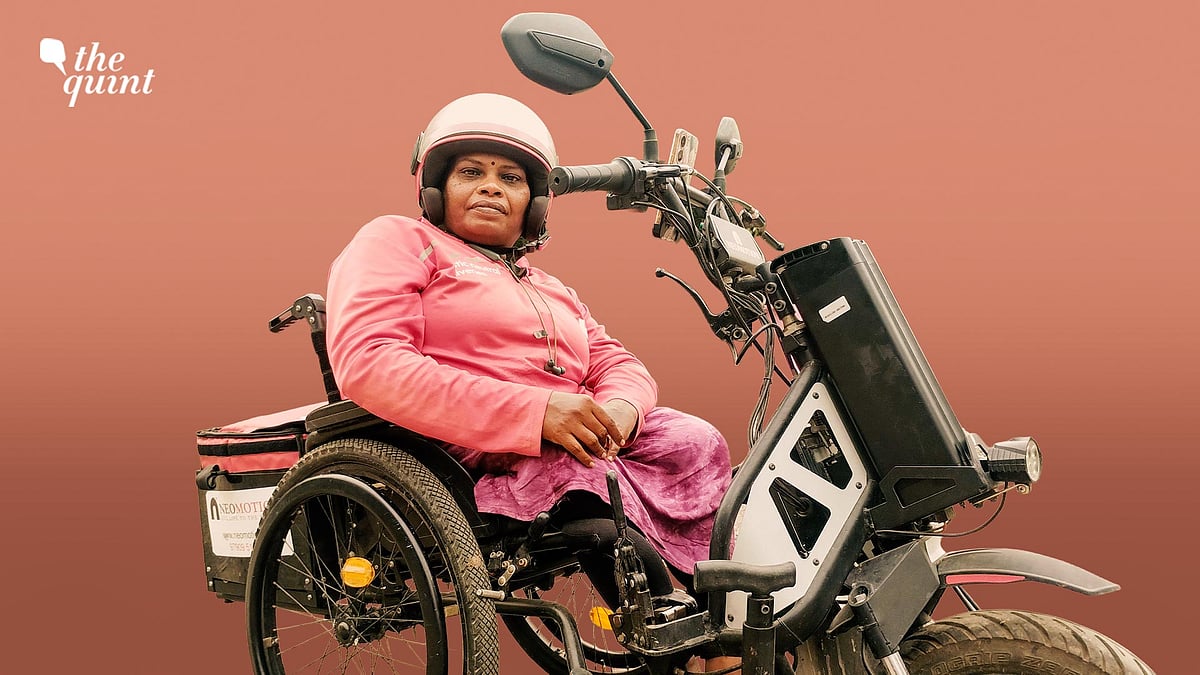
For Chennai-based Lakshmi Mani, who is 90 percent disabled due to polio, her grandmother used to take care of her daily needs.
Unable to manage Lakshmi’s periods with growing age, she had approached doctors seeking a hysterectomy for her. However, the doctors turned down her request, citing potential side effects of the surgery. Lakshmi eventually learnt managing periods on her own. Now 47, she earns as a Zomato delivery partner.
Lakshmi Mani has learnt to manage the challenges of menstruation over the years. She is also working towards financial independence as a Zomato delivery partner.
(Credit: Rituparna Palit/The Quint)
Available Alternatives for Limiting Menstrual Flow
Even as doctors keep getting requests such as in Mani’s case, hysterectomy is not the only way to reduce the difficulties associated with menstruation.
Dr Devineni says hysterectomy is permitted only when there is a bona fide therapeutic indication such as intractable heavy bleeding not responding to medication, severe uterine pathology, or cancer.
Even after this, doctors need to be sure that they have exhausted all reversible alternatives, carried out evaluation by multidisciplinary board, and received institutional ethics committee approval and informed consent from legal guardian and assent from the girl to the extent possible. An approval from district court or appropriate legal authority is also required for intellectual disability cases, the doctor adds.
On alternative methods that can reduce both caregiver burden and help a high-support need disabled girl or woman, Dr Devineni says, “There are progesterone-only pills which when given continuously, suppress menstruation and reduce number of menstrual cycles...Depot progesterone injections can also be given to cause reduced flow, infrequent periods and sometimes no periods.”
Dr Devineni further noted that it is a reversible procedure where plastic device is placed inside the uterus and can be removed by a clinician at any time, after which a woman’s fertility returns right away.
A 2025 case series by Delhi’s Guru Tej Bahadur Hospital shows how differently such decisions can play out for disabled women. In one case, a medical board recommended continued menstrual management with depot medroxyprogesterone acetate, while two other disabled women, facing different medical conditions, ultimately underwent hysterectomy after discussions with their families and medical teams.
Early, Repeated Training is Key
Research suggests menstrual education for girls with intellectual disabilities should begin well before menarche. One approach is to use “practice periods”—allowing girls to get used to wearing pads and identify a size and shape that works for them before they start menstruating.
Ali’s NGO, which works with early identification and intervention for disabled children in four blocks—Pandua, Polba Dalpur, Dhaniakhali, and Balagarh—has been putting this into practice.
“Our workers go to the houses of girls with severe intellectual disabilities and train their mothers and daughters in menstrual management before they even get their periods,” Ali says.
AADI’s Singh tells The Quint,
Menstrual management training can take months in such scenarios, she says, adding “You have to train them step by step—demonstrate using same materials, practise and then repeat it when the next cycle comes.”
While training visually challenged girls, a three-dimensional model of the uterus can be helpful, says Goyal, who has been imparting sex education to adolescents for the last 12 years.
Goyal called for “closing of loopholes” in legal provisions that allow caregivers to seek hysterectomy for girls and women, apart from the need for comprehensive sex education that would educate teenagers about their bodies, relationships and consent.
So for women like Tarini, the choice may begin with something as basic as understanding their own bodies. But for those who need greater support, early training and accessible facilities can help parents support their daughters with disability manage periods without making an irreversible decision on their behalf.
This story was supported by the International Foundation for Disability Inclusion’s (IFDI) Journalism Fellowship on Disability Inclusion.
(Rituparna Palit is an independent journalist exploring how health, environment and technology intersect to shape our daily lives.)