Chhari Dhandh: What Do We Lose When We Build Green Energy in the Wrong Places?
Chhari Dhandh was designated a Ramsar Site in January 2026, recognising its international importance as a wetland.
advertisement
The Quint is telling the full story of how climate change is reshaping lives in India. Help us do more. Become a member.
“I last photographed the only surviving male Great Indian Bustard of Kutch,” says birder and wildlife photographer Ashok Chaudhary, who has been documenting Kutch’s wildlife and landscapes for 25 years.
From the salt desert (Rann) to its grasslands and wetlands, Kutch is home to a remarkable range of landscapes and wildlife. One of these landscapes is the Banni grasslands. For most of the summer, roughly 3,800-sq-km Banni grasslands look like a place where little happens. The grass is pale. The earth is cracked and saline. Seasonal wetlands dry up as the heat intensifies.
But Banni grasslands are deceptive.
Jacobin Cuckoo in Kutch.
(Photo Courtesy: Ashok Chaudhary)
That cycle is part of what makes Banni what it is. It is also what makes the landscape difficult to understand from a map alone. The grasslands support a wide range of wildlife including chinkara, nilgai, blackbuck, Indian wolf, and caracal, along with more than 275 recorded bird species.
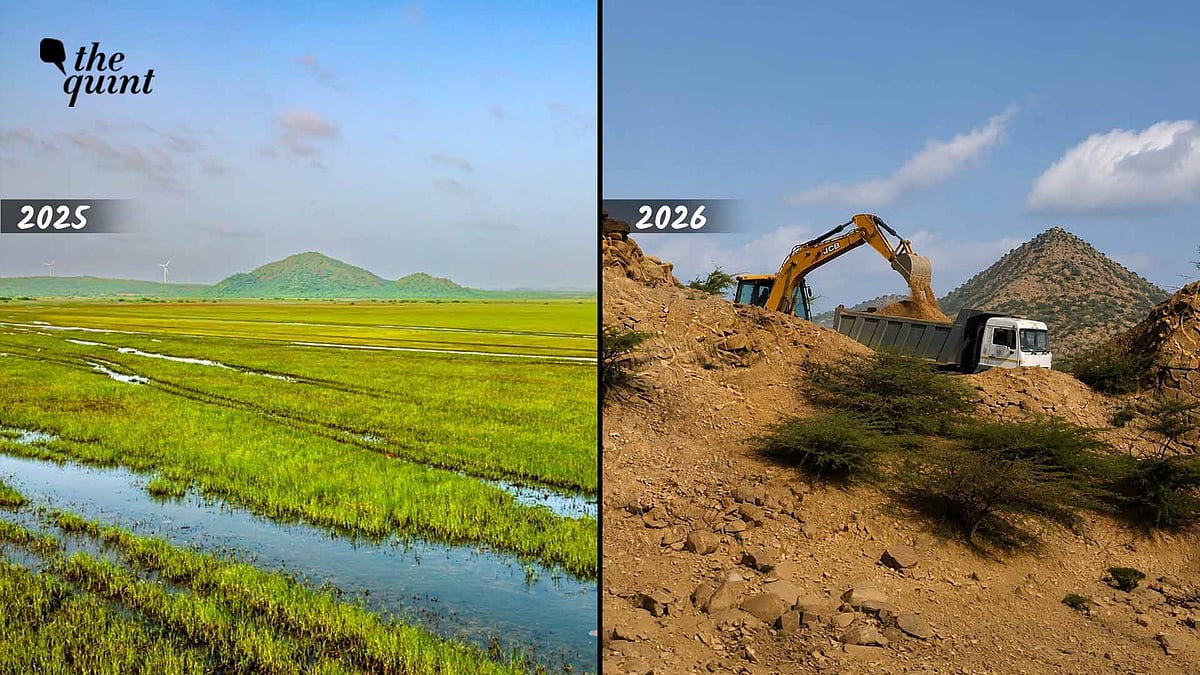
In the heart of this grassland mosaic lies Chhari Dhandh, a seasonal wetland and important stopover for migratory birds. Chhari Dhandh was designated a Ramsar Site on 31 January 2026, recognising its international importance as a wetland.
Now, parts of this wider landscape are being altered for a 4,500-acre, 900 MW solar project proposed by NTPC Renewable Energy Limited. Around 1,400 acres of the project site fall within the eco-sensitive zone adjacent to Chhari Dhandh, an area roughly equivalent to 440 cricket grounds.
A Landscape Mistaken for Wasteland
“To the untrained eye, a solar park in a place like this may seem like a natural fit,” says Chaudhary. “There is abundant sunlight, vast open land, and little that appears to be growing during the dry months.”
But a landscape can look empty without being unused. Varun Suchday, who has been researching indigenous cultures and climate change for over a decade, says,
"Green energy projects in such locations are, hence, counterintuitive. If we lose Kiro Hill [a prominent landmark of Banni] and its surroundings despite the Ramsar status of the wider wetland landscape, I fear for all of its grasslands and wetlands,” Suchday adds.
The importance of landscapes like Banni was also acknowledged recently at the global level. Speaking at the UN Convention to Combat Desertification's COP17 in Ulaanbaatar, Mongolia, Union Environment Minister Bhupender Yadav said grasslands and grazing lands like Banni support both livestock and people, while deep-rooted grasses help store carbon in the soil, improve water infiltration, and support groundwater recharge. India has around 10 million hectares of permanent pastures and grazing lands, he said.
For birds, the grasslands, wetlands, water channels and open spaces are not separate pieces of land. Together, they form a larger habitat.
Eurasian Hoopoe in Kutch.
(Photo Courtesy: Ashok Chaudhary)
Dr Ketan Tatu, the Founding Director of the Foundation for Ecological Welfare, who has studied the wetland birds of Chhari Dhandh, says, “The wetland and surrounding grasslands serve different but connected functions. Tens of thousands of Common Cranes arrive at Chhari Dhandh each winter to rest and roost while foraging in the surrounding Banni grasslands for the tubers of Cyperus bulbosus, locally known as Theg.”
Common Cranes in Kutch.
(Photo Courtesy: Ashok Chaudhary)
Every winter, the cranes leave the northern breeding grounds and begin the long journey south. Some travel thousands of kilometres before reaching the wetlands and grasslands of western India. And then, somehow, they come back to places they have known before.
This behaviour is what scientists call site fidelity: the tendency to return to familiar breeding, stopover, or wintering areas. Studies of Common Cranes have documented site fidelity, with birds returning to the same wintering and staging areas across different years. When important habitats disappear, birds cannot always compensate by simply moving to another nearby site.
That makes this winter’s return significant. The cranes left Chhari Dhandh last year with the wetland and surrounding landscape largely as they had known them. Then the development work began.
“It all started with fencing. Then came land levelling and stopping water from accumulating in the area to prevent the seasonal wetland from forming. An act against nature,” says Chaudhary.
The cranes, flamingos, pelicans, storks and spoonbills are now due to return after their long journey south. But the landscape they left behind has changed.
Chhari Dhandh itself is a dhandh, a local term for a saucer-shaped wetland in the grasslands where water collects. Around it are small features that can seem insignificant from a distance but serve different purposes for wildlife. One of them is what local birdwatchers call a pankhipith, or bird rock. Chaudhary says, “These rocky formations have long served as roosting places for birds, including the Trumpeter Finch and Pale Rock Sparrow.”
When the dhandh fills with water, the same rock takes on another role. Golden jackals, desert cats, Indian cats, desert foxes, desert monitor lizards, and other mammals use the formations for shelter and to raise their young.
The Quint sent a detailed questionnaire to NTPC Renewable Energy on 29 September 2026, regarding the concerns raised by birdwatchers and ecologists. Their response will be added to the article as and when they respond.
There is another change the cranes will encounter when they return: large stretches of solar panels where there was once open ground.
From the ground, the panels are clearly infrastructure. From the air, their effect can be more complicated. Research on utility-scale solar facilities has documented a phenomenon known as the “lake effect”, in which polarised light reflected from photovoltaic panels can resemble the visual cues produced by water. Researchers have recorded birds approaching and descending towards solar installations, mistaking solar panels for water.
The transmission lines needed to transfer electricity pose another concern for migratory birds. The Corbett Foundation, based on unpublished data, has estimated that nearly 30,000 birds of different species die annually from power-line collisions in the nearby Abdasa taluka of Kutch.
Jackal Pups in Kutch.
(Photo Courtesy: Ashok Chaudhary)
One way to reduce collision risk is to place power lines underground. The Supreme Court has directed the undergrounding of power lines in certain parts of Gujarat and Rajasthan. But an SC-appointed committee later reported that most existing power lines in priority had neither been fitted with bird diverters nor laid underground. It also reported that some of the diverters installed were of poor quality and had fallen from the lines. The committee further received reports of new power lines being installed despite the court's directions.
The Grass is Also an Economy
The birds are not the only ones who inhabit this landscape. For centuries, Maldhari pastoralists have followed the seasons across Banni, moving their animals in search of grass and water. Livestock is central to the region's economy. An ICAR-led study found that pastoralism accounts for about 82 percent of Banni's regional economy, with milk and milk products providing the largest share of pastoral income.
For Maldharis, livestock is more than a source of milk. They call their animals maal: an asset that supports the household and carries economic value. At the centre of this system is the Banni buffalo, a breed closely adapted to the grasslands. The ICAR study based on 2011-12 data recorded nearly 49,000 buffaloes, more than 10,000 cattle, 4,700 goats and 4,000 sheep in the Banni grasslands. Buffaloes made up 72 percent of the livestock population.
The dairy economy begins with grass. As monsoon water collects in the low-lying depressions, the surrounding grasslands turn green. As the water recedes, grasses remain behind, eventually drying into fodder. For pastoralists, this seasonal cycle determines where their animals can graze and how long they can stay.
But not all grass serves the same purpose.
The Centre for Pastoralism estimates that Maldhari pastoralists in Banni produce around 100,000 litres of buffalo milk a day, generating an annual turnover of more than Rs 125 crore. Banni buffaloes move through the grasslands, while camel herders also use the wider Chhari Dhandh-Banni landscape.
The proposed solar project has raised another concern: access. Grazing in Banni depends not only on the availability of grass but also on the ability to move animals across a landscape of common lands and seasonal grazing routes.
“The project is coming on the grazing commons, just next to my home. I am not even able to get out of my home. I have to take a 3-4 km detour,” says Karimbhai, 45, from Fulay village.
That dependence has brought Maldharis into the debate over the proposed renewable-energy project.
The Question is Not Development or Conservation
Solar and wind power are an important part of the country's transition away from fossil fuels. The harder question is where that infrastructure should go, and how its impacts should be understood before work begins.
In the case of Chhari Dhandh, the proposed solar project did not require prior environmental clearance under India's EIA framework. Solar photovoltaic projects are not covered by the EIA Notification, 2006, following a 2011 clarification by the Environment Ministry, a position reiterated in 2017. This means a formal EIA is not legally required for the project, even though the landscape may still face risks.
“Renewable-energy projects in and around such landscapes should be planned at the landscape level, considering their direct, indirect and cumulative impacts. The objective should not be development versus conservation, but development that does not adversely alter the wetland's ecological character or the ecological processes and connections that sustain it. Where a formal EIA is not required, a Biodiversity or Ecological Risk Assessment should nevertheless be carried out for the wetland and its surrounding landscape before project implementation, followed by appropriate ecological monitoring during the operational phase,” he adds.
Can We Save the Bird Without Saving its Habitat?
Chaudhary's photograph of the last known male Great Indian Bustard in Kutch is a reminder of how quickly a species can disappear from a landscape. Today, only three females are known to remain in Kutch’s grasslands. With no male left in the wild, natural breeding in the region is no longer possible. Conservation has therefore had to become more inventive.
Great Indian Bustards.
(Photo Courtesy: Ashok Chaudhary)
In Rajasthan, the government's captive-breeding programme is raising Great Indian Bustards with the eventual aim of returning them to the wild. By June 2026, 94 birds were held in the programme, with 26 chicks hatched during its fourth year. The programme uses both natural breeding and artificial insemination.
Kutch has also become part of an unusual experiment. In March, a fertile Great Indian Bustard egg was transported about 770 km from a breeding centre in Rajasthan to Kutch and placed with one of the surviving wild females under the “jumpstart” approach. The effort produced the first Great Indian Bustard chick to hatch in Kutch in a decade. After the chick disappeared, a second attempt followed, and another chick hatched in May. By September, the second Kutch chick had survived beyond its first three months in the wild.
He asks me this while looking at the land where he once photographed that last male. His eyes fill with tears. I don't have an answer.
Perhaps that is because the question is not only about the Great Indian Bustard. Its decline is tied to the disappearance and fragmentation of the open grasslands it depends on, along with threats from power infrastructure and other development.
We can move an egg 770 km. We can hatch chicks in breeding centres. We can use artificial insemination. But eventually, those birds will have to live in the wild. They will need open grasslands and space to feed, nest and move. They will need a landscape that still works.
And the same landscape has to work for the people who depend on it. For Banni's Maldhari pastoralists, grass is fodder, milk, and income. If development reduces access to grazing areas or changes the seasonal cycle of grass and water, the effects could reach a pastoral economy that has existed here for generations.
Dr Tatu's email signature comes back to me here. Beneath his name is a line from Aldo Leopold: “A thing is right when it tends to preserve the integrity, stability, and beauty of the biotic community. It is wrong when it tends otherwise.”
Perhaps that is the question Kutch is asking too. Not whether we can build renewable energy, or save a bird, but whether we can do both without losing the landscapes that birds, animals, and people already depend on.
(Nikita is an environmental advocate who writes about climate change and sustainable living, seeking to inspire meaningful change.)