When America Breaks the Weather Machine, India Pays in Lives
With the US planning to dismantle NCAR, the next extreme weather event could leave Indian scientists on their own.
advertisement
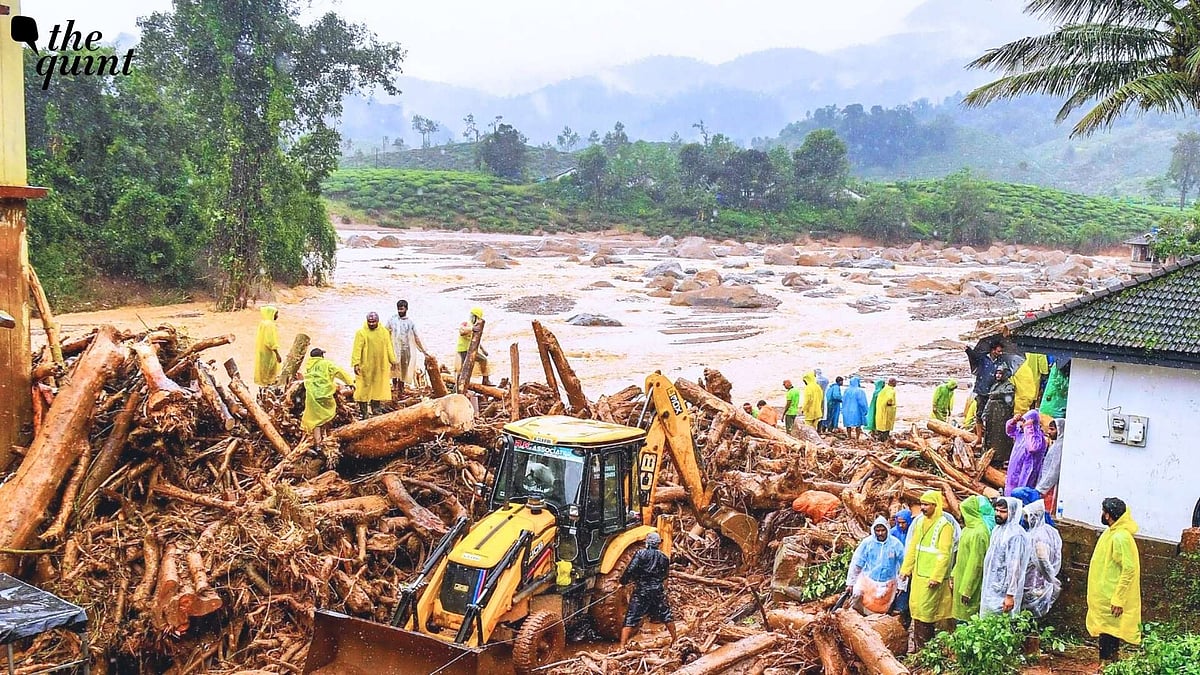
Last August, before floodwaters submerged farmland across Punjab, affecting nearly 1,400 villages in more than 13 districts, and the Yamuna swelled through parts of Delhi, the India Meteorological Department (IMD) was able to issue a warning several days in advance. That's precious time to move boats, alert villages, and pre-position relief.
That forecast came from a suite of models—some developed at the Indian Institute of Tropical Meteorology (IITM) in Pune, and others adapted from code written nearly 8,000 miles away in Boulder, Colorado, in the US.
That code, the Community Atmosphere Model (CAM), was developed at the National Center for Atmospheric Research (NCAR).
Now, the Donald Trump administration has announced plans to dismantle NCAR, and with it, India’s margin of safety is quietly evaporating, which is a live threat to Indian lives.
The Invisible Backbone of India’s Monsoon Forecasts
For more than sixty years, NCAR has functioned as the world’s atmospheric research commons, providing the university community with world-class facilities and services that were beyond the reach of any individual institution.
In 2014, India’s Ministry of Earth Sciences signed a memorandum of understanding (MOU) with UCAR, the consortium that operates NCAR, explicitly to improve forecasts of major weather events in India, including monsoonal rainfall. The partnership was practical. India contributed observations from the Himalayas and the Indian Ocean; NCAR provided the modeling framework and training.
The result is visible in the daily work of IITM in Pune.
When they test how aerosols alter monsoon circulation, Indian scientists use a suite of models, including regional models like WRF-Chem and global models such as NCAR’s CAM family, to isolate the impacts of pollution sources such as stubble burning.
When they simulate how Himalayan orography deflects rain-bearing winds, researchers draw on multiple modelling frameworks, including NCAR-developed models and other regional climate systems, to capture the complex terrain-atmosphere interactions.
What “Dismantling” Actually Means
Last month, on 17 December, Trump’s budget director, Russell Vought, posted on X that NCAR is “one of the largest sources of climate alarmism in the country” and announced a “comprehensive review” to break it up.
The White House promised that vital functions, such as weather modeling, would be moved elsewhere. But scientists who have seen this playbook before are not reassured.
The immediate impact on India is threefold.
First, model maintenance stalls
NCAR’s community models receive continuous updates—bug fixes, physics improvements, compatibility patches for new supercomputers. If the core team is dissolved, Indian scientists must either fork outdated code or rebuild from scratch. Neither option is quick or cost-effective.
Second, collaboration evaporates
The 2014 MOU envisioned joint field campaigns, visiting scientist exchanges, and co-designed experiments. Dismantling NCAR means fewer Indian researchers training in Boulder, fewer NCAR scientists advising IITM, and a slower transfer of know-how.
Third, long-range climate projections blur
NCAR’s flagship contribution is coupling weather and climate: running century-long simulations that show how a warming Indian Ocean will reshape future monsoons.
Those projections inform India’s National Adaptation Fund and state-level disaster plans. Without NCAR’s capacity, planners are left with older, coarser models that miss regional detail. A district-level irrigation project built on outdated rainfall projections is a project that will fail.
The View from a Village
Consider a tenant farmer in Bihar, one of the five states that are flagged as most climate-vulnerable. In May 2025, he faced a heatwave that killed dozens in his district.
The IMD’s heat action plan—based on NCAR-influenced models—gave him a five-day warning. He adjusted his planting schedule, shaded his seedlings, and survived.
Now imagine the same farmer in 2027 after NCAR’s dismantling. The forecast still comes, but the model behind it is a year out of date, missing the latest physics for aerosol-cloud interactions.
The heatwave arrives a day earlier than predicted, before he can finish planting. The crop fails. He defaults on his loan.
This is climate colonialism in its modern form.
The Global North controls the infrastructure of planetary knowledge, then starves it for ideological reasons.
A Choice Between Alarmism and Survival
The Trump administration calls NCAR a source of “alarmism.”
Indian meteorologists and disaster planners treat NCAR’s models as essential infrastructure for life-saving forecasts. When 331 out of 334 days bring disaster, alarm is the appropriate response.
India cannot build NCAR’s replacement overnight. The supercomputers cost billions; the expertise takes decades.
What India can do—what it must do—is treat this as a national security threat and climate justice issue. New Delhi should publicly demand that the US honour its scientific commitments, fund alternative global modeling centers, and accelerate its own high-resolution model development.
More urgently, Indian media and civil society must name this for what it is: not an American domestic dispute, but an act of climate aggression against the Global South.
The farmer in Bihar does not care about Colorado politics. He cares whether the rain comes tomorrow.
Right now, that forecast depends on a research center his government does not control, funded by a country that has decided his survival is less important than its culture wars. If that is not a crisis, nothing is.
(David Sathuluri, a recent graduate from Columbia University, is engaged with questions around caste, climate change, and urban spaces. This is an opinion piece and the views expressed above are the author's. The Quint neither endorses nor is responsible for the same.)