


New UGC Rules Trigger Violent Protests at Jawaharlal Nehru University (JNU), Delhi
The central university, located in the national capital, has witnessed a tumultuous start to 2026. The University Grants Commission(UGC) notified its new regulations to promote equity and prevent caste discrimination on 13 January; and two weeks later, they were stayed by the Supreme Court for being “vague” and “open to misuse.” Both the moves triggered sharply bipolar demonstrations across India’s legacy central universities in late January, including JNU.
Early February saw student groups intensify campus mobilisation — AISA demanded the UGC rules be implemented, while ABVP cautiously welcomed the top court’s stay.

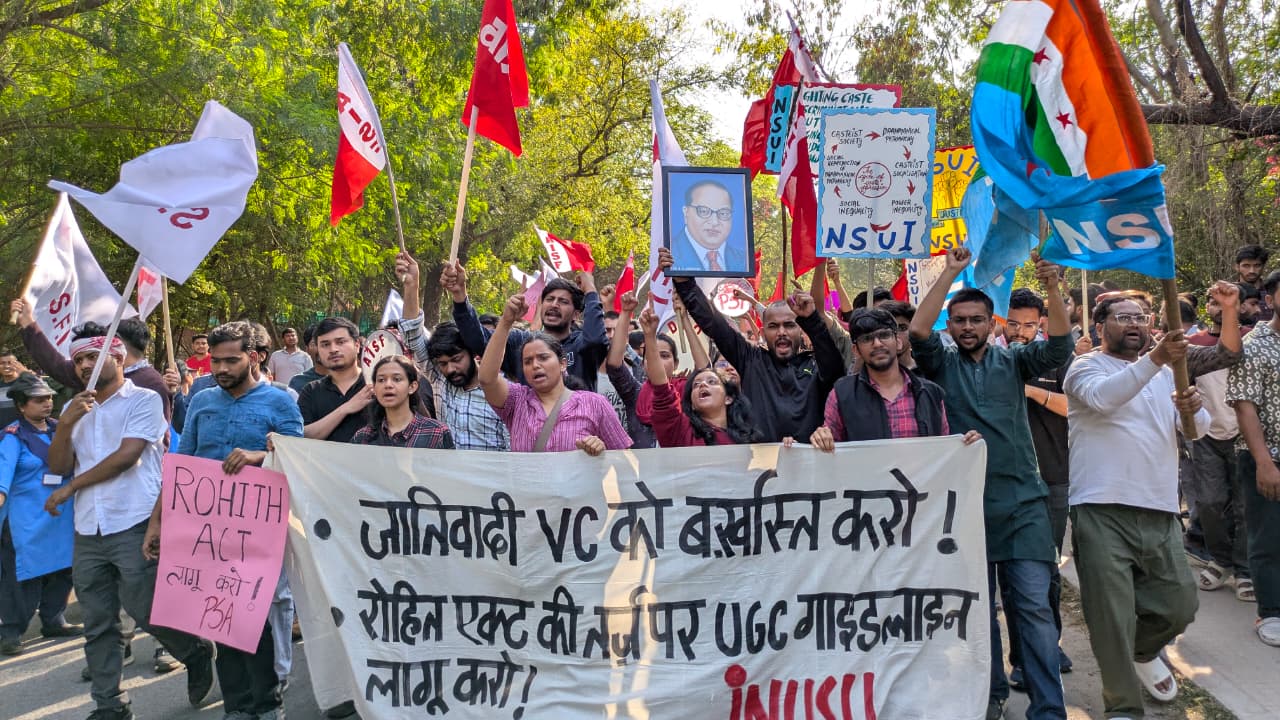
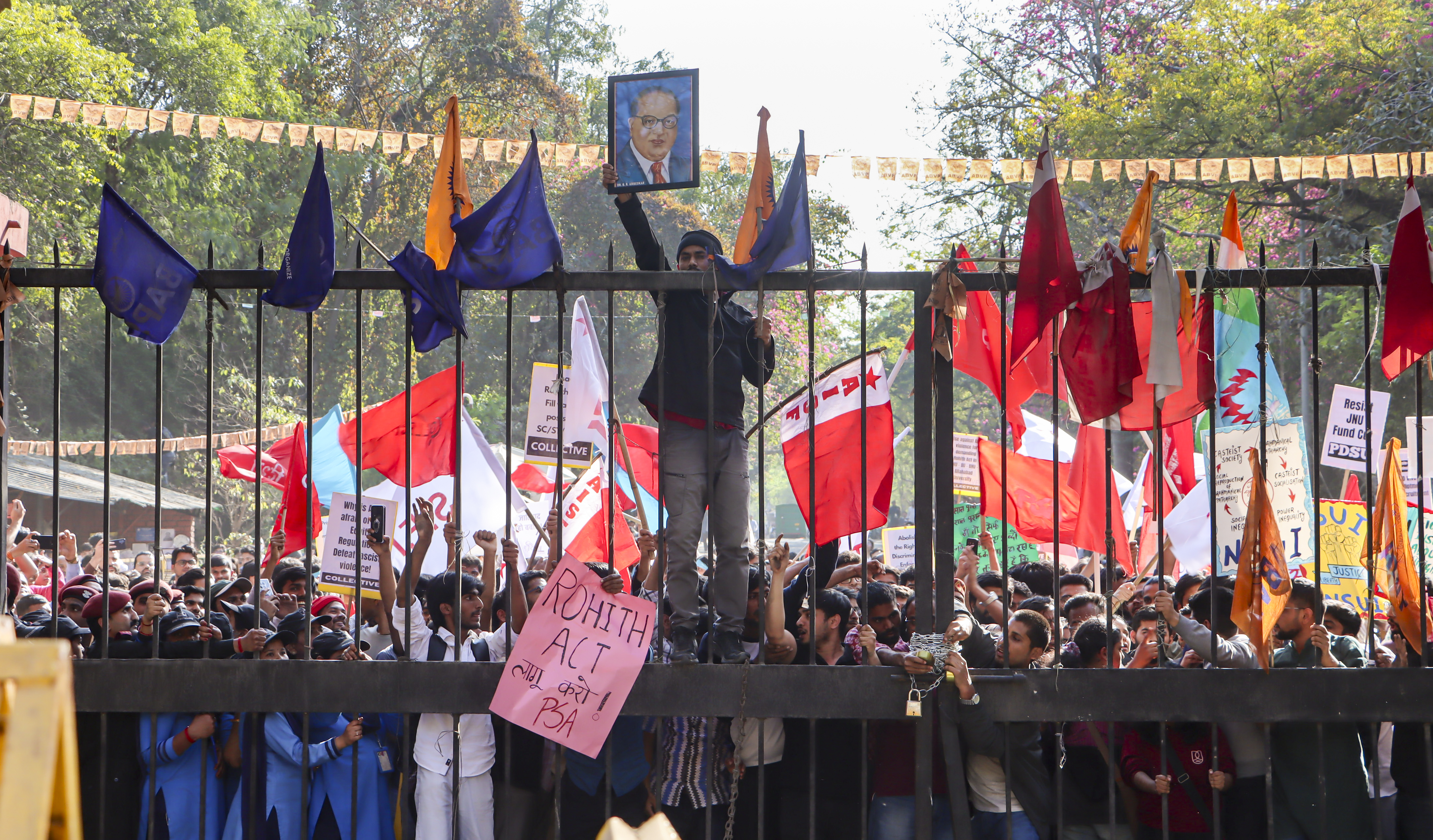
Fresh protests by Left-dominated JNU Student Union broke out in mid-February in response to their VC Santishree Dhulipudi Pandit labelling UGC regulations as “unnecessary” and suggesting that marginalised communities “can’t progress by perpetually playing the victim card.” This is when clashes first broke out between AISA and ABVP, each accusing the other of violent attacks. The Delhi Police filed an FIR against JNUSU members under serious sections, including rioting and unlawful assembly.
This was followed by the All India Equity Forum, an umbrella group of student unions and social justice groups, organising a Long March to Union Education Ministry on 26 February. It demanded the implementation of UGC regulations, the immediate suspension of their “casteist” VC and against the rustication of JNUSU Office Bearers and the Ex-JNUSU President earlier in February. Students alleged that the Rapid Action Force, CRPF’s riot-control wing, was pre-emptively deployed on campus while media persons were not allowed to enter.
Soon after, clashes were reported between the Delhi Police and the students—both reporting injuries. Nearly 50 students were detained by the police, while 14 students were arrested the next day and sent to Delhi’s Tihar Jail. And though granted bail by a Delhi court, the bail condition demanded that their permanent address be verified before they are released — which inevitably prolonged the process due to administrative delays since neither of the arrested students were from Delhi. On 1 March, the 14 students were granted bail with the court observing, “the object of bail is to secure the presence of the accused at trial, not to inflict pre-emptive punishment.” JNUSU president Dhananjay filed a complaint against the VC with the National Commission for Scheduled Castes under the SC/ST (Prevention of Atrocities) Act, but has received no response till now.
Discussion on Kashmir Incident Leads to Vandalism at Azim Premji University (APU), Bengaluru
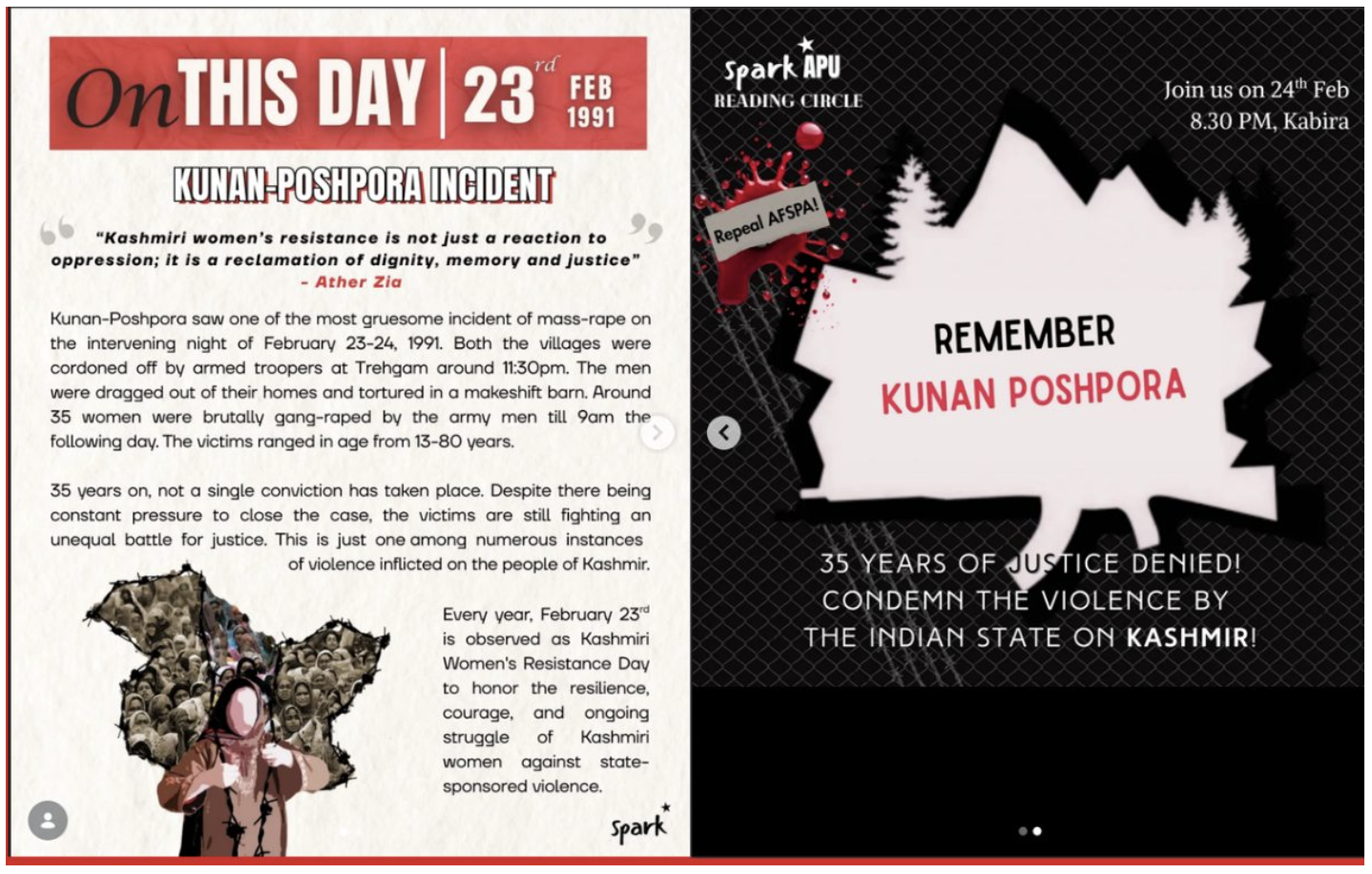
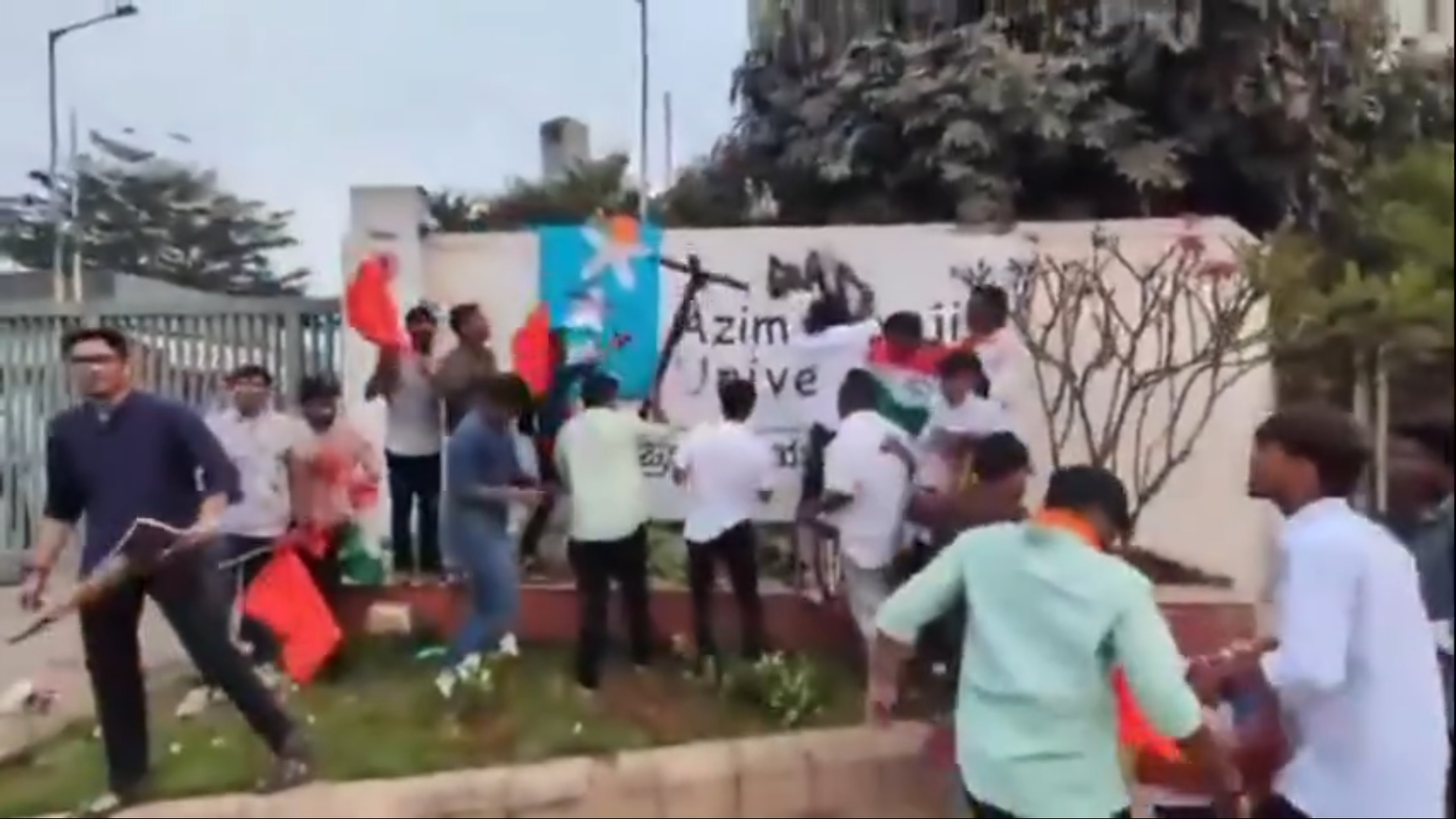
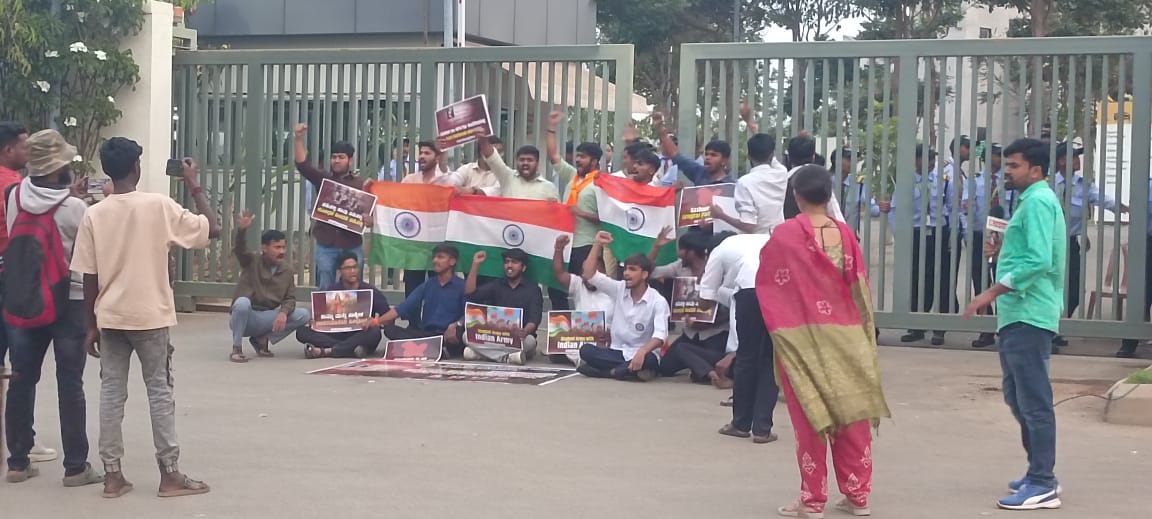
APU is a private university established and run by the Azim Premji Foundation. On 24 February, APU Spark Study Circle, affiliated to AISA, organised a discussion on the alleged mass rapes in Kunan and Poshpora villages of Kashmir by the Indian armed forces during an anti-militancy operation in 1991. ABVP condemned the event as 'anti-national', 'Kashmir separatist' and 'against the Indian Army’. The same day, 20 ABVP members barged into the campus, vandalised property with metal rods, smeared black ink on the name board and allegedly assaulted a students and several security guards.
While the university’s security manager filed an FIR against ABVP members, the registrar also filed an FIR against its own students belonging to the Spark Study Circle on the grounds that they did not seek permission to hold such an event on campus. Over 400 academics, writers, journalists and advocates have written an open letter to the university to consider withdrawing the FIR against its own students. The letter stated, “Criminal law is an instrument of last resort. It must not be used to regulate student expression, to manage reputational anxiety, or to appease violent disruption by external political actors.”
Delhi University Bans Protests After Violent Clashes
The Delhi University, in collaboration with the Union Ministry of Culture among others, organised the first-ever Delhi University Literature Festival (DULF) from 12–14 February. The event saw speakers such as RSS ideologue and former BJP general secretary Ram Madhav, BJP leader Sudhanshu Trivedi, The Kashmir Files director Vivek Agnihotri, TV news anchors Anjana Om Kashyap, Rubika Liyaquat, Rahul Shivshankar among others.

Left-affiliated student group AISA protested this festival by organising its own outside the Arts Faculty in DU’s North Campus and named it People’s Literature Festival – Samta Utsav. On 12 February, as this festival was underway, a bucket of water was hurled at 73-year-old historian Irfan Habib while he was addressing the students; bricks were allegedly hurled at other speakers. However, no action was taken against the perpetrators.
On 13 February, AISA organised the Adhikar Rally against the attack during the festival and in favour of the UGC rules. During the rally, a YouTuber Ruchi Tiwari barged in and allegedly hurled casteist slurs at a Dalit journalist. This leads to a clash between AISA President Anjali and Ruchi Tiwari. Even as AISA members headed towards at Maurice Nagar Police Station, they were met with a large crowd led by Megha Lawaria, chanting ‘Brahmanvaad Zindabad.’ Cross FIRs were filed after clashes continued at Maurice Nagar police station. Soon after the incident, Delhi University banned public meetings, processions and protests for one month effective 17 February. Responding to the move, Congress-affiliated student group National Students’ Union of India (NSUI) said, "Silencing students will not solve problems, it will only expose the administration’s unwillingness to listen.”
Fencing Off a Lal Baradari During Ramzan Simmers Tensions at Lucknow University (LU)
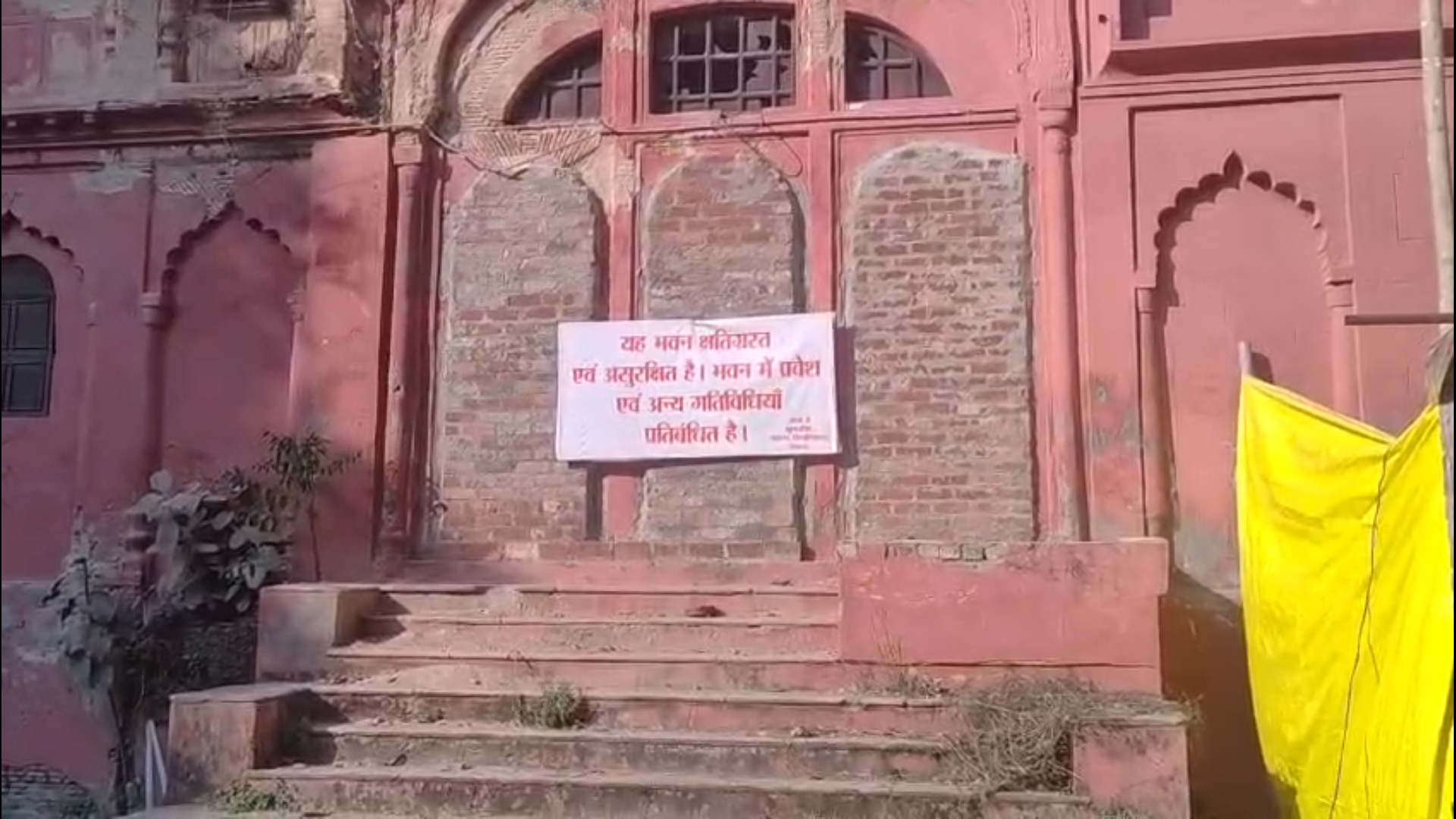
On 22 February, Sunday, the LU administration fenced off the Lal Baradari, a Mughal-era structure located within the university campus. Students protested the move, saying it was unauthorised and it restricted access to Muslim students offering prayers there during the ongoing holy month of Ramzan. The university, however, claimed that the structure was in a dilapidated condition and that fencing off was a safety measure. Although several students claimed that a hall inside Lal Baradari has been used as a mosque; the university refuted this.
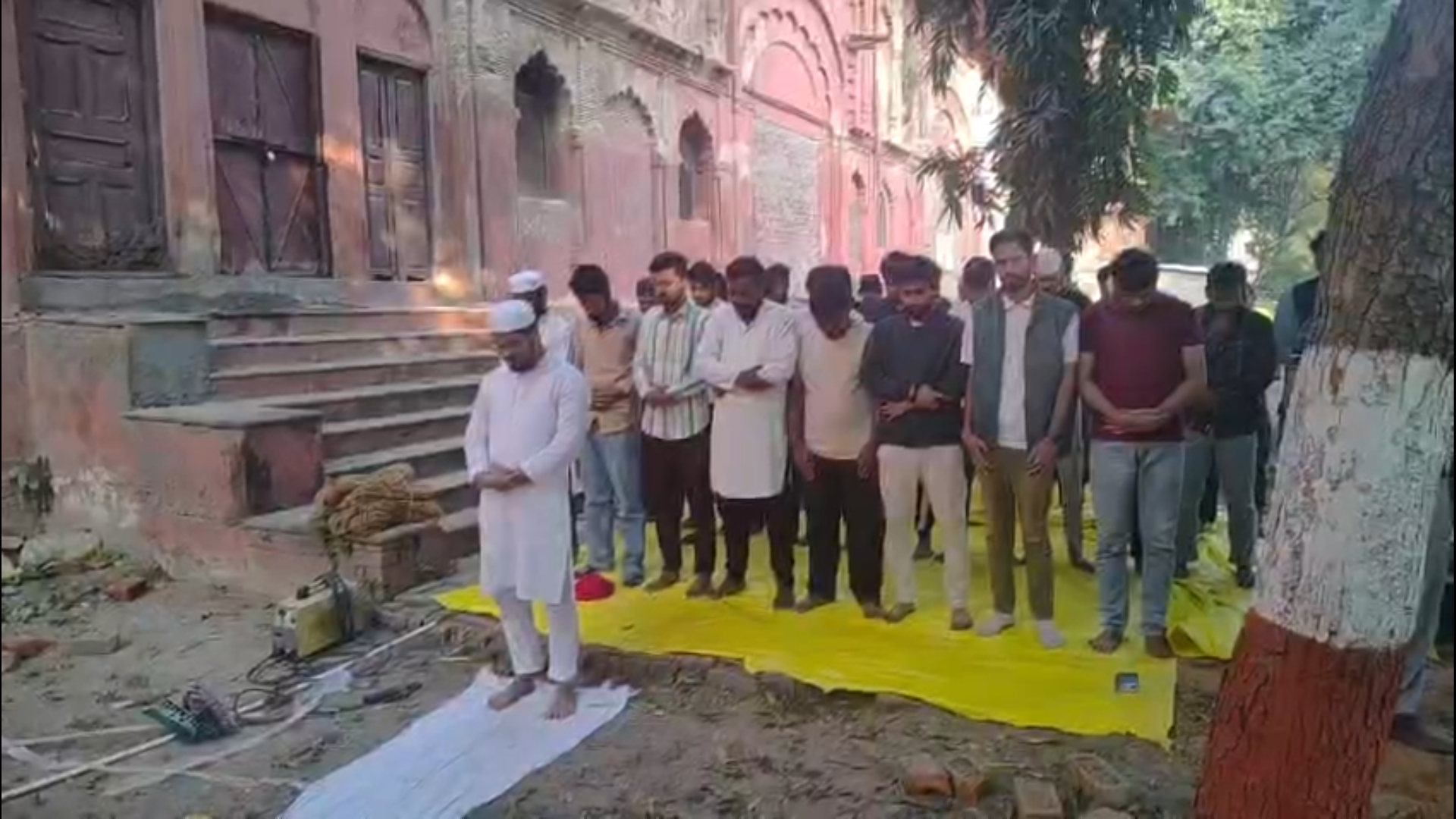
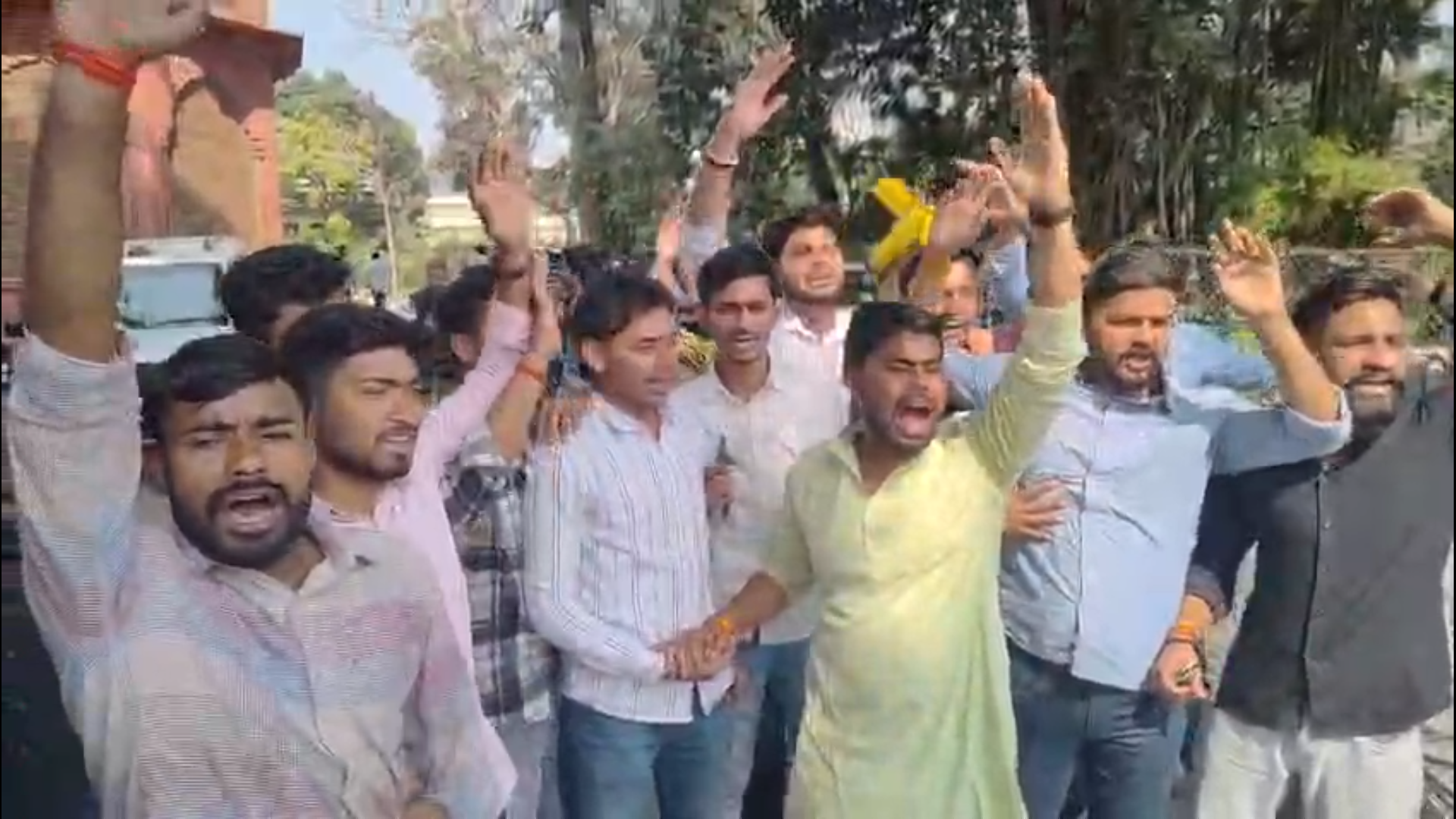
NSUI and Samajwadi Chhatra Sabha protested the move. The same day, Muslim students offered namaz outside the Lal Baradari building as Hindu students formed a human chain to safeguard them. The university registrar Bhavna Mishra lodged an FIR against unknown students and outsiders on charges of rioting, vandalism and disturbing communal harmony on campus. In addition, the Executive Magistrate of Lucknow Commissionerate issued notices to 13 students for offering namaz and raising slogans outside Lal Baradari. On 24 February, ABVP members gathered near the Lal Baradari to recite the ‘Hanuman Chalisa’ and demanded a ‘shuddhikaran’ of the place. Police detained 7-8 ABVP members as a precautionary measure.
Police Complaint After Students Protest RSS Event at Gujarat University
On 16 February, the Gujarat University, Bharat Shodh Sansthan and RSS jointly inaugurated an exhibition at the Atal Kalam Research Park in Ahmedabad. On 23 Feb, Congress-affiliated NSUI protested against the event, claiming “incomplete and selective information” was presented about national leaders such as Sardar Patel and BR Ambedkar, while accusing the university of promoting a specific ideological propaganda.
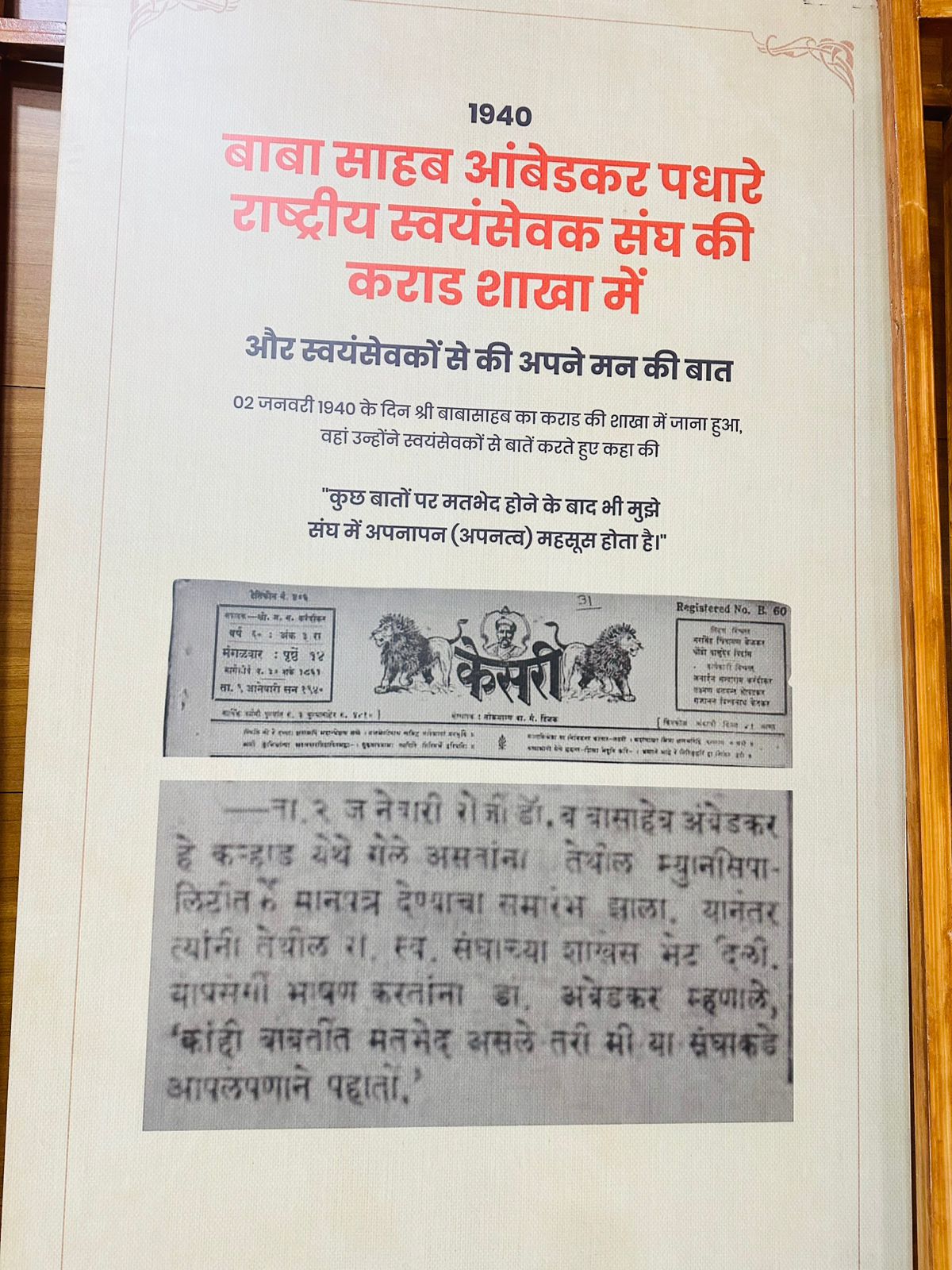

NSUI members allegedly tore down some of the posters put up ahead of the exhibition — the move outraged ABVP, which protested and demanded a police complaint.
Following this, a non-cognizant police complaint was lodged by the university registrar against NSUI members. Local reports indicated that the university cancelled admissions of at least nine NSUI student members and banned their entry into the campus. However, two days later, the university revised the disciplinary action, restricting the nine students’ access to only their course blocks during valid ID cards. GU Vice Chancellor Neerja Gupta defended the move and the police complaint as necessary actions against “hooliganism in the university campus.”
Police Detains Students After Protest Over RSS Speakers at Panjab University
A seminar was organised at Panjab University in Chandigarh on ‘Sikh history, Guru Tegh Bahadur, and the Panj Pyare’ on 9 March. The speakers included RSS North Zone Pracharak Pramukh Banveer Rana, and former National Commission for Minorities chairperson and BJP leader Iqbal Singh Lalpura.
Sikh and Left-affiliated student groups protested the move and asserted that an academic institution should remain free of political propaganda.
During the seminar, students reportedly raised slogans both inside and outside the venue. As the situation escalated, the Sector 11 police was called to disperse the students. A scuffle broke out between the police and the students. Nearly 40 students were reportedly rounded up, detained, kept in preventive custody and released after the programme concluded.
Cancel Culture on Campus at Mumbai
Apart from criminalisation of campus protests, central universities are also being marred by cancellation (often last-minute) of events and speakers.
For instance, Maharashtra’s SNDT Women’s University, located in Mumbai, on 7 March cancelled the Neera Desai memorial lecture scheduled to be delivered by eminent feminist historian Prof. Uma Chakravarti—a day after it was announced. Reports suggested that soon after the poster of the event was released on social media, it was met with criticism that Prof. Chakravarti is the inventor of the term ‘Brahminical Patriarchy’. Reacting to the cancellation of the lecture, Prof. Chakravarti said, “I am amused that a women’s university which has historically been a place for women to get educated and speak-up, should feel anxious about hosting an event organised by its own Women’s Studies Centre.”
On 5 March, documentary filmmaker Anand Patwardhan, whose films vocally criticise governments and political parties, was denied entry at the Kalina campus of Mumbai University. He had gone there to express support for research scholar Rajesh Bankhande, who is now a Buddhist monk and has been on a peaceful protest on the campus for over six months. According to reports, Patwardhan was not given any reason as to why he was barred from the campus; while the university stated that it had no prior information about his visit and would’ve welcomed the filmmaker had it known in advance.
A month before that, veteran actor Naseeruddin Shah said that he was disinvited from a Mumbai University event at the last minute without any explanation or apology. "The Jashn-e-Urdu organised by the Urdu department of Mumbai University for February 1, from which I was disinvited at the last moment, was an event I was greatly looking forward to because it meant interacting with students. The university, after informing me that I needn't attend (on the night of January 31, and giving no reason for it, forget an apology) obviously considered this not insulting enough. So they decided to rub a little salt in by announcing to the audience that I had refused to be there," he wrote in The Indian Express.
It is important to note here that the Rashtriya Swayamsevak Sangh (RSS) centenary celebrations in Mumbai were also scheduled for 7-8 February.
Veteran Journalist Disinvited by Kerala College
Around the same time, on 4 February, journalist Vinod K Jose, former editor of The Caravan magazine, said that he was disinvited from delivering a lecture on ‘The State of Indian Democracy’ at the St Thomas College in Kerala’s Pala town. Noting that the institution is a Catholic diocese-managed college, Jose said in a social media post: “These are interesting times we live in. If not all, at least a section of the Christian society in Kerala are tiptoeing the RSS-BJP line of blocking relevant, transparent conversations at the least, and at its maximum, working to help the Hindu right get a foothold in Kerala.”