No, Rajkummar Rao Did Not “Smash the Patriarchy”
Men get too much praise for doing too little.
advertisement
Selflessness is admirable. Displaying empathy for the struggles of the subjugated and fighting for their rights is a cause for celebration of character. However, this celebration, very often, is tinted with archetypes of gender. Being male grants men with male privilege, which forms the basis of their interactions with the world henceforth. To be male and fight for the rights of women is easy: to be female and fight back is much more difficult. When the uncharacteristic straight male advocates equality, wearing it like a badge of honour, he is welcomed into society. The hypocrisy of the situation lies in that the emergence of the compassionate, conscious male casts the female rendition of the same into the shadows.
Bollywood has seen strong women. Kangana Ranaut, Shabana Azmi, Konkana Sen Sharma, Kalki Koechlin, have constructed a narrative for other women to follow by deploring the culture of toxic masculinity that Indian cinema prides itself in. The opposition they have faced in doing so has been heavy, vast, and unfair, and their influence has been limited to a target audience of somewhat similar opinions.
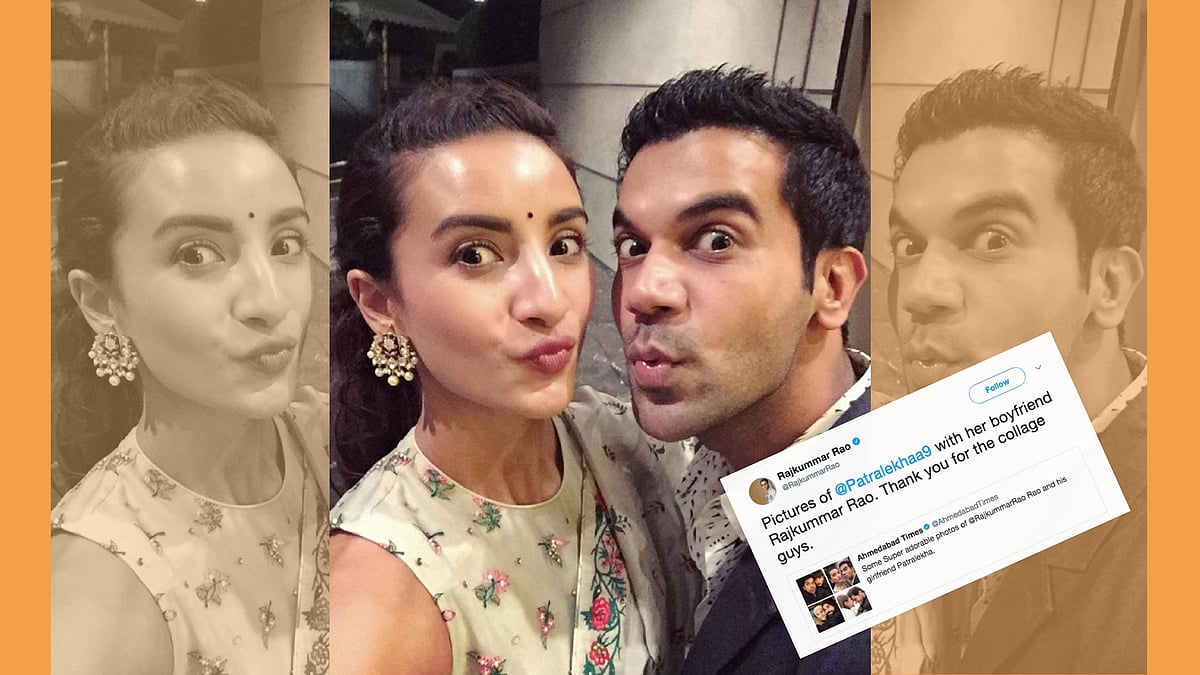
When Ahmedabad Times tweeted a collage of photos of Bollywood actor and actress Rajkummar Rao and Patralekhaa, Rao was quick to respond to the underlying sexism in the caption. With a whopping 3.6k likes and 585 retweets, Rao was hailed by many media outlets including The Quint, Scoop Whoop, Miss Malini, as one who gloriously “Smashed the Patriarchy” with a single tweet. He also received an overwhelmingly positive response from his fan base and Twitterati.
The unnecessary glorification of it comes from shock at the concept that even though Rao is notably more famous, he would rather she be referred by her name. Decent, civil behaviour is expected from men, and the world shouldn’t be ready to shower them with praise when they behave as any rational being would.
Ahmedabad Times made it seem like Patralekhaa was only worthy of media attention because of her relationship with a respected man in the media. Patralekhaa, albeit less famous, should’ve been referred to by her name and profession, as an actress, just like Rao. Indian society has actively propagated and consequently normalised a woman’s choices as less important than a man’s. Bollywood has given this impetus by promoting women as side pieces and trophy wives. In romantic relationships, publicity promotes the man’s choice and his reasons behind it, which invariably refer to the woman’s physical appeal and desirability.
Though it may be argued that Ahmedabad Times worded it to market well, owing to Rao’s fame, they should move beyond pandering to stereotypes to gain support. Holding sway over the political and social stances of a vast audience comes with a responsibility to be moral and sensible while portraying the news. Corporate money-making machine objectives aside.
Men, while actually doing very little, can wish to be seen as Feminists because they remain well-liked in the public eye.
According to a mixed study done by linguist Dale Spender, when fourteen Feminists spoke between 8% and 38%, they believed they had a fair share of the discussion. Two men who spoke for 67% and 75% of the time respectively claimed they had not had their fair share. This raises the question: what is fair, and to whom? Male Feminists may think making waves is as easy as announcing their stand for equality, as the media creates an aura of nobility around them. What they fail to recognise is that even though their agenda attempts to break patriarchal structure, they have been and will remain beneficiaries of it. When male allies remain oblivious to their role in the cycle of oppression, they undermine the movement they claim to support.
Spender’s study also mentions that men do not have the same responsive way towards other speakers as women do. Women giving their opinions are often regarded as rude and aggressive, while men as masterful and forceful. When men bandy about “equality for women in the workplace”, “equality for all genders”, it’s easy to trust them. It’s also easy to place them on a pedestal and think we have made progress. Female Feminists, on the other hand, are trying to restructure the fabric of the society that has constantly conspired against them. Their arguments must be flawless, and they must unfalteringly prove their social identity. They’re taking up space that would otherwise naturally be ceded to men, which is a challenge in itself.
Working against a social structure that inundates women with expectations is exhausting. Maybe what we need to do is not search for hope in men who we believe have changed. We need to sequester ourselves from the slogans and facades of Feminism, and the pride that comes with being socially conscious. Instead, we should use our individual interactions to work towards a structural change and build a more peaceful, co-dependent society with equal stakeholders. Moving beyond breaking and remoulding a power dynamic, we should feed the idea that men can, and must, prove themselves to be better.
(Nandini Talwar is a 17-year-old student, social activist, and bookworm. This is a personal blog and the views expressed above are the author’s own. The Quint neither endorses nor is responsible for them.)