Q&A: Kashmir Docu That Bares All Will Have No Cuts, Says Court
Delhi HC has allowed the release of Pankaj Butalia’s documentary on Kashmir without any cuts, overruling the CBFC.
advertisement
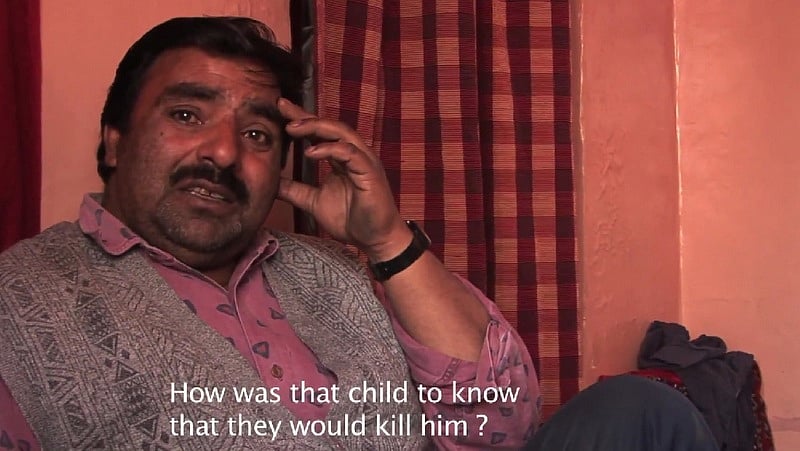
The Delhi High Court has ruled in favour of documentary film-maker Pankaj Butalia, allowing the release of his film Textures of Loss with a ‘U’ rating. The film, which focuses on violence in the Kashmir valley between 2005 and 2013, contains interviews with those affected, and their families.
The Central Board of Film Certification (CBFC) had insisted that the film carry a disclaimer stating “that all views are personal”, and the emotional and angry remarks of parents whose children were killed during the 2010 stone-pelting clashes be removed.
You can watch the clips that the censor board wanted to cut from the film.
Considering this an attack on his freedom of expression, Pankaj Butalia moved court to have his film released in its entirety.
Aviral Virk of The Quint spoke to Butalia on his experience with the Censor Board and his film.
Q. What was your experience of dealing with the Censor Board and getting your film passed?
A. Dealing with the Censor Board was very unpleasant. In the first stage, when the film was with the CBFC in Delhi, they took only 24 hours between my application and the decision. According to the rules, a representative from the film is supposed to be informed if the Board is suggesting any cuts — they didn’t do anything like that. I just got a phone call saying “implement these four cuts” and asked me to add a disclaimer. I said I can’t implement any changes unless I get them in writing.
I did not have a problem putting in a disclaimer, but then you should ask all films to put in a disclaimer. And why put a disclaimer if you want me to delete the offending scenes?
They didn’t respond to me. I wrote to Leela Samson (the then chairman of the CBFC) but received no response. Finally, I put my appeal through to the FCAT (Film Certificate Appellate Tribunal). Without even watching the whole film, Lalit Bhasin of the FCAT said “two of the cuts I accept, two I reject.” I wrote to the I&B Ministry but they didn’t respond. I even cited Haider in which Shahid Kapoor stands in the middle of Lal Chowk and speaks against India. So finally, I sought relief from the court.
Q. What is your reaction towards people who said your film portrays ‘anti-national’ sentiments?
It’s completely absurd. Even the Censor Board said “remove these two comments” where I said that if 120 people were killed, then the police used disproportionate violence. The media is always talking about police brutality. If someone is brutally beaten [by the police], every journalist worth his/her salt comments on whether too much force was used. I just used the word ‘disproportionate’ — you don’t kill 120 people because they were pelting stones. Last year, when Baba Rampal’s supporters threw stones, chairs, and iron rods at the police, why didn’t they start firing? Why didn’t they kill 200 people? What they used there was a ‘proportionate’ response. In Kashmir, it was a disproportionate response.
The term anti-national is used so loosely that it has lost all meaning. The BJP used to say FDI in retail was anti-national, now they are allowing it. Do I call them anti-national?
Q. Why do you think this kind of mindless censorship is happening? “Allow two cuts, and let two go.” Do you think there is pressure from the ‘higher-ups’?
I think this is about arrogance, which is what I am fighting against. They think they know everything that is right. Now, when they are confronted with people who are powerful — people like Vishal Bharadwaj and Shahid Kapoor who come with the power of the Bombay film industry and money behind them — the Censors choose to be less arrogant. Everybody sits down together and discusses the nuances of the film.
When it’s a documentary, the entire board doesn’t see it — one joker sitting in his office hurriedly runs through it on his laptop, or office TV . And they charge Rs 7000 per film!
Q. Is there a difference in the way documentaries and fiction are processed by the CBFC? The power of a documentary to convey emotion could be greater than a film.
I have to go by the law. In the law there is no such distinction. The Cinematographic Act doesn’t say that a documentary has to go through a stricter standard and fiction through an easier one. For example, Lady Chatterley’s Lover or Jesus Christ Superstar are both works of fiction, but in India a strict standard was applied to them.
Of course, when it suits them, they use this distinction between documentary and fiction. In fact, I could argue that a fiction film reaches a much larger audience, lakhs of people whereas my documentary may reach a few hundred or at best a few thousand people. It shouldn’t even come under the concept of mass media.
Q. When and where is the film releasing?
There is no possibility of a commercial release, since it’s a documentary. Now if anyone wants to show it, I can give them the film. Earlier, I couldn’t even do that. It will probably go to universities in Delhi and Mumbai, and places like the India International Centre.
Watch the trailer for Textures of Loss below.