In Stats: Records Set by Williamson, Bumrah in Second India-NZ ODI
The Quint brings to you all the stats from the second ODI between India and New Zealand.
advertisement
The visiting New Zealanders finally have a win on their tour of India. After being blanked 3-0 in the Test series and after losing the first ODI, the Kiwis held their nerve to win the second ODI played at the Feroz Shah Kotla Stadium in Delhi.
Batting first, the Kiwis posted a competitive 242-9 and then dismissed the home side for 236 to win by a narrow margin of six runs and level the series one-all. New Zealand’s win was their first in ODIs against India in India since November 2003 and brought to an end to India’s 13-match unbeaten run in international matches at the historic venue.
The last time India lost a match at Feroz Shah Kotla was in April 2005, when Pakistan defeated them in an ODI.
Earlier in the evening, after being put in to bat, the Kiwis got off to the worst possible start – losing opener Martin Guptill even before they had a run on the board. But the visitors recovered very well, with the second wicket pair of Tom Latham and Kane Williamson adding 120 runs at nearly a run-a-ball. After Latham was dismissed in the 21st over, New Zealand consolidated further, reaching the 200-run mark in the 40th over.
But that’s when the wheels came off. At 200 for 3, the Kiwis looked good to post a total in excess of 280. But they lost six wickets for 40 runs in the final ten overs and could only finish with 242-9.
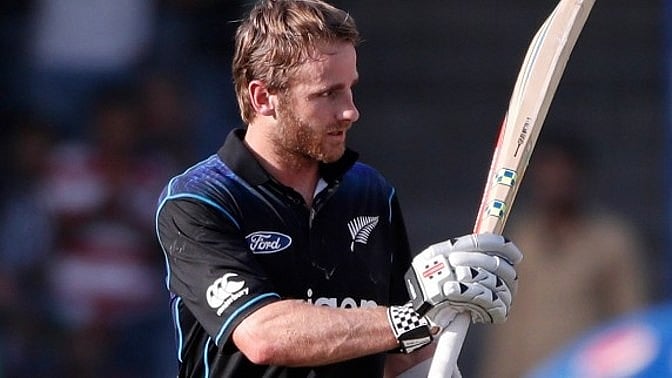
If the Kiwis got to 242, much had to do with a sterling knock from their captain. On an extremely hot afternoon, the 26-year old Kane Williamson scored his eighth ODI hundred and in the process became only the third New Zealand captain to score an ODI century against India.
Since the time he made his debut in 2010, Kane Williamson has always been spoken about as the one destined to finish among the greats of the game. In recent times, despite being burdened with the additional responsibility of captaincy, he continues to score runs just like he did earlier.
In AB de Villiers’ first 21 matches as South Africa captain, he had scored 1089 runs, while the former England captain Alastair Cook had scored 1075 runs in his first 21 matches as captain.
Williamson’s numbers compare very nicely; he has scored 1034 runs in his first 21 matches as New Zealand captain and his average in these matches stands at 54.42 –nearly a 20 per cent increase over his average when he was just a specialist batsman in the team.
For India, the wickets were shared between five bowlers. But the bowler who walked away with the best returns was the young lad Jasprit Bumrah, who finished his ten overs with figures of 3-35.
Together with his three scalps in the match, Bumrah now has 14 wickets in his brief ODI career – which equals the record for the most wickets by an Indian bowler in his first six ODI appearances.
India’s chase of 243 was rocked early when they lost Rohit Sharma and Virat Kohli with just 40 runs on the board. The home team suffered a mini slide when they lost two well-set batsmen – Ajinkya Rahane (28) and Manish Pandey (19) – in the space of four deliveries.
And again, when the chase was in control, India lost the wickets of Kedar Jadhav (41) and MS Dhoni (39) against the run of play. Altogether, there were eight batsmen who got starts, yet Jadhav’s 41 was the highest score of the innings.
And that possibly could be attributed to being one of the reasons for India’s inability to get over the line – not one batsman carried on to convert the start into a big score.
One could also attribute the lack of rotation of strike by the Indian batsmen as one of the reasons for falling short in the run-chase. The Indian top six consumed a total of 216 deliveries in the chase, out of which a significant portion – 121 balls – were dot deliveries.
Given the result, it feels awkward to single out MS Dhoni, but the Indian captain could have definitely applied better.
On the day, he looked out of sorts against Mitchell Santner. The New Zealand left-arm spinner bowled 21 deliveries to MS Dhoni, 14 of which were dot deliveries.