In Photos: Inside a Weaving Mill in Delhi's Sunder Nagri
There was a time when every house in the neighbourhood had a handloom. But now, the industry is slowly dying.
advertisement
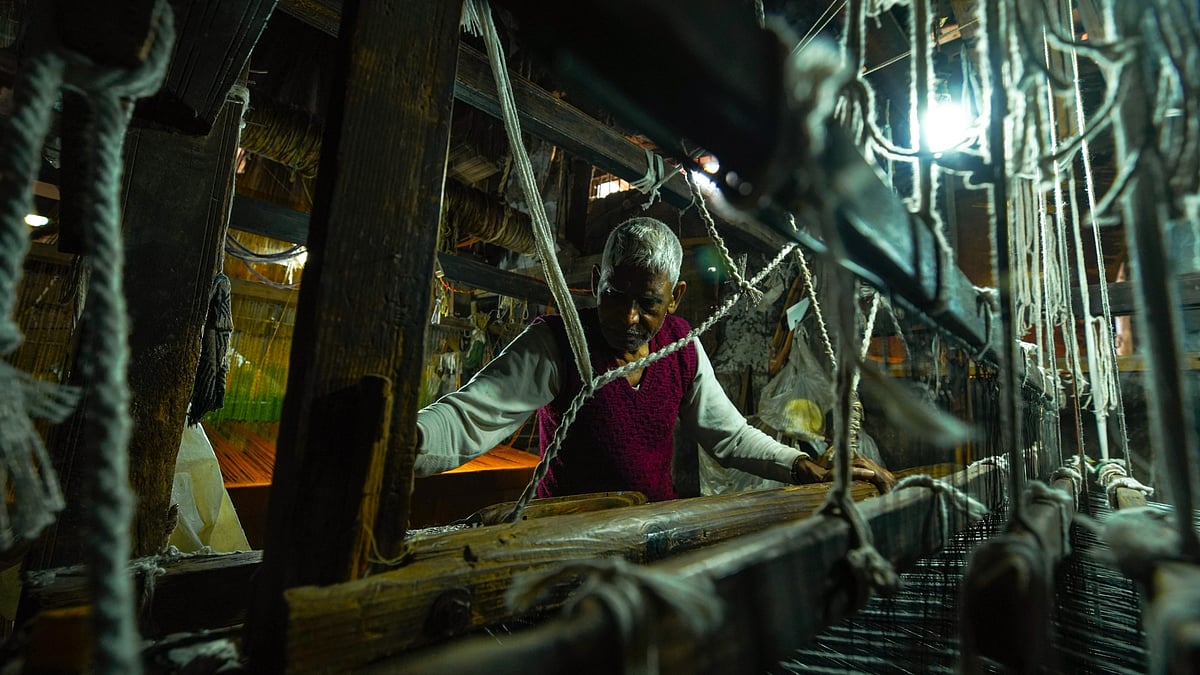
The shrinking of India's handloom industry over the past few decades is evident in the decrease in the number of weavers over the years. Between 2010 and 2019, the country has seen a 19% fall in the number of weavers, according to the Handloom Census 2019-20. The Quint spent a day in Sunder Nagri in Delhi's Dilshad Garden – once a thriving weavers' colony – to talk to weavers about the changing landscape of the industry.
(Photo: Ribhu Chatterjee/The Quint)
Md Jamal, 65, has been working in this particular mill for four years now. Jamal left his driving job in Saudi Arabia after he crossed 60. Soon after, he returned to India and joined this mill where he now lives as well.
(Photo: Ribhu Chatterjee/The Quint)
Jamal learnt weaving from his older brother and uncle who live in Gorakhpur, Uttar Pradesh. Here, he can be seen coiling the thread in the bobbin – which is then placed inside the shuttle before it is put into the weaving yarn. "This work is not easy, but when once you learn it, it seems easy," he tells The Quint.
(Photo: Ribhu Chatterjee/The Quint)
A worker is seen wrapping the yarn on a ballast.
(Photo: Ribhu Chatterjee/The Quint)
The fabrics are wrapped on a wooden frame called 'chaukta', to make them into a fine sheet of yarns.
(Photo: Ribhu Chatterjee/The Quint)
The threads are spread manually so that they don't entangle during the weaving process.
(Photo: Ribhu Chatterjee/The Quint)
Bhagwan Devi, 70, resides in a neighbouring slum. Her day's labour involves spinning some of the best fabrics to come out of the mill.
(Photo: Ribhu Chatterjee/The Quint)
She's been in this industry for over 30 years now.
(Photo: Ribhu Chatterjee/The Quint)
When asked who taught her the intricacies of weaving, she simply answers, "It's been ages, so I have forgotten who did I learn from."
(Photo: Ribhu Chatterjee/The Quint)
At one time, there used to be six mills inside the Delhi State Cooperative Bank Limited in Sunder Nagri. Today, only one remains. In the photo, bobbins with coiled thread can be seen still lying intact in one of the abandoned mills.
(Photo: Ribhu Chatterjee/The Quint)
The long thread, (tana) is weaved with the shorter ones (bana) by a shuttle movement controlled by foot pedal. Hence, the weaving is also called “tana-bana”. There are eight antique traditional handlooms and yarns under a huge studio-style apartment structure in this mill, where elderly folks may be seen working.
(Photo: Ribhu Chatterjee/The Quint)
Mehraj Ul Haq Ansari, 48, is seen checking the slits of the reed aka kangi. He is responsible for the maintenance of this mill. He's been teaching the skill to his son Rehan, who is 22 now, and has a keen interest in this work.
(Photo: Ribhu Chatterjee/The Quint)
He recalls, "My father and I used to dye together when we started the loom. My elder brother and mother used to spin the charkha as well. We used to work together.
(Photo: Ribhu Chatterjee/The Quint)
Hasan Mia, also known as Masterji by his coworkers, can be seen putting the loom before beginning to weave.
(Photo: Ribhu Chatterjee/The Quint)
Masterji sits down for lunch with his friend Bansi Laal. He says, "When I make something, I feel good. I love this work."
(Photo: Ribhu Chatterjee/The Quint)
At 53, he is the most experienced of all. He lives in Mustafabad near Bhajanpura. "My father didn't want to teach me. He wanted me to study, but I got into this line of work at the age of seven," he adds.
(Photo: Ribhu Chatterjee/The Quint)
Surrounding this one mill are several abandoned ones. In this photo, unused shuttles can be seen at an abandoned mill.
(Photo: Ribhu Chatterjee/The Quint)
A dilapated mill, where threads are still in the loom, but no one to work on them.
(Photo: Ribhu Chatterjee/The Quint)
Sunder Nagri in Delhi's Dilshad Garden was once a hub for weavers of traditional handloom. According to locals, there was a time when every house in the neighborhood had a handloom. Today, with the introduction of readymade items and technology into the market, the industry is slowly dying.