Home Photos In Pictures: NASA Releases New Close-up Images of Pluto
In Pictures: NASA Releases New Close-up Images of Pluto
Scientists at NASA say the information collected from their Pluto flyby is quite the revelation.
Neelima
Photos
Published:
i
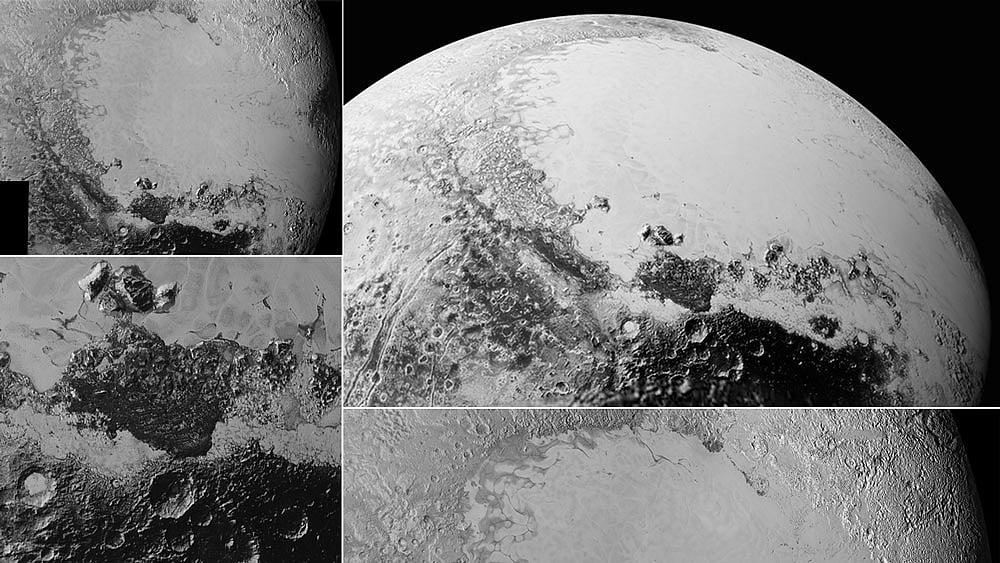
Latest images of Pluto released by NASA.(Courtesy: NASA)
null
✕
advertisement
On Thursday, NASA released some of the latest pictures of Pluto captured by the New Horizons spacecraft. The astronomers who have sent the pictures from NASA’s flyby say that it has revealed a new range of complexities.
Pluto is showing us a diversity of landforms and complexity of processes that rival anything we’ve seen in the solar system. If an artist had painted this Pluto before our flyby, I probably would have called it over the top — but that’s what is actually there. – Alan Stern, New Horizons Principal Investigator
New Horizons began the download of tens of GBs of data only recently. The pictures that have been released are the one downlinked in the past few days.
“The surface of Pluto is every bit as complex as that of Mars. The randomly jumbled mountains might be huge blocks of hard water ice floating within a vast, denser, softer deposit of frozen nitrogen within the region informally named Sputnik Planum. – Jeff Moore, Leader of the New Horizons Geology, Geophysics and Imaging team
This synthetic perspective view of Pluto, shows what you would see if you were approximately 1,800 kilometers above Pluto’s equatorial area. The dark, cratered area is informally named Cthulhu Regio and the bright, smooth, expanse of icy plains informally called Sputnik Planum. (Courtesy: NASA)
The image is dominated by the Sputnik Planum region across the center. It also features a tremendous variety of other landscapes surrounding Sputnik. (Courtesy: NASA)
This 350-kilometer wide view of Pluto illustrates the incredible diversity of surface reflectivities and geological landforms on the dwarf planet; its origin is under debate.(Courtesy: NASA)
ADVERTISEMENT
ADVERTISEMENT
This image is of Pluto’s largest moon Charon. It is 1,200 kilometers in diameter and displays a surprisingly complex geological history, including relatively smooth, fractured plains in the lower right; several mountains surrounded by sunken terrain features on the right side, and heavily cratered regions in the center and upper left portion of the disk. (Courtesy: NASA)
In the center of this 470-kilometer wide image of Pluto is a large region of jumbled, broken terrain on the northwestern edge. (Courtesy: NASA)
This image of Pluto processed in two different ways, shows how Pluto’s bright, high-altitude atmospheric haze produces a twilight that softly illuminates the surface before sunrise and after sunset, allowing the sensitive cameras on New Horizons to see details in night time regions that would otherwise be invisible. (Courtesy: NASA)