
State Power vs Public Voice: The Case of Bengal Circular for Govt Employees
The Bengal government circular on public interactions of government employees was evidence of authoritarian intent.
advertisement
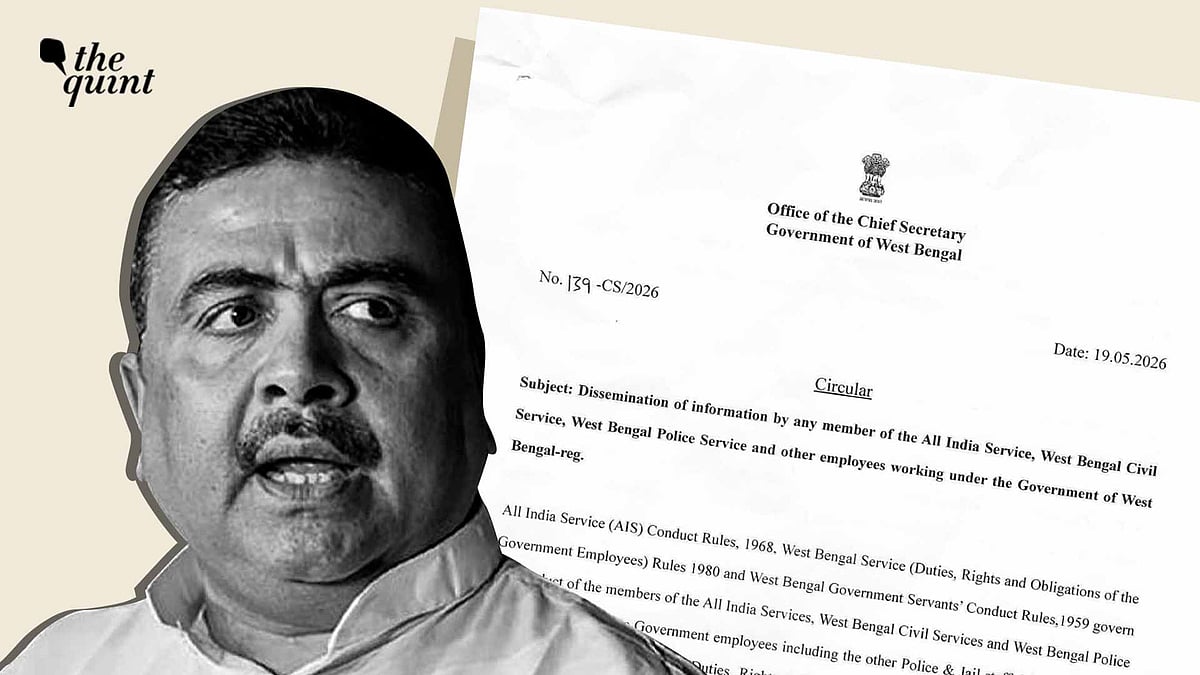
On 19 May 2026, the government of West Bengal issued a circular restricting how members of the All India Services, West Bengal Civil Service, West Bengal Police Service and other state-linked employees could share information with the press, participate in media programmes, or publicly criticise government policy. At first glance, it reads as a stark, even draconian, gag order. The government’s defence, however, would be that it merely restates long-standing service conduct rules. That is precisely why it is politically dangerous.
Circular 139-CS/2026 did not invent a new regulation. It invoked familiar conduct regimes: the All India Services Conduct Rules, 1968, the West Bengal Services Rules of 1980, and the West Bengal Government Servants’ Conduct Rules, 1959. But law does not operate only through novelty. It operates through timing, emphasis and administrative mood. Issued by the freshly elected BJP government in Bengal, the circular turned old bureaucratic discipline into a public warning – the state will decide who may speak, when, and on what terms.
The first version was so sweeping that the government had to clarify it almost immediately. That clarification is now being presented as moderation. It is better read as evidence of authoritarian intent.
The Circular
The original circular extended its warning not only to government employees and All India Services officers, but also to employees of autonomous bodies, boards, corporations, undertakings and educational institutions funded wholly or substantially by the state. The next day’s memorandum narrowed this. It said the circular would apply “only” to officers and staff of regular West Bengal government establishments, as well as boards, corporations, undertakings and other parastatal organisations under the administrative control of the state government. PTI reports similarly noted that the state later clarified that the directive applied only to regular state establishments and organisations under its administrative control.
This amendment matters. It means the earlier claim that the order directly covers the entire state-funded educational sector must now be qualified. But it does not make the order benign. On the contrary, it reveals the nature of the original impulse. The first draft was expansive enough to provoke immediate criticism and require repair. The government did not withdraw the gagging architecture. It merely redrew the boundary of those to be gagged.
The text that remains is severe. It repeatedly speaks of “complete prohibition”: on participation in media programmes without sanction, on direct or indirect communication of documents or information to the press, on editing or contributing to newspapers and broadcasts without sanction, and on any publication, interaction, utterance or media contribution that adversely criticises the policy or decision of the state or central government. It also explicitly prohibits expression that may strain relations between the state government and the Centre, between state governments, or with foreign governments.
This is not a narrow reminder to protect confidential files. It is an instruction to make media interaction by public employees risky.
Departure in Spirit from Old Rules
This is also why the circular should be understood not only as a service matter, but as a democratic problem. Political theorist Marlies Glasius has argued that authoritarian practices need not always take the form of formally authoritarian regimes. They can operate within elected systems whenever political actors sabotage accountability through secrecy, disinformation or the disabling of voice. The Bengal circular matters in precisely this sense. By narrowing who may speak, what may be shared, and how criticism may circulate, it restricts the public’s access to the information through which governmental power is made intelligible and contestable.
The difference between the old rules and the new circular lies in the hardening of tone. The 1980 West Bengal rules were restrictive, but they also recognised government employees as citizens with rights. They gave employees the right to form associations, full trade union rights including a qualified right to strike, and “full democratic rights” except membership of a political party. They allowed participation in radio or television programmes with prior intimation, subject to limits against communal incitement and attacks on national unity. They also allowed literary or scientific writing and letters to newspapers.
The 2026 circular changes that administrative mood. It foregrounds not rights, exceptions or civic participation, but prohibition, sanction and discipline. The older framework still contained spaces, however narrow, through which public employees could exist as citizens. The new circular compresses those spaces into fear.
Confidentiality vs Rights
The second problem is confidentiality. A democratic state is entitled to protect secret documents, sensitive files and privileged information. No serious argument for free speech requires public employees to leak protected material. But the circular refers broadly to “any direct or indirect communication of any document or information with the press” without a government order.
That phrase matters. The 1980 rules barred communication of any “secret document or information” acquired in the course of public duties. The difference between “secret information” and “any information” is the difference between confidentiality and silence.
A doctor pointing to shortages in a district hospital, an engineer flagging irregularities, a clerk correcting misinformation about welfare delivery, or an officer alerting citizens to administrative failure may now hesitate. The question will no longer be whether the public has a right to know. It will be whether disciplinary action might follow.
That is how such circulars work. They do not need to punish everyone. They work by anticipation.
The third problem is the erosion of intellectual safe harbours. The All India Services framework itself recognises that literary, artistic and scientific work occupies a different space from partisan political campaigning. Government of India instructions under the AIS rules state that sanction is not necessary for literary, artistic or scientific books and articles, provided the work is not aided by official duties and does not violate other conduct rules.
The Bengal circular does not foreground this distinction. By placing articles, letters, broadcasts, publications, interactions and utterances under the shadow of prior sanction or prohibition, it risks treating public reasoning itself as a regulated privilege.
A Cause for Alarm
The fourth problem is digital. The 1959, 1968 and 1980 frameworks emerged in a media world of newspapers, periodicals and radio. Today, “any media” can mean digital news portals, podcasts, YouTube, Facebook, X, WhatsApp groups, Instagram and online magazines. A phrase once tied to formal press interaction can now cover the everyday digital life of public employees.
This is where Bengal resonates with developments elsewhere. In BJP-ruled Uttar Pradesh, a 2024 order similarly extended older conduct rules to digital news outlets and social media platforms. Employees were barred from commenting on government decisions across print, electronic, digital and broadcast media without prior permission.
This pattern is not exclusively BJP-made. Restrictive service rules long predate the party. But BJP-ruled states have shown a clear tendency to adapt older bureaucratic discipline to a digital public sphere where criticism circulates faster and outside older editorial gatekeeping.
The fifth problem is federal. The circular prohibits speech that may strain relations between the state government and the Centre or other governments. In a federal democracy, such “strain” is often the substance of public debate. Fiscal devolution, education policy, border politics, policing, minority rights, welfare funding and disaster management all require disagreement.
For Bengal, the political stakes are sharper. The 1980 rules carried traces of the state’s long history of employee unionism and democratic associational politics. The new circular arrives after a regime change in which the ruling party in Kolkata is aligned with the ruling party in Delhi. This alignment changes the meaning of “adverse criticism” of either state or central government. Criticising the Centre and criticising the state now risk being folded into the same political offence – disloyalty to the governing formation.
The democratic answer cannot be that public employees may say anything, disclose anything or use office for partisan campaigning. Neutrality, confidentiality and discipline matter. But a democratic state must distinguish secrecy from embarrassment, criticism from insubordination, and public interest disclosure from political sabotage.
That is why Bengal’s amended circular remains alarming. Its significance lies not in legal originality but in administrative intent. The amendment narrows the circle. It does not soften the message.
And the message is clear. Knowledge produced within government and government-controlled institutions must not easily enter the public domain unless the state permits it.
In a democracy, that is an alarming inversion. Public institutions do not exist to protect governments from scrutiny. They exist to serve the public, including by making failure, distortion and abuse visible.
(The writer is Senior Lecturer and Researcher, Department of Cultural Sciences, Linnaeus University, Sweden and Affiliated researcher, University of Oslo, Norway.)
- Access to all paywalled content on site
- Ad-free experience across The Quint
- Early previews of our Special Projects
Published: undefined