
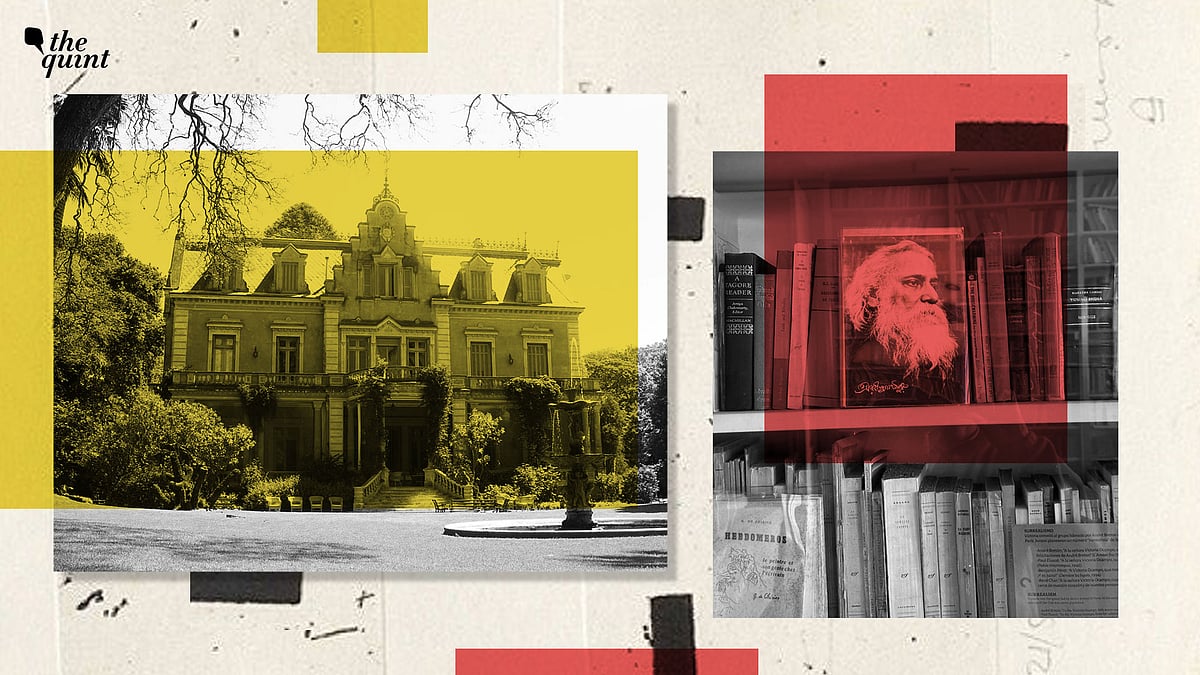
A House in Argentina Where Tagore Once Found Solace
Tagore stayed in Villa Ocampo for almost two months, rested, worked on his poems, and received visitors.
advertisement
This summer, as we headed to Argentina, football wasn’t much on our minds. It was still the early phase of the FIFA World Cup, and being vacationers, we were more excited about our first trip to South America. But in the airport where we changed flights, for football fans going in the opposite direction, the “Vamos Argentina” buzz was very real.
In fact, after we landed in Buenos Aires, our cab driver was puzzled that we’d come for a visit from the US during the World Cup. Such encounters can be deceptive, though. Once we got to El Centro, what we found was a vibrant, cosmopolitan, and sprawling city—a city where the lionisation of sports heroes like Lionel Messi, captured by billboards and cutouts in shop windows, told only one story.
An Unexpected Discovery
A chance encounter alerted me to Victoria Ocampo’s family villa, now owned by UNESCO. The name rang a bell, faintly. Wasn’t there a connection to Rabindranath Tagore? Yes, indeed, but as I learned, there was more to it.
Villa Ocampo was only 20 miles away in San Isidro, a city just north of Buenos Aires. Digging a little deeper, I realised this would be an ideal destination for a side trip.
The villa combines French, Italian, and English styles.
(Photo: Murali Kamma)
Here I should add that our son, a newly minted college graduate who is fluent in Spanish, made a difference. My Spanish is confined to hola, buenos días, muchas gracias, por favor, and si. Alarmingly, that didn’t stop people from speaking to me in Spanish. But it wasn’t because they were impressed by my paltry vocabulary, and it didn’t have anything to do with my appearance either.
The locals weren’t surprised to hear where I was from originally. Argentines use Spanish by default, just as Americans speak to strangers in English. It’s their country, after all.
Disembarking in San Isidro, we walked along a congested street lined with shops selling all kinds of merchandise. At a Havanna café, which seemed like their local Starbucks with a better menu, I ordered a cortado and an avocado toast topped with scrambled eggs. Fortified, we took an Uber for the short drive to Villa Ocampo, located at the end of a secluded and tree-lined street in an upscale area.
The river, in particular, must have brought him joy and comfort. While the surrounding area is not as rural as it was a century ago, it still feels like the perfect retreat for city dwellers seeking a reboot.
It was a Friday, luckily, for we hadn’t known the villa was closed Monday through Thursday. When I entered after buying our tickets, there was another déjà vu moment. By the front door, we saw photos of Indira Gandhi with Victoria Ocampo and an unidentified Indian aide. A guide informed us that, in 1968, despite a busy schedule in Buenos Aires, Prime Minister Gandhi had come to San Isidro to confer an honorary doctorate on Ocampo from the Tagore-founded Visva-Bharati University.
And this wasn’t her first visit. In 1934, a decade after Tagore’s stay at Villa Ocampo, Indira Gandhi herself had spent time there as a teenager.
By the front door, we saw photos of Indira Gandhi with Victoria Ocampo and an unidentified Indian aide.
(Photo: Murali Kamma)
Tagore's Two Months in Argentina
In 1924, on Tagore’s first trip to South America, when he was waylaid by illness, Ocampo—a poet who’d been moved by his poetry, especially the collection Gitanjali, during a challenging time in her life—offered the villa for his recuperation. It happened only because she was able to persuade her family and sell some jewellery for expenses.
As we wandered through the rooms on two levels (only the bedroom is out of bounds, though it can be viewed from the doorway), Ocampo’s legacy was hard to miss. We saw her vast book collection, the piano where Igor Stravinsky had played, and reprinted copies of Sur in the tiny giftshop. Founded and edited by Ocampo, Sur, named after her publishing house, was then Latin America’s most influential literary journal.
Many writers were drawn to it, including Jorge Luis Borges (a close friend), Aldous Huxley, Gabriela Mistral, Graham Greene, Pablo Neruda, and Albert Camus. They all spent time at Villa Ocampo, as did another French author, André Malraux, who encouraged her to donate the villa to UNESCO in 1973. Ocampo died in 1979.
Jawaharlal Nehru and the philosopher Jiddu Krishnamurti, whose pictures we saw in one room, also stayed at Villa Ocampo, and so did other luminaries like the architect Le Corbusier and the actress Greta Garbo. A photo of Tagore is prominently displayed in the library.
In 1924, on Tagore’s first trip to South America, Ocampo offered the villa for his recuperation.
(Photo: Murali Kamma)
A Film That Took Me Back
On our long flight to Buenos Aires, I noticed that at least a few passengers were watching Diego Maradona, Asif Kapadia’s acclaimed 2019 documentary about the late Argentine football star. However, after we returned home, it was another film that took me back to Argentina.
Although the movie isn’t entirely successful, and the contemporary story (Raima Sen has a role as well) set in Buenos Aires and Santiniketan seems stilted, the film is overall visually striking and worth watching if only for the Tagore-Ocampo saga. Their scenes, and Tagore’s poems, are touchingly rendered. Also aesthetically pleasing is the way the film toggles between black and white (past) and colour (present).
Did the director take creative licence in depicting the emotional bond between Tagore and Ocampo? Most likely, but it works in the film. The title comes from the telegram Ocampo dispatched to India after hearing of Tagore’s death in 1941.
So, how deep was the connection between Gurudev—as Ocampo called Tagore—and Victoria, whom he affectionately called Vijaya? As Tagore, who was three decades older than Ocampo, put it, while quoting from a poem, “this love between you and me is as simple as a song.”
(Murali Kamma is a managing editor and writer based in Atlanta, Georgia. This is an opinion piece and the views expressed are the author’s own. The Quint neither endorses nor is responsible for them.)
- Access to all paywalled content on site
- Ad-free experience across The Quint
- Early previews of our Special Projects
Published: undefined