
Iftar on the Ganga: How a Meal Turned into a ‘Non-Bailable’ Crime
Strangely, bail was denied despite no direct evidence or recovery of any chicken remains from the site.
advertisement
In the ancient city of Varanasi, where the Ganga flows as a symbol of eternal purity and spiritual absolution, the scales of justice appear to have been weighed down by the gravity of chicken biryani.
In what is rapidly becoming a barometer for the state of religious intolerance and judicial overreach, 14 men find themselves behind bars not for violence or theft, but for hosting an iftar party on a boat. The crime, as per the FIR, is the consumption of chicken biryani and the alleged discarding of its remnants into the river—an act that authorities claim was designed to "deliberately hurt religious sentiments.”
The incident, which occurred on 15 March, has since spiralled from a viral social media clip into a legal spectacle that exposes the frayed nerves of India’s secular fabric.
From Viral Video to FIR
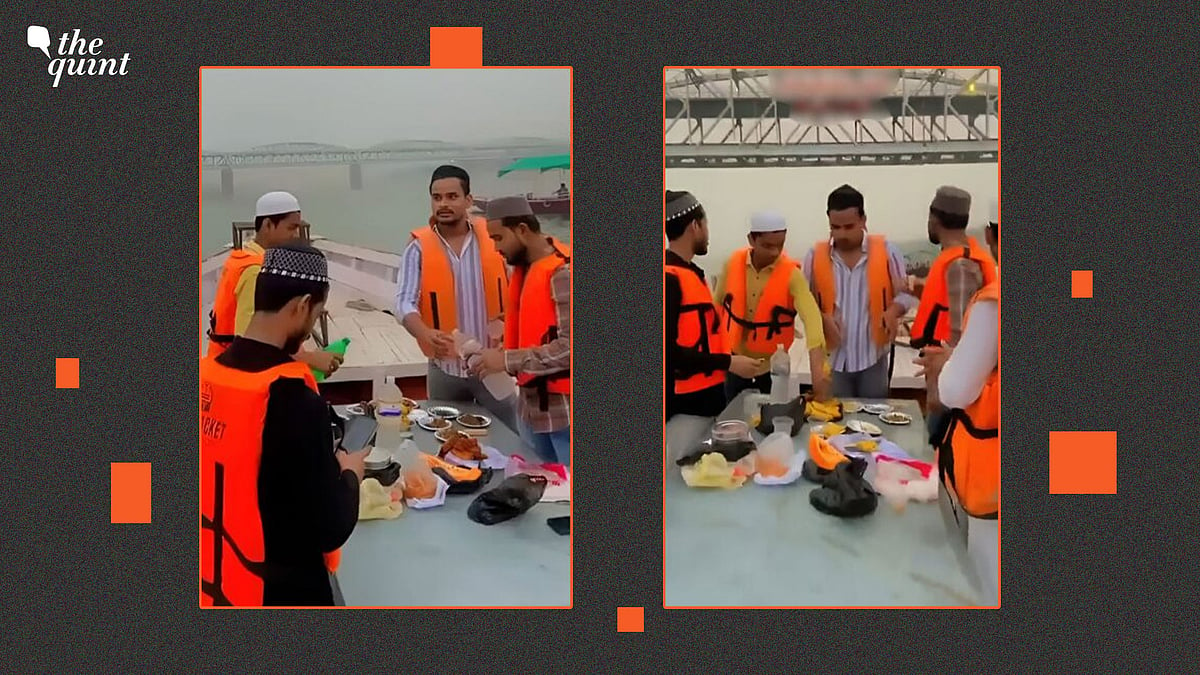
The sequence of events began with a video circulating on X, showing a group of men breaking their fast with an iftar meal aboard a boat on the Ganga.
The visuals, which showed the consumption of biryani, were enough to prompt Bharatiya Janata Yuva Morcha (BJYM) president Rajat Jaiswal to file a complaint, alleging that the men had desecrated the holy river by discarding chicken bones and leftovers into the water.
Based on this complaint—despite the original video lacking evidence of such disposal—the Varanasi Police swiftly arrested the 14 men on 17 March. They were booked under a slew of stringent charges, including Sections 298 (defiling a place of worship), 299 (malicious act to outrage religious feelings), and 279 (fouling water of a public reservoir) of the Bharatiya Nyaya Sanhita (BNS). Even the mosque management committee distanced itself from the act, criticising the men for turning a religious observance into a "picnic."
Yet, the state’s response transformed a question of etiquette into a question of criminality, with police later adding charges of forceful boat-taking (Section 308(5) BNS) to further bolster their case.
Even setting aside legal doctrine, the basic question of investigation remains: what exactly is being proved? There is no strong evidence to suggest that any food was thrown into the river. This raises a more fundamental question—can eating or breaking one’s fast on a boat constitute a criminal offence?
The Bail Rejection: Gravity Over Evidence
While rejecting the bail application of the 14 accused, the court placed significant emphasis on the nature and gravity of the offences alleged. The Assistant Prosecuting Officer argued that the accused face charges carrying a potential punishment of up to 10 years' imprisonment, categorising the crimes as "non-bailable" and "grave" under the BNS.
The court concurred with this assessment, noting that the allegations particularly under Sections 298 (defiling a place of worship) and 299 (malicious acts to outrage religious feelings)—strike at the heart of communal harmony and public order. The addition of Section 308(5) BNS (forcible taking of a boat) further reinforced the narrative that this was not a simple act of religious observance but a pattern of deliberate misconduct.
In addition to the above, the court also appeared to weigh the potential repercussions of granting bail against the backdrop of heightened religious sensitivities in Varanasi. Given that the alleged act involved the Ganga River—an entity of profound spiritual significance for a large segment of the population—the prosecution successfully argued that the release of the accused could exacerbate tensions and send a "wrong signal" to the community.
While it is strange that the bail application was rejected because there is no direct evidence or recovery of any ‘bone or chicken remains’ from the place of incident. The defence counsel argued that no mutton or chicken was recovered, and that the viral video did not capture any act of discarding remains or show the boatmen (mallah).
Despite this, the court appears to have given greater credence to the prosecution’s prima facie case. The complaint by the BJYM president, Rajat Jaiswal, coupled with the subsequent statement from the boat owners alleging forcible taking of the vessel (leading to the addition of Section 308(5) BNS), was deemed sufficient to sustain the charges.
It is important to point out here that the test for bail is based on conditions, and that the 14 accused had no prior criminal history. The magistrate’s decision suggests that the absence of a prior criminal record does not automatically entitle an accused to bail when the alleged offences are of a "serious and non-bailable nature," particularly where the allegations implicate actions intended to disrupt religious harmony.
The court effectively held that the nature of the act alleged, rather than the history of the actor, was the decisive factor.
When Symbolism Replaces Substance
Even as the initial furore over the video subsided, the judicial machinery has ensured that the 14 men remain ensnared in a legal quagmire that prioritises symbolism over substance.
As Senior Advocate Sanjay Hegde remarked, “The river belongs to the non-vegetarian as well," while another Senior Advocate Sanjoy Ghose wrote bitingly,
This incident lays bare a grotesque hypocrisy that has become the hallmark of modern political and legal discourse. Every single day, the Ganga—revered as a goddess yet treated as a municipal drain—absorbs millions of litres of untreated sewage, toxic industrial effluents, chemical waste from tanneries, and the silent, somber procession of countless human and animal carcasses that find their way into her waters.
The selective silence on these daily violations exposes the truth: the sanctity of the Ganga is not the concern; it is merely a convenient altar upon which to sacrifice the liberties of a few for political gain.
In essence, the iftar on the Ganga has become a metaphor for the state of "petty justice" in India today. The arrests, and now the denial of bail, reveal a system where the law is wielded not to protect rights or ensure factual accuracy, but to punish perceived slights against religious sentiment.
Let us hope that the High Court, operating with the sobriety and detachment that the trial court lacked, will restore the foundational principle of "bail, not jail." The higher judiciary now has an opportunity to remind the state that the Ganga is a river meant to unite, not a weapon meant to divide.
By conflating a meal with malice, and a boat ride with blasphemy, the courts have shuttered their eyes to the disproportionate nature of the state’s power.
If a community meal can invite such draconian punishment, it signals a chilling reality in the current legal landscape: the crime is not what you do, but who is perceived to be offended by it. The biryani has long since been digested, but the bitter taste of this judicial overreach will linger far longer than any bone thrown into the river.
(Areeb Uddin Ahmed is an advocate practising at the Allahabad High Court. He writes on various legal developments. This is an opinion piece and the views expressed above are the author’s own. The Quint neither endorses nor is responsible for them.)
- Access to all paywalled content on site
- Ad-free experience across The Quint
- Early previews of our Special Projects
Published: undefined