
Sajjan Kumar: Why 1984 Still Divides Congress and Tests its Equation with Sikhs
Punjab can move forward with the Congress. It can embrace Rahul Gandhi. But this doesn't mean it has forgotten 1984.
advertisement
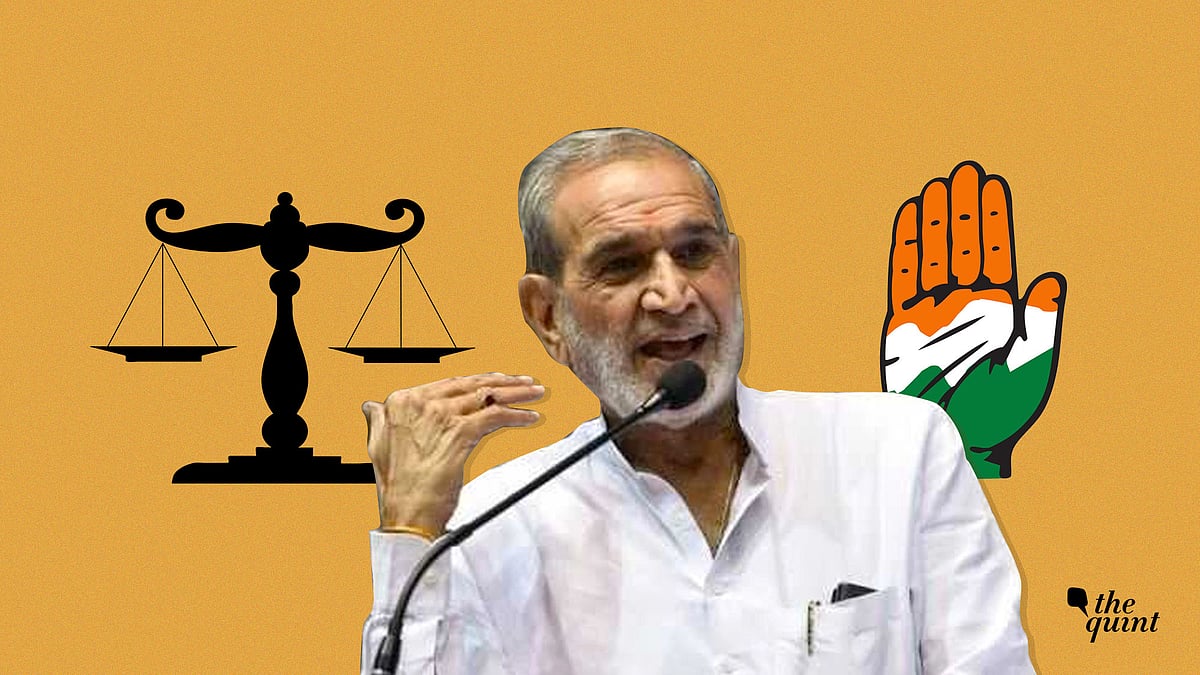
Sajjan Kumar’s death has once again brought focus on an issue that the Congress’ has never really been able to escape from: the events of 1984.
Sajjan Kumar was not just any former Congress politician. He died while serving a life sentence following his conviction by the Delhi High Court for his role in the 1984 anti-Sikh pogrom. The court’s judgment went beyond the individual case, describing the mass killings of Sikhs in Delhi and elsewhere as “crimes against humanity”.
The issue is no longer merely about Sajjan Kumar. It is about how the same man can inhabit two radically different memories. For some within the Congress, he was remembered as a former colleague or friend. For many Sikhs, however, his name is inseparable from the violence of 1984, the loss of loved ones and an agonisingly long wait for justice.
Need for Moral Clarity
Offering condolences to a bereaved family is an ordinary act of human decency. But condolences and glorification are not the same thing.
When words of admiration are publicly used for a man convicted by courts in cases related to the 1984 anti-Sikh pogrom, they acquire a meaning far beyond a conventional obituary. For survivors and victims’ families, they raise a deeply uncomfortable question: does political fraternity matter more than the memory of those who suffered?
That is why tributes to Sajjan Kumar by some Congress leaders have provoked anger among sections of the Sikh community. But an important distinction must also be made.
Are the actions of individual Congress leaders in 1984 and the moral responsibility of today’s Congress the same thing?
No. It would be historically inaccurate and morally unfair to hold every Congress leader in 2026 personally responsible for crimes committed more than four decades ago. Many of those leading the party today had no role whatsoever in the events of 1984.
But individual culpability and institutional responsibility are not the same thing.
This is precisely why the contrasting reactions within the Congress after Sajjan Kumar’s death deserve attention.
Congress Speaks in Two Voices
Why does the Congress appear to speak two different languages on Sajjan Kumar, one in Delhi and Haryana, and another in Punjab?
The contrast was visible in the reactions that followed Sajjan Kumar’s death. Congress MP Deepender Singh Hooda described Sajjan Kumar as a prominent political figure with an exemplary connection with people and called his death an “irreparable loss”. His remarks drew criticism, particularly in Punjab. Hooda later clarified that he had not called Kumar a “role model” and said that words had been put in his mouth.
Yet the controversy itself revealed how differently Kumar’s political legacy continues to be viewed within the Congress. In Punjab, Congress leaders quickly sought to distance themselves from the remarks. Punjab Congress president Amarinder Singh Raja Warring described Hooda’s comments as his personal view and stressed that the wounds of 1984 remained. Former Punjab Chief Minister Charanjit Singh Channi was even more categorical. He put out an old video in which he is demanding that Sajjan Kumar being hanged to death on the street.
That difference cannot be explained by political calculation alone. It is also rooted in Punjab’s memory.
A Question of History
For political circles in Delhi, 1984 may be an event that occurred more than four decades ago. For many families in Punjab, it remains a four-decade-old wound.
Dates recede into history. Governments change. Generations of politicians come and go. Collective memory does not move according to an electoral calendar.
It is in this context that Rahul Gandhi’s relationship with Punjab also becomes important.
There are many people in Punjab, including Sikhs, who view Rahul Gandhi favourably. A younger generation may judge him on his own politics rather than hold him personally responsible for events that occurred when he was a child. People may disagree over his politics, his party or his family’s legacy, but that is a separate debate.
Political acceptance of Rahul Gandhi does not amount to emotional amnesia about 1984. That distinction is crucial.
A Sikh can support Rahul Gandhi, vote for the Congress, even work for the Congress and still react very differently when a figure associated with the trauma of 1984 is publicly eulogised.
Because at that moment, the issue ceases to be merely partisan. It becomes a question of memory, dignity and justice.
This perhaps explains why, whenever someone convicted in connection with 1984 appears to be politically rehabilitated or glorified, whatever political distance may have narrowed between the Congress and sections of the Sikh community can suddenly widen again. History re-enters the room.
And this history is not merely a matter of political memory. It is also part of the judicial record and of a more than four-decade-long struggle for justice. In its 2018 judgment convicting Sajjan Kumar, the Delhi High Court described the 1984 violence in deeply critical terms and examined the role of political actors, law-enforcement agencies and the prolonged failure to prosecute those responsible. The judgment is also an important part of the historical record that today’s Congress cannot simply separate itself from.
It is not enough to argue that the Congress of today is not the Congress of 1984. That distinction must also be reflected in the party’s language, choices and moral boundaries.
Offering sympathy to the family of a deceased person is human. Turning that sympathy into an uncritical celebration of his political legacy is something entirely different. It is an insult to families who paid the price of the history attached to his name.
There is another uncomfortable question this episode raises: the language used to describe 1984. Much of the media coverage following Sajjan Kumar’s death again referred to the events as the “anti-Sikh riots”. The distinction is not merely semantic. “Riot” can suggest a spontaneous clash between two sides, while “pogrom” conveys targeted and organised violence against a particular community. The continued use of “riot”, even when the judiciary has described the violence in far more serious terms, raises a larger question about how one of India’s darkest episodes continues to be remembered and described.
This exposes the considerable distance that can exist between justice being delivered and justice being felt.
More than four decades later, the question is not whether 1984 belongs to the past. It is how the present chooses to remember it.
Perhaps that is the most important lesson to emerge from the controversy following Sajjan Kumar’s death.
Punjab can move forward with the Congress. It can embrace Rahul Gandhi. It can forge new political relationships. But none of this should be mistaken for Punjab having forgotten 1984. Some histories eventually become confined to textbooks. For the victims of the 1984 Delhi Sikh pogrom, that is not one of them.
(Damanjeet Kaur is a writer and Kanwal Singh is a writer and political analyst. This is an opinion piece and the views expressed are the author's. The Quint does not endorse or is responsible for them.)
- Access to all paywalled content on site
- Ad-free experience across The Quint
- Early previews of our Special Projects
Published: undefined