
More Than a Name: What Assam Risks by Erasing Fakhruddin Ali Ahmed’s Legacy
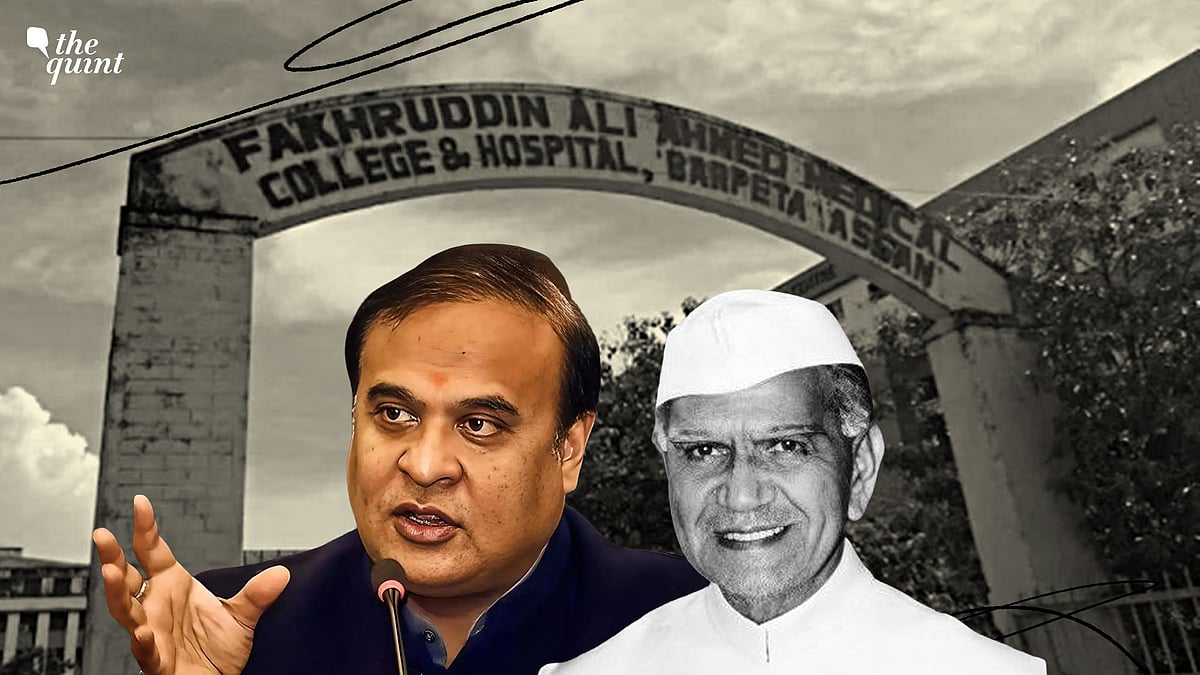
The Assam government last week decided to remove the former President’s name from a medical college in Barpeta.
advertisement
When governments change the names of public institutions, it often appears to be a minor administrative decision, a matter of signboards, official documents, and bureaucratic order. But names are rarely just labels. They carry memory, identity, and the stories a society chooses to honour.
That is why the Assam government’s decision to remove former President Fakhruddin Ali Ahmed’s name from a medical college in Barpeta raises a question that goes far beyond one institution: when governments alter the names of public spaces, is it merely administrative housekeeping, or a quiet reshaping of how history is remembered?
The Legacy of Fakhruddin Ali Ahmed
Fakhruddin Ali Ahmed was not an obscure political figure whose name happened to appear on a government building. He was a freedom fighter who went to prison during the Independence movement, a long-standing political figure from Assam, and eventually the fifth President of India—the first Assamese to occupy the highest constitutional office in the country.
The Assam government, however, has presented the decision as an administrative one. Chief Minister Himanta Biswa Sarma said the move was intended to bring “uniformity” to the naming of government medical colleges.
According to him, most state-run medical colleges in Assam—in places such as Guwahati, Silchar, Tezpur, Dhubri, and Dibrugarh—are named after their locations rather than individuals. The Barpeta institution, he said, had become an exception to this pattern, and its name sometimes led people to assume that it might be a private medical college.
The Cabinet, therefore, decided to rename it after the town where it is located, while promising that another institution would be named after Fakhruddin Ali Ahmed in recognition of his stature.
Uniformity vs Historical Recognition
Yet, this explanation invites a few obvious questions. Across India, countless public institutions , universities, hospitals, roads, and cultural centres carry the names of individuals whose contributions shaped the nation’s history.
These names are not accidents; they reflect deliberate decisions about which lives and legacies a society chooses to recognise. If uniformity in naming were truly the guiding principle, many such institutions across the country would also have to abandon their historical associations.
The issue, therefore, is not simply whether the medical college in Barpeta follows the naming pattern of other institutions. The deeper question is whether administrative consistency should outweigh the symbolic recognition of a leader whose life formed part of Assam’s political and national story.
Why the Decision Has Sparked Concern
It is in this context that the reaction to the decision must be understood.
For many in Assam, Fakhruddin Ali Ahmed is not merely a historical figure but a symbol of Assamese political history itself, a leader from Barpeta who rose from provincial politics to become the President of India. The removal of his name from an institution in his home district has been viewed by some groups, particularly organisations representing indigenous Assamese Muslims, as a decision that carries meaning beyond administrative tidiness.
Their concern is not only about a name on a building, but about whether the contributions of certain figures in Assam’s shared history are gradually being pushed to the margins of public recognition.
In such a context, the removal of a name associated with a minority leader inevitably raises questions about selective historical recognition, even when the official explanation is framed in neutral language.
Renaming and the Politics of History
This controversy also fits into a wider national pattern. In recent years, the renaming of cities, districts, roads and public institutions has become an increasingly visible feature of public debate in India.
Governments have defended such decisions as administrative corrections, historical restoration or cultural assertion. Yet, these acts rarely remain purely bureaucratic.
Assam has seen this dynamic play out before. The recent renaming of Karimganj district as Sribhumi was also presented in the language of heritage and cultural meaning. Whether one agrees with such decisions or not, they illustrate an important point: naming is not a trivial state function. It is one of the ways governments narrate history in public.
Once this is recognised, the Barpeta decision can no longer be treated as a routine correction of administrative form. It becomes part of a broader pattern in which names are not simply inherited but actively organised, revised and invested with political meaning.
What Democracy Chooses to Remember
In a democracy like India, public institutions do more than deliver services; they also reflect the values of the constitutional community they serve. The Constitution speaks not only of rights and governance but also of fraternity, the idea that citizens, despite their differences of faith, language or background, share a common public life.
The names attached to universities, hospitals, or roads often serve as reminders of the diverse individuals who contributed to the nation’s history. When those names change, it is natural for citizens to ask whether the country’s public spaces continue to reflect that diversity or gradually narrow the range of histories they acknowledge.
This is what makes the Barpeta controversy larger than a dispute over one institution. It touches a deeper question about how democracies remember their past. Every society honours certain individuals in its public spaces as a way of acknowledging the journeys that shaped its present.
Perhaps the most important lesson from this controversy is that collective memory is never a trivial matter. The names attached to institutions are small but powerful reminders of the people who shaped a society’s journey.
Fakhruddin Ali Ahmed’s life, from a freedom fighter jailed during the independence movement to the first Assamese to become President of India, was part of that journey. Whether or not another institution eventually carries his name, the debate unfolding in Assam today reflects something larger: a public desire to ensure that historical recognition is not reduced to administrative convenience. When democracies decide how to remember their past, they also decide what kind of future they wish to build.
(Sahil Hussain Choudhury is a lawyer and Constitutional Law Researcher based in New Delhi. Sayed Salim Ahmed is an advocate at the Gauhati High Court. The views expressed above are the authors' own. The Quint neither endorses nor is responsible for the same.)
- Access to all paywalled content on site
- Ad-free experience across The Quint
- Early previews of our Special Projects
Published: undefined