
Remembering Che Guevara: The Great Fumbler Behind the Iconic Revolutionary Face
Che Guevara’s image as a revolutionary hero persists, partly because his actual record is less well-known.
advertisement
Ernesto “Che” Guevara—the face emblazoned on T-shirts, murals and dorm-room posters around the world—is usually presented as the quintessential revolutionary: fearless, romantic, and eternally young. Yet behind the iconic photograph lurks a man whose life often seemed to be an extended exercise in getting things spectacularly wrong.
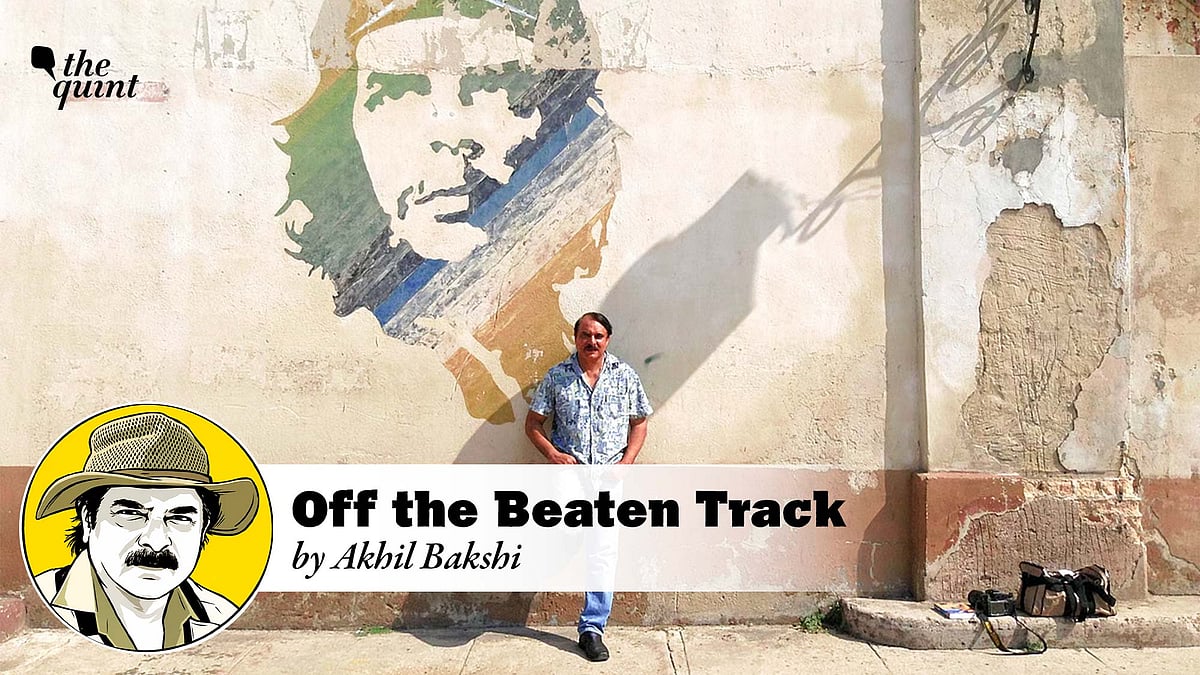
I’m embarrassed to admit that, until I reached Cuba, I knew next to nothing about Che. I had heard of The Motorcycle Diaries but had no idea he had written it. The face, of course, was familiar. I had been seeing it on T-shirts and graffiti since my teenage years in Europe; during the Pangea One World Expedition, it seemed to be plastered on every other wall in Latin America. Somehow, the man behind the face had never caught my interest.
Havana changed that. At the bookshop in the Hotel Nacional, I bought two of his books—The Motorcycle Diaries and The Latin American Diaries. At the book market in Plaza de Armas, I found a second-hand copy of his Bolivian Diary. In Trinidad, on Cuba’s southern Caribbean coast, I acquired a biography written by none other than Fidel Castro. It was quite a reading list for a man I had barely bothered to meet, even at a distance.
I read in room 735, looking out over the vast blue expanse of the Straits of Florida and the Atlantic. Seated in a rocking chair, I devoured page after page of Che’s writing, accompanied by a bottle of dark Havana Club rum presented by the hotel’s general manager. Between the sea, the rum, and the revolutionary’s prose, I was in danger of becoming a convert.
Fortunately, Che’s own record soon came to my rescue.
The Medical Mishaps
Before Che decided to play the part of the revolutionary, he was a medical student. His dedication to medicine was admirable but often overshadowed by his stunning lack of bedside manner.
Imagine going to a doctor who, instead of comforting you about your flu, starts lecturing you about the oppressive nature of capitalist healthcare. Patients probably left Che’s consultation rooms more perplexed and agitated than when they walked in.
His stint as a doctor in Guatemala was no better. Guevara was so engrossed in political activism that his medical duties took a backseat. To call him the Doctor Dolittle of medicine would be generous: Dr Do-Little-Else-But-Politics might be more accurate.
The Motorcycle Diaries: Two Wheels, Little Stability
Che’s early travels offer a preview of the man to come. He set off across South America on a second-hand motorcycle with his friend Alberto Granado, hoping to discover a continent and, in the process, himself.
The machine, however, had other ideas. It broke down, threw them about and repeatedly threatened to turn the grand adventure into roadside theatre. New to driving, Che was forever falling off; by his own account, on one particularly memorable day he managed nine spills. On the fourth day, he abandoned the motorbike and hitchhiked through the rest of the continent.
There were other mishaps. On one occasion, he shot his host’s pet dog, apparently mistaking it for a puma. The episode neatly captures a recurring feature of his life: enormous enthusiasm, questionable judgement and consequences that other people had to live with.
Che's Crash Course in Guerrilla Warfare
Che's revolutionary career began with his involvement in the Cuban Revolution alongside Fidel Castro. While history books often gloss over the details, Che’s contributions were a mixed bag. His knowledge of guerrilla warfare was mostly theoretical, gleaned from books rather than actual experience.
During the initial landings in Cuba, Guevara’s group almost didn’t make it past the first few days. They were ambushed, scattered, and had to regroup under less-than-ideal conditions. Che himself was injured and nearly captured, a far cry from the seamless heroics often depicted.
After the revolution succeeded, Guevara was placed in charge of the Cuban economy. Che, a self-proclaimed Marxist economist with no formal training, approached the task with the enthusiasm of a toddler handling a chainsaw.
His economic policies were a comedy of errors. He attempted to rapidly industrialise Cuba using Soviet-style central planning, but without the necessary resources or infrastructure. The result? A disastrous drop in production and living standards. He even tried to eliminate money and implement a barter system. That went about as well as you would expect: people were confused, transactions stalled, and the black market flourished.
Che’s crowning economic achievement was the “Great Sugar Harvest” of 1965. He promised a ten-million-ton sugar crop, a target that was as unrealistic as it was ambitious. Workers were diverted from other industries, infrastructure was stretched to breaking point, and in the end, the target was missed by a wide margin. The economy was left in shambles, and Che was quietly removed from his economic post.
The Congo Catastrophe
Undeterred by his Cuban misadventures, Che set his sights on Africa, deciding that the Congo was ripe for revolution. His foray into the Congo was a perfect storm of cultural misunderstanding, lack of preparation, and logistical nightmares. Che arrived with a small band of Cuban fighters, none of whom spoke the local languages or understood the culture.
He tried to train the Congolese rebels, but his methods didn’t translate well. The local fighters were unimpressed by Che’s speeches on Marxist theory and even less so by his insistence on strict discipline. They were more concerned with immediate survival than ideological purity. Che’s attempts to impose his will on the situation were met with frustration and apathy.
Eventually, malaria and dysentery forced Che to abandon the mission. His departure from the Congo was so hasty and chaotic that he left behind a treasure trove of equipment and documents, a gift to his enemies that was as generous as it was unintended.
Bolivia: The Final Blunder
Che’s last adventure took him to Bolivia, where he sought to ignite a continent-wide revolution. His strategy? Enter a country with little support, no knowledge of the terrain, and a minuscule band of followers. What could possibly go wrong?
Che’s ragtag group of guerrilla was constantly on the run, hampered by a lack of supplies and support. His asthma flared up, a debilitating condition for someone trying to lead a revolution in mountainous terrain. The final blow came when his location was betrayed, leading to his capture by the Bolivian army. In a tragicomic end, the great revolutionary was executed in a small village schoolhouse, far from the epic battles he had envisioned. Acutely asthmatic, his last wish was to smoke a cigarette.
The Myth vs The Man
Despite these monumental failures, Che Guevara’s legacy has been burnished to a high sheen. His image as a revolutionary hero persists, partly because his actual record is less well-known. The fumbling doctor, the inept economist, the misguided guerrilla—these are the aspects of Che Guevara that history tends to overlook in favour of the iconic, romanticised version.
Reading his diaries in that Havana hotel room, with the Atlantic glittering outside and the rum disappearing inside, I found myself admiring the man while quietly questioning his competence.
Perhaps that is the most honest way to remember Che: not as the flawless hero of the posters, nor as a mere collection of blunders, but as a passionate and deeply fallible man who kept charging into battles that were not always his to fight—and rarely went quite as he expected.
((The author is a Fellow of the Royal Geographical Society and Explorers Club USA, and Editor of ‘Indian Mountaineer’. He is also the founder of Bharatiya Yuva Shakti, an organisation that ensures good leadership at the village level. He tweets @AkhilBakshi1. This is an opinion piece and the views expressed above are the author’s own. The Quint neither endorses nor is responsible for the same.)
- Access to all paywalled content on site
- Ad-free experience across The Quint
- Early previews of our Special Projects
Published: undefined