
Beyond Presser Row, Modi's Scandinavia Visit Brought Focus on Democratic Decline
Norway and Sweden honouring Modi isn't just diplomatic engagement. It is a form of democratic prestige laundering.
advertisement
When Prime Minister Narendra Modi arrived in Sweden and Norway as part of a strategic multi-nation European tour in May 2026, the choreography was unmistakable. It was not merely diplomacy. It was admiration staged as diplomacy.
In Gothenburg, Sweden’s government confirmed that Modi was presented with the Royal Order of the Polar Star by HRH The Crown Princess. He was also given a symbolic gift: reproductions of handwritten cards by Rabindranath Tagore, the Indian poet, Nobel laureate and critic of aggressive nationalism.
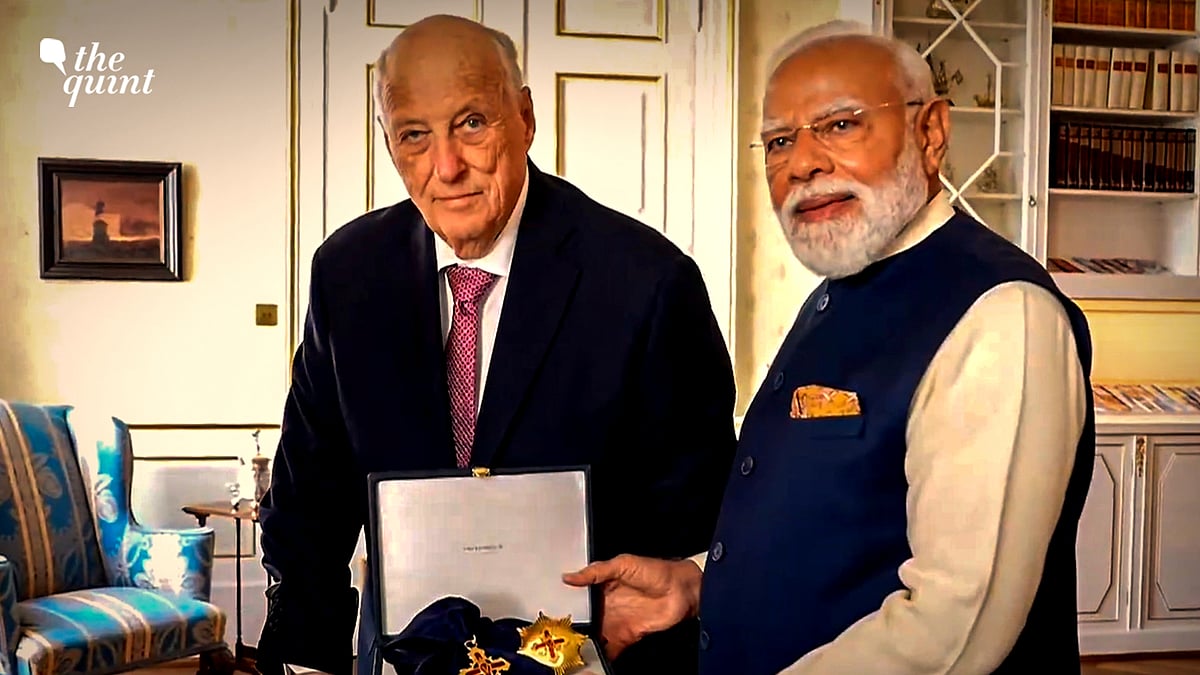
A day later, in Oslo, India’s Prime Minister’s Office announced that King Harald V had conferred upon Modi the Grand Cross of the Royal Norwegian Order of Merit, describing it as Norway’s highest honour bestowed on foreign heads of government.
These were not routine gestures of protocol. They were symbols. And symbols matter.
As Modi left a joint press appearance with Norwegian Prime Minister Jonas Gahr Støre, Helle Lyng Svendsen, a journalist with the Oslo-based newspaper Dagsavisen, asked why he would not take questions from “the freest press in the world”. The question went unanswered.
Later, at a Ministry of External Affairs briefing, Lyng and other journalists pressed Indian officials on trust, human rights, and press freedom. MEA Secretary (West) Sibi George defended India’s democratic framework and criticised what he called selective assessments by NGOs.
Yet, the exchange exposed precisely the tension at the heart of the visit: Sweden and Norway were honouring Modi in the language of democratic partnership, while the most basic democratic ritual, an unscripted question to power, remained unanswered.
The debate was further complicated when Aftenposten, Norway’s leading daily, published a commentary illustrated by Marvin Halleraker in which Modi was depicted as a snake charmer, seated on a rug, with a fuel hose replacing the cobra. The image was defended in Norway as part of a tradition of sharp press caricature, but it was widely criticised in India and beyond as an orientalist and racially charged stereotype.
Engagement or Prestige Laundering?
The problem is not that Sweden and Norway engaged with India. They must. They are not morally innocent actors floating above power politics. They are small states with commercial, strategic and security interests, navigating an unstable world in which old US-centred certainties no longer carry the same force. Europe is searching for new partners, markets and geopolitical footholds. In that context, closer engagement with India is unsurprising. India is too large, too consequential and too central to climate politics, technology, trade, security and development to be ignored. No serious foreign policy can proceed by moral distance alone.
But engagement is one thing, ceremonial glorification is another. What Sweden and Norway offered Modi was not only diplomatic hospitality. They offered him the symbolic capital of liberal democracy. The issue is that this strategic accommodation was wrapped in the language and ceremony of shared democratic virtue.
This is where the discomfort begins.
Norway holds the top position in the 2026 World Press Freedom Index, and Sweden remains among the world’s leading liberal democracies. These countries do not merely practise diplomacy, they export a moral vocabulary. Their soft power depends on the idea that they stand for democratic norms beyond narrow interest.
That is precisely why their reception of Modi carries significance beyond bilateral relations.
The phrase may sound severe, but it captures what is at stake. Prestige laundering occurs when a political leader facing criticism for democratic erosion at home is externally validated by institutions whose reputations rest on democratic legitimacy. The honour does not erase criticism. It does something subtler. It softens it. It gives supporters a photograph, a medal, a headline and a narrative: if the world’s most respected democracies honour him, how can he be authoritarian?
Concerns About India's Democratic Decline
This is not an abstract worry. India under Modi remains an electoral democracy, and elections continue to matter. But elections alone do not exhaust the meaning of democracy. Freedom House’s 2026 report on India notes that the Modi government and the Bharatiya Janata Party have presided over discriminatory policies and a rise in persecution affecting Muslims, while harassment of journalists, NGOs and government critics has increased significantly.
V-Dem, a leading democracy research institute based at the University of Gothenburg, goes further. Its 2026 Democracy Report classifies India as an electoral autocracy since 2017 and describes a slow but systematic dismantling of democratic institutions, including deterioration in freedom of expression, media independence, civil society and opposition space. Reporters Without Borders describes press freedom in India as being in crisis in “the world’s largest democracy,” citing violence against journalists, concentrated media ownership and increasingly overt political alignment among media outlets.
These are now part of the global democratic record on India.
And yet, in the Nordic reception, the language of shared values seemed to float above these realities.
Norway’s Prime Minister Jonas Gahr Støre described the visit as part of a growing partnership and stressed that the India-EFTA trade agreement would aim to mobilise $100 billion in investment into India over 15 years.
There is nothing surprising, or necessarily scandalous, about this. States pursue interests, and small states cannot afford moral distance from a world in disorder. Sweden and Norway need partners beyond their traditional Atlantic comfort zone. But if this was strategic realism, it should be recognised as such. The problem begins when realism is narrated as democratic affinity, and geopolitical necessity becomes moral endorsement.
Sweden’s invocation of Tagore makes the symbolism especially uneasy. Tagore has long functioned as a bridge between India and Sweden, not least because of his Nobel Prize and his place in global literary humanism. But Tagore’s legacy cannot be easily conscripted into state spectacle. He was deeply suspicious of aggressive nationalism and warned against reducing civilisation to collective pride and political power. To place Tagore’s memory beside the ceremonial elevation of Modi is, therefore, not merely elegant, it is historically strained.
State Honours Aren't an Innocent Exercise
The wider issue is not confined to Modi. It belongs to a broader Nordic politics of recognition, in which liberal institutions often assume that their own moral authority can stabilise the meaning of the people they honour. The controversy around María Corina Machado’s 2025 Nobel Peace Prize revealed this danger in another register.
The Norwegian Nobel Committee honoured her for promoting democratic rights in Venezuela and for her struggle toward a peaceful transition from dictatorship to democracy. Yet, the subsequent controversy over her political alignments, including her symbolic transfer of the medal to Donald Trump, exposed how recognition can escape the moral frame intended by the awarding institution. Norwegian politicians themselves criticised the gesture as “absurd” and damaging to the credibility of the prize.
As I argued elsewhere, in relation to Machado, the question is not only who is recognised, but what kind of peace, democracy and legitimacy are produced through the act of recognition. Recognition is not passive. It does not simply reward virtue after the fact. It helps manufacture political meaning.
The same lesson applies to Modi’s Scandinavian reception.
For Modi’s admirers, these honours will be folded into a familiar narrative: India has arrived, the world respects Modi, Western critics have been silenced. This is precisely why Sweden and Norway should have been more careful. In contemporary majoritarian politics, international recognition can become domestic propaganda. A medal conferred in Europe can be converted into proof of moral vindication in India.
BJP uses international honours for Modi as domestic propaganda.
(BJP Goa Facebook page)
This matters because Modi’s international image has always depended on a double movement. At home, he is projected as the embodiment of civilisational resurgence, national pride and strong leadership. Abroad, he is presented as a reformer, moderniser, development visionary and reliable strategic partner. The two images reinforce each other. International honours help domesticate global criticism by suggesting that concerns over minority rights, media freedom and institutional erosion are exaggerated or irrelevant.
The point, therefore, is not that Nordic leaders should lecture India. Nor is it that they should refuse cooperation. India is not a pariah state, and treating it as one would be diplomatically foolish and analytically unserious. The point is more modest, and more demanding: liberal democracies must learn to distinguish engagement from endorsement.
They can sign agreements without staging adulation. They can pursue green technology, maritime cooperation, artificial intelligence, research collaboration and trade without pretending that all is well with Indian democracy. They can recognise India’s importance without transforming Modi into a symbol of shared democratic virtue. Diplomacy requires conversation. It does not require moral amnesia.
There is also a deeper Nordic question here. Not whether Sweden and Norway are uniquely hypocritical. They are not. Nor whether they can avoid dealing with powerful states whose democratic records are contested. They cannot. The question is what happens when countries that have cultivated reputations for democracy, rights and institutional trust convert those reputations into diplomatic instruments without acknowledging the political cost. Values do not disappear only when openly abandoned. They also weaken when retained as language but emptied out as practice.
The Polar Star may have been awarded in the name of friendship. But its light also revealed something else: the ease with which liberal democracies can confuse access with principle, ceremony with diplomacy and strategic interest with shared values.
India deserves engagement. Modi did not need sanctification.
(The author is Senior Lecturer and Researcher, Department of Cultural Sciences, Linnaeus University, Sweden; and affiliated researcher, University of Oslo, Norway. This is an opinion piece and the views expressed are the authors's own. The Quint does not endorse or is responsible for them.)
- Access to all paywalled content on site
- Ad-free experience across The Quint
- Early previews of our Special Projects
Published: undefined