
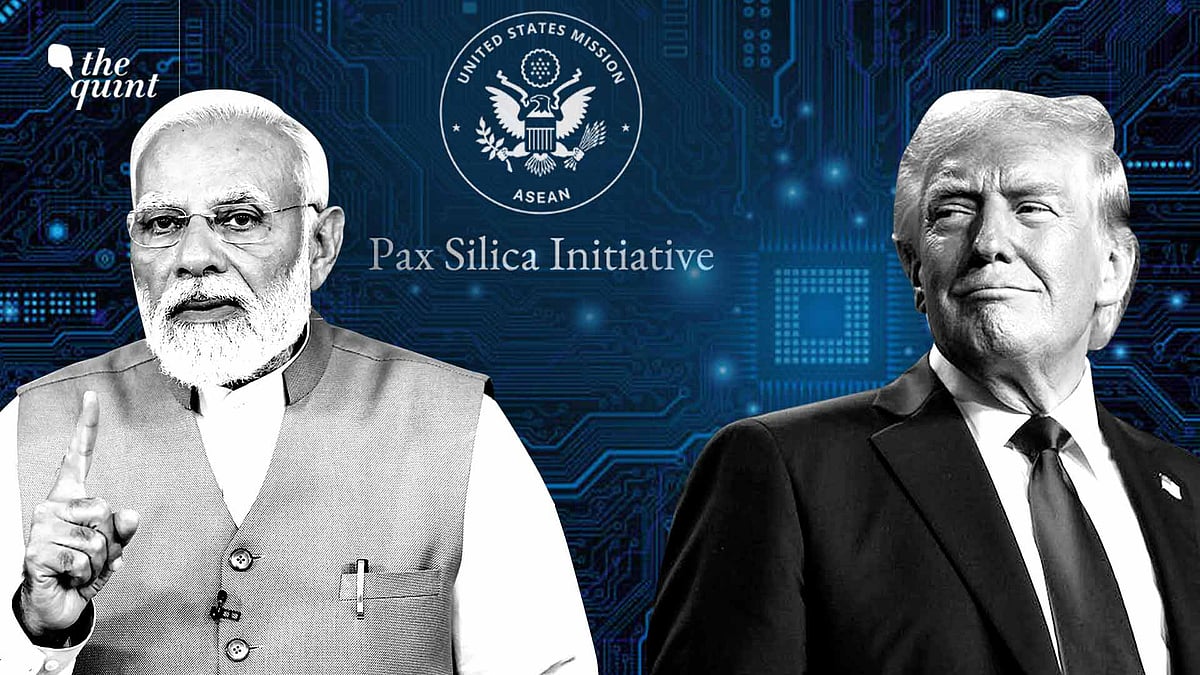
India’s Exclusion From Trump’s Pax Silica Is a Bad Omen for Its AI Dreams
A new game is on and India will have to, for the present, watch it from the sidelines, writes Vivek Katju.
advertisement
On 12 December, a group of nine countries met in Washington to issue a Pax Silica Declaration. The meeting was convened by the US government, the moving force behind the initiative. Apart from the host the participating countries were from the Indo-Pacific—Japan, Korea, Singapore and Australia; from West Asia—Israel and the United Arab Emirates (UAE); and, from Europe—Britain and The Netherlands.
In addition, three entities and a country were invited to make ‘guest contributions’. These were Taiwan, the European Union (EU), the Organisation for Economic Cooperation and Development (OECD), and Canada. The meeting was held at a senior officials’ level under the chairmanship of the US State Department’s Under Secretary for Economic Affairs, Jacob Helberg.
India was conspicuously left out.
The Pax Silica Declaration
A State Department fact sheet on the meeting mentioned “Pax Silica is a US-led strategic initiative to build a secure, prosperous, and innovation-driven silicon supply chain—from critical minerals and energy inputs to advanced manufacturing, semiconductors, AI infrastructure, and logistics”.
The Pax Silica Declaration noted, “We recognise that a reliable supply chain is indispensable to our mutual economic security. We also recognise that artificial intelligence (AI) represents a transformative force for our long-term prosperity and that trustworthy systems are essential to safeguarding our mutual security and prosperity”.
It went on to state, “We recognise that the technological revolution in AI is accelerating, increasingly reorganizing the world economy, and reshaping global supply chains. We believe that economic value and growth will flow through and across all levels of the global AI supply chain, driving historic opportunity and demand for energy, critical minerals, manufacturing, technological hardware, infrastructure, and new markets not yet invented”.
The security and foreign policy community and sections of the media in India have raised the question of the reason for its exclusion from the US initiative. The query acquires significance also because the White House announced the US National Security Strategy (NSS) for 2025 a few weeks ago. In that it noted inter alia “President (Donald) Trump’s May 2025 state visits to Persian Gulf countries demonstrated the power and appeal of American technology. There, the President won the Gulf States’ support for America’s superior AI technology, deepening our partnerships. America should similarly enlist our European and Asian allies and partners, including India, to cement our joint positions in the Western Hemisphere and with regard to critical minerals, in Africa”.
But Why Was India Left Out?
Is India’s exclusion from Pax Silica on account of the current difficulties between it and the US on trade and tariffs? Is it Trump’s pique at the Narendra Modi government for refusing to give him credit in bringing about a cessation of hostilities between India and Pakistan in May?
Or has India not been made part of Pax Silica, notwithstanding what the NSS document states, because this country simply does not have the scientific, technological and industrial heft to be part of such a grouping? This would be especially so in the area of AI development.
That Trump is unhappy with India is no secret. He is particularly miffed that India has not ‘recognised’ his contribution in bringing an end to the armed hostilities between India and Pakistan in May.
Significantly, he could have done away with the 25 percent tariff on India’s imports of Russian oil because reports indicate that these have almost been done away with. That he has not done so also shows his ire. It is also a near certainty that while India has attempted to go a long way in meeting Trump's demands in the trade deal, he wants major concessions in agriculture that will be perceived in India as hurting the interests of Indian farmers. Modi will find it difficult to undertake such a step.
The US’ recent decision to upgrade Pakistan’s F-16 aircraft also shows scant regard for Indian concerns and interests. Reports show that the US is going slow in renewing some categories of H1-B visas. The news came in the wake of Putin’s visit. Trump has also threatened to impose additional tariffs on Indian basmati rice exports to the US.
Taken together, these add up to measures that indicate the extent of negativity in India-US ties. But is the shadow of this negativity alone responsible for India’s exclusion from Pax Silica?
Truth May be a Harder Pill to Swallow
It would be difficult to attribute India being kept out of Pax Silica to only the present state of India-US ties. The Indian strategic and foreign policy community also needs to reflect on what India would bring to such a group in terms of the current situation of Indian industry in the AI sector.
India’s strengths lie in its manpower skills. It acts as the back office of major IT companies and others as well. It has also done a fine job in IT applications in the government as well as the financial sectors.
They are
Either making major financial investments in, or
Have companies that are world leaders either in making machines for designing and manufacturing the latest computer chips or
Are making the latest chips. Indian chip manufacturing is only now beginning and that too with the assistance of foreign companies.
The fact is that Indian companies are simply unwilling to put in the funds needed for R&D generally and specifically in IT and now in AI. That is the reason why India has no companies like those that were mentioned in the State Department’s ‘explanatory material’ on the “most critical companies and investors in the global AI supply chain” which are located within Pax Silica’s “participating countries.”
In this context it mentioned, as South Korea’s The Chosun reported “ South Korea’s Samsung and SK Hynix, Holland’s ASML, Japan’s Sony, Hitachi and Fujitsu and Australia’s mining giant Rio Tinto”.
In addition, it mentioned Google’s DeepMind, headquartered in Britain. In respect of investors, it named Singapore’s sovereign wealth fund Temasek and the UAE’s state-owned investment company, Mubadala.
In view of the facts mentioned above Trump would have had to go out of his way to get India to become part of Pax Silica at this stage. Obviously he has been unwilling to do this despite the clear anti-China motivation of forming the group.
On their part, the Chinese have expressed great unhappiness at the US initiative. The Global Times, which articulates the views of the Chinese government, noted in a report that China’s Foreign Ministry spokesperson said on Pax Silica, "All parties should adhere to the principles of a market economy and fair competition and work together to maintain the stability of the global supply chain.” Chinese analysts were more blunt. They felt “the moves, still scant on details and subject to a conflict of interests among its partners, are unlikely to achieve its stated goal”.
A new game is on and India will have to, for the present, watch it from the sidelines.
(The writer is a former Secretary [West], Ministry of External Affairs. He can be reached @VivekKatju. This is an opinion piece, and the views expressed above are the author’s own. The Quint neither endorses nor is responsible for the same.)
- Access to all paywalled content on site
- Ad-free experience across The Quint
- Early previews of our Special Projects
Published: undefined