
Passport Row Reveals Modi Govt's Own Doubt Over What Counts as Citizenship Proof
The technically correct legal status of a passport has never come up in any interaction over the years. So why now?
advertisement
The Union Home Ministry is curiously silent, even as a fierce debate rages nationwide on what constitutes the definitive document of proof of citizenship in India.
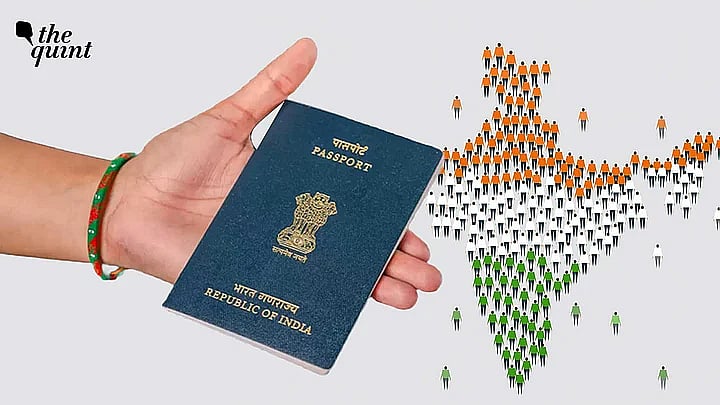
As the nodal ministry for framing and implementing India’s citizenship policy, surely the Home Ministry should step in to clarify the issue for millions of confused and anxious Indians after the Ministry of External Affairs (MEA) declared, almost in passing, on Passport Seva Divas that a Government of India-issued passport is merely a travel document, not a "standalone conclusive proof of citizenship’’.
That one sentence jeopardised the sanctity of the navy blue booklet issued by the MEA, presumably after thorough checks and verification of place of birth, residence and other parameters that supposedly define citizenship.
An estimated 10 percent of the population, which means around 140 million persons, are passport holders. Their world has been turned upside down overnight, negating decades of belief and trust that their passport was the ultimate citizenship document.
The Home Ministry’s studied silence on the ongoing controversy seems to stem from confusion within the government on designating one single document or a set of documents as definitive proof of citizenship.
The Proof isn't in the Passport
Consider the contradictory messaging emanating from different arms of the government. On 24 June, an MEA official declared that passports are issued to facilitate international travel. They are not citizenship documents even though they do have a column for nationality.
As a storm erupted, an official of the Election Commission stepped in with the intention of clarifying, but ended up stirring the pot. The official told PTI that a passport remains one of the 12 supporting documents that voters can use for inclusion in the electoral rolls.
It would seem that the left arm of the government doesn’t know what the right arm is doing.
The real giveaway of the prevailing uncertainty in the government came in the form of a press release from the Press Information Bureau (PIB). It was issued in December 2019 but since there has been no update, it is presumed that this continues to be the government’s official position.
The PIB stated, "Citizenship can be proved by submitting any documents related to date of birth and place of birth. However, a decision is yet to be taken on such acceptable documents.’’
Why The Government Has No Clear Answer
Clearly, the government itself is in a quandary after it burnt its fingers with the controversial compilation of the National Register of Citizens (NRC) in Assam in 2019. This was the first attempt to define and implement a legal framework for citizenship. It was a pilot project to be replicated across the country.
The Assam NRC was kept in abeyance and the Union government subsequently put out that PIB press release, admitting its own lack of clarity on the vexed issue of citizenship proof.
The confusion is understandable. As former foreign secretary Nirupama Rao explained in a post on X in response to the storm set off by her erstwhile ministry, "India’s systems of civil registration developed unevenly over many decades. Millions of Indians were born when birth registration was incomplete. Names were recorded differently across school certificates, land records and electoral rolls. The painful experience of the Assam NRC showed how documentary inconsistencies can create profound hardship when citizenship itself becomes the subject of legal scrutiny.’’
It is worth noting that registration of birth became compulsory only after 1970. Consequently, millions of Indians born before that do not have birth certificates. This was one of the major roadblocks that the Assam NRC ran into while trying to separate genuine Indian citizens from illegal migrants.
The Next Citizenship Test
The Citizenship Act 1955 states that all those born in India after 1950 are regarded as citizens. All of us, regardless of caste, creed, and ethnicity, whose forefathers have lived in this land for generations, have grown up presuming that we are Indian citizens.
We never thought the day would come when we would have to prove it to some official who comes knocking at our door to issue a voter ID, a passport and myriad other documents that have now become mandatory, even to cremate our loved ones.
What is really perplexing is why the MEA chose to draw a fine distinction between a travel document and proof of citizenship. Passport Seva Divas was celebrated for the 14th time this year. The technically correct legal status of a passport has never figured in any interaction over the years. So why now?
Governance is a compact between the state and the people. It is built on trust. It would be unfortunate if 1.4 billion people find themselves living in a perpetual state of fear and anxiety because systemic deficiencies have deprived them of definitive proof of their citizenship.
(Arati R Jerath is a senior Delhi-based journalist. She tweets @AratiJ. This is an opinion piece and the views expressed are the author’s own. The Quint neither endorses nor is responsible for them.)
- Access to all paywalled content on site
- Ad-free experience across The Quint
- Early previews of our Special Projects
Published: undefined