
No FIR, No Case: How the National Herald Prosecution Collapsed in Court
A money laundering offence cannot exist in isolation; there has to be some crime. There also has to be an FIR.
advertisement
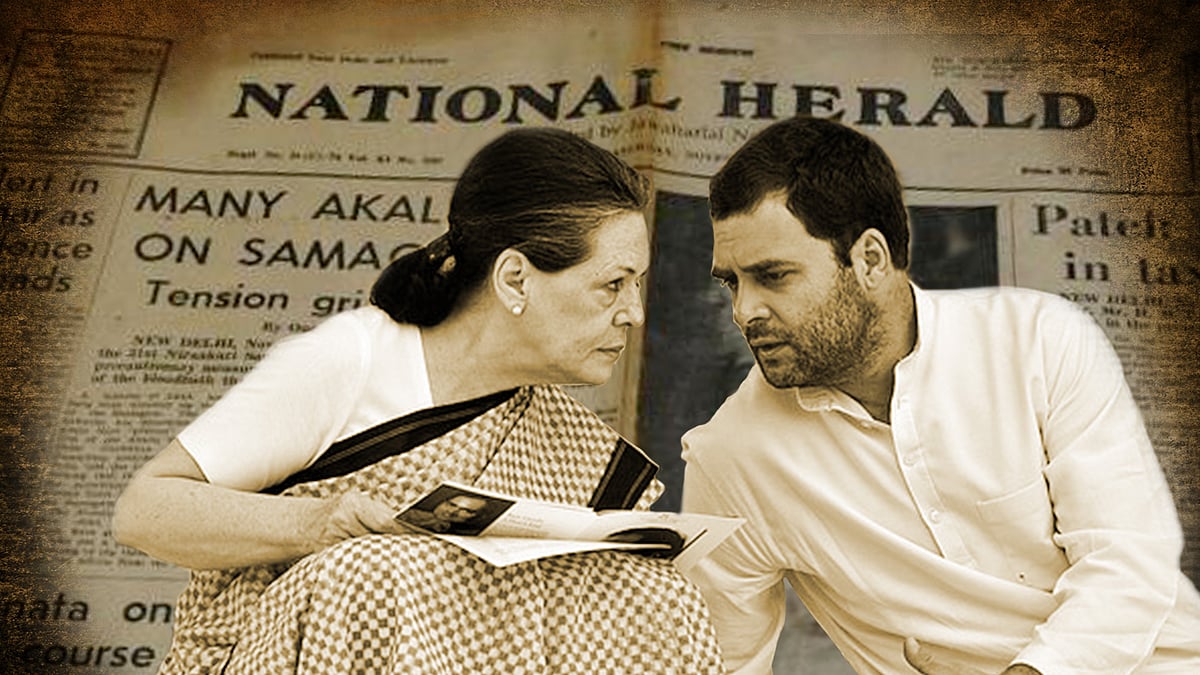
Earlier this week, a special court in Delhi refused to take cognisance of the Enforcement Directorate (ED)’s prosecution against Sonia Gandhi, Rahul Gandhi, and five others in the case now known as the National Herald Case. In this piece I will try to cut through the legalese and share what happened.
At the outset, I want to point out that this judgment was authored by Judge Vishal Gogne, who also framed charges of corruption, criminal conspiracy, and cheating against former Bihar Chief Minister Lalu Prasad Yadav.
The Law
Under the Indian Penal Code, which has now been repealed and become Bhartiya Nyaya Sanhita, if anyone goes to the police or any other investigating agency and shares information which disclosed the commission of an offence, the police will register a first information report (FIR).
The registration of an FIR grants powers to both the police investigating it, and the magistrate before whom the case is brought. If the police refuse an FIR, the complainant has two options:
He could go to the court under 156(3) of the Code of Criminal Procedure (CrPc)—now repealed and become Bharatiya Nagarik Suraksha Sanhita—and seek directions from the court to the police to register an FIR.
If 156(3) fails, the complainant can try the Section 200 CrPc route, which is the most limited of all. Under this route, the complainant has to convince the court based on the evidence he himself has; the powers of the magistrate and the police are limited.
The Case
Hang on to your seats. What is the crux of Swamy’s allegations against the accused? Associated Journals Limited (AJL) was an unlisted public company (public not to be confused with government) started by Jawaharlal Nehru and many other freedom fighters.
Swamy alleges that when AJL fell on hard times, the Congress loaned it about Rs 90 crore. The accused, including Sonia Gandhi and Rahul Gandhi, started another company called Young India, and purchased the debt of Rs 90 crore for 50 lakh only, and (I’m sparing you the legalese) became 99 percent shareholders of AJL.
According to Swamy, AJL has real estate properties worth Rs 2,000 crore, and this was a clever evil scheme by the accused to grab all this prime real estate for a paltry sum of Rs 50 lakh.
The obvious question here is: Did any of these allegedly defrauded people or their heirs ever go to any court? The sum is not small after all.
No.
No matter. Did Swamy, or later the ED, summon any of these defrauded people as witnesses before the court? Even one?
No. The judge makes note of this.
Did the accused, including the Gandhi family, become owners of all that real estate?
Erm. No. The Supreme Court clearly says that even in ordinary circumstances, becoming shareholders is not = becoming owner of its properties. But these weren’t ordinary circumstances. Young India was a not for profit company. The properties were leasehold from the government. Its shareholders could not have transferred title.
They could not have transferred collected rent to themselves. They weren’t allowed to take a penny. So the accused—Sam Pitroda, Suman Dubey, Sonia and Rahul Gandhi—categorically chose to incorporate a form of a company which could not benefit them. The could have started an ordinary private limited company. They did not.
The Rs 2,000 Crore Claim That Didn’t Hold Up
Oh. And about that Rs 2,000 crore figure? Here, read it in the court’s words: “Upon query from the court , the ld. ASG preferred the valuation of the immovable properties of the AJL at Rs 755 crore over the larger figure of Rs 2,000 crore mentioned in the earlier portion of the complaint.”
Oops.
Moving on. There’s another aspect of the law you need to know. Money laundering law requires what is called a predicate offence. This means that you must have committed some offence—say robbery, murder etc—and attempted to launder the proceeds of that offence.
The court examined the case diaries of the ED in this case. For seven years, countless officers of the ED kept noting that without an FIR, the ED cannot investigate anything, and an FIR does not exist. It said this in this case, and in other cases. What happened after seven years?
In 2021, in the private complaint U/S 200 filed by Swamy, the magistrate issued a summoning order to the accused. In a S 200 complaint, a summoning order says—this chap has come to us with these allegations against you, tell us what you have to say. The ED treated this summoning order of a magistrate as an FIR and jumped into the fray. Meanwhile, as noted by the court, in the ED’s case diaries, countless officers across hierarchy kept noting that summoning order by magistrate cannot be = an FIR.
It gets worse.
No Predicate Offence, No FIR
The CBI
Here’s another observation from the court: “219. In fact, as early as on 28.07.2014, the ED dispatched a letter to the CBI intimating that on perusal of the complaint (dated 04.07.2014) of Dr Subramanian Swamy, it appeared that no predicate offence for initiating investigation under the PMLA appeared to have been made out as there was no mention of any FIR in the complaint. The ED also forwarded a copy of the complaint from Dr Swamy to the CBI for appropriate action. The ED thus remained contended with directing a discreet enquiry and sharing information with other agencies...The court has highlighted the above observations from the case diaries to record that the ED was itself unconvinced of a prosecution under the PMLA being maintainable in the absence of a FIR in the predicate offence.”
So. The ED wrote to the Central Bureau of Investigation (CBI) saying, there’s nothing for us here, you see what you want to do. From 28 July 2014 till this date, has the CBI filed an FIR?
No.
No FIR for seven years. During the Narendra Modi government. With Amit Shah as Union Home Minister to whom all investigative agencies report to. What does that tell you?
So how did this case start. The ED treated that summoning order by the magistrate as an FIR. The court has now ruled—sorry, that was not an FIR, you have no business investigating anything here, and you have been internally admitting as much for almost a decade, the CBI has been quiet, what are you even talking about? Or, in much harsher words from the court:
“Upon first having shared information with the CBI in the year 2014 and then having waited for seven years for the CBI to act, the ED simply inverted the template of money laundering being consequential to the predicate offence by recording its own ECIR on 30.06.2021. This act was not a mere expression of the independent nature of the ED as an agency to probe proceeds of crime. It rather reflected a unilateral over reach of the other law enforcement agency viz. the CBI on one hand and an ill advised out pacing of the scheme of the PMLA itself. The PMLA perceives the scheduled offence to be recorded and commenced for investigation as the first step and the probe into money laundering as the second step. Perhaps, the ED should have stayed as staid as the CBI.”
“Unilateral overreach”, “ill-advised” even I want to say—ouch!
In 2025, the Economic Offences Wing has filed a fresh FIR for the same facts. In court, the judge categorically asked the ED’s lawyer: Are you going to say that this new FIR should now be treated as an FIR on which the ED’s actions were based?
The ED’s lawyer said…. No. I imagine with a very red face.
In the age of Modi, when people in far more senior positions fall over themselves to please the government, countless officers in two agencies reporting to Amit Shah, decided that there was absolutely no case. You can’t blame them. For an economic offence, someone has to benefit. The accused in this case, including Sonia and Rahul Gandhi, did not get a penny.
Why This Judgment Matters Beyond the Gandhi Family
This saga reminded me of the observations of another judge, in another “scam”. Judge OP Saini, writing the judgment in the infamous 2G scam, had observed:
“For the last about seven years, on all working days, summer vacation included, I religiously sat in the open court from 10 AM to 5 PM, awaiting for someone with some legally admissible evidence in his possession, but all in vain. Not a single soul turned up. This indicates that everybody was going by public perception created by rumour, gossip and speculation. However, public perception has no place in judicial proceedings.”
Someone, somewhere understood that it was crucial to malign the Gandhi family beyond repair for any other political party to come to power. The Modi government has been in power 11 years now, and we haven’t seen a single charge stick to the Gandhi family yet.
Earlier this year, I was standing outside Prithvi Theatre. A bunch of young people, possibly in their early 20s, were excitedly talking, when one remarked, "Do you know... Sonia Gandhi is the richest person in the world?"
She’s not. She is not the richest person in India, or North India, or Delhi. She may not be the richest even on the street she lives on.
(The author is a lawyer and research consultant based in Mumbai. This is an opinion piece, and the views expressed are the author’s own. The Quint neither endorses nor is responsible for them.)
- Access to all paywalled content on site
- Ad-free experience across The Quint
- Early previews of our Special Projects
Published: undefined