
Middle East Balancers: Why Modi’s Visit to Jordan, Oman is Beyond Bilateralism
Modi's visits to Jordan & Oman give cause for cheer at the end of a particularly trying year for India's economy.
advertisement
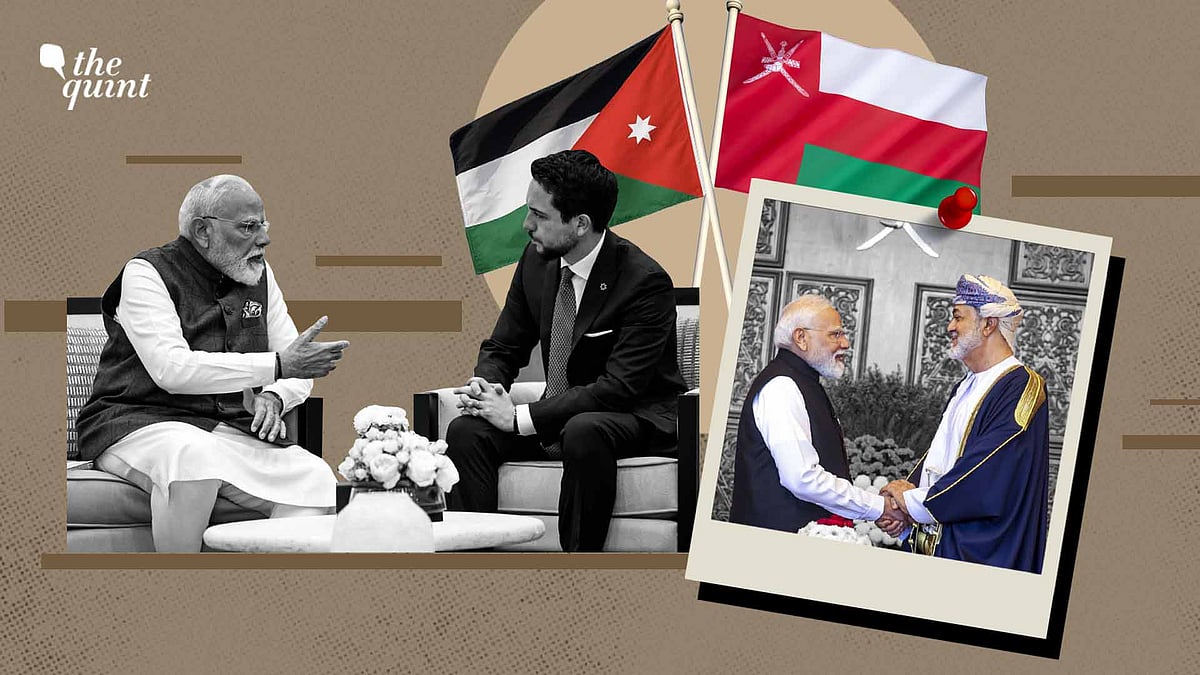
Prime Minister Narendra Modi has just concluded an extremely successful visit to two Middle Eastern countries, Jordan and Oman, where symbolism matched substance. Both Jordan and Oman, while usually keeping a low profile are important countries in the region, where increasingly they are playing an important role as bridge builders and stabilising forces in the volatile politics of the region.
With zero appetite and tolerance for terrorism or religious radicalism, both countries had reached out to India after the Pahalgam massacre.
Jordan, An Important Trade Channel
The Hashemite Kingdom of Jordan, whose ruling family traces their lineage back to Islam's prophet Muhammad includes, at a conservative estimate, about half of its population consisting of Palestinian descent. At the same time, it is a moderate Muslim country, which recently banned the Muslim Brotherhood—viewed as a radical, violent and pernicious entity. These two factors have underpinned its foreign policy.
It became the second Arab country to normalise relations with Israel and has been playing a mediating role between Israel and the Palestinians for long. This helps Jordan exert a moderating influence in the Muslim world.
Further, the kingdom's geopolitical location makes it an important node in the ambitious India-Middle East Economic Corridor, as King Abdullah mentioned in his address to the India-Jordan Business Council during the Prime Minister’s visit. This is significant given that the Israel-Hamas war had put the topic on the back burner since 2023—the very year it was mooted.
As per the more immediate impact, the PM's visit has infused fresh life into the economic relations between India and Jordan, which have increased quietly yet steadily and in a sustained manner. Bilateral trade has shown robust growth, with India now Jordan's fourth largest trading partner.
In the financial year 2023–24, the total India-Jordan trade reached US$2.875 billion, with India’s exports to Jordan amounting to US$1,465 billion, indicating a healthy trade balance. The two countries signed five MoUs during Modi's visit, encompassing a range of fields, including new and renewable energy, water resources management, and development, digital solutions, cultural exchanges and a twinning agreement between Jordan's archaeological wonder, Petra, and India's magnificent Ellora Caves.
Both India and Jordan have also pledged totake bilateral trade to $5 billion by 2030. The setting up of Indian manufacturing bases in Jordan were mooted which would give Indian manufacturing and businesses a great fillip.
Oman, An Old Ally
The PM's Oman visit was even more significant as it saw the signing of the Comprehensive Economic Partnership Agreement (CEPA) between the two countries, and the Sultan conferred on him the ‘Order of Oman’ award for his exceptional contribution to India-Oman ties and his visionary leadership.
According to a report prepared by the think tank Global Trade Research Initiative (GTRI) titled India-OMAN CEPA: Gateway to the Middle Eastern Markets and Beyond in 2023, CEPA will enable 83.5 percent of Indian goods worth $3.7 billion such as gasoline, iron, steel, electronics and machinery will get a significant boost in Oman, where they currently face a five percent import duty.
The agreement has now slashed to zero the tariffs on most Indian goods across sectors. Meanwhile, the biggest win was for food and agricultural products, which got 100 percent duty waivers.
This has unlocked unprecedented opportunities for India's exports, particularly in sectors like mineral as well those like gems and jewellery which had been hit hard by US President Donald Trump's imposition of 50 percent tariffs—the highest tariffs on any country—on many Indian goods, mostly labour-intensive ones. Similarly India, in turn, will cut tariffs on about 78 percent of its tariff lines, covering nearly 95 percent of imports from Oman by value.
The CEPA, thus, will not only offset some of the strains caused to indian exports by the US tariffs, but will further boost bilateral trade which had been growing dynamically over the last few years.
“This (pact) will set a new pace for our trade, add new trust to our investments and open doors to new opportunities in many sectors,” Modi said in his address at Oman.
Modi's Oman visit is continuing the momentum in bilateral ties achieved by the visit of Sultan Haitham bin Tarik to India in December 2023—the Sultan’s first visit to India and also the first by an Omani Sultan here in 26 years.
Both sides had then adopted the document “India-Oman Joint Vision: A Partnership for Future”, which set the direction for current and future bilateral engagement, based on Oman Vision 2040, a national development blueprint, and India’s vision of "Amrit Kaal" till 2047.
The CEPA is an outcome of that, becoming as it is the second economic pact that India signed in the last six months after its FTA with the UK, and the first bilateral agreement for Oman, since its 2006 deal with the United States.
Beyond Trade and Bilateralism
But Oman is important to India for a variety of other reasons too. Like Jordan, Oman has been a beacon of light, pluralism, and peace in the region. The country’s geographical location makes it a natural bridge between the Arab world and Iran.
Oman is isolated from much of the Arabian peninsula by a formidable mountain range, while Iran is just across the narrow Strait of Hormuz. Given the current crisis in the region, this is important.
Most importantly, Oman plays a crucial role in ensuring global energy and trade security, as one third of the world's oil and gas pass through the Straits of Hormuz.
The Indo-Oman bilateral ties go back centuries, with hundreds of Indian families domiciled there for more than a century with naturalised Omani citizenship. More than seven lakh Indians currently live and work in Oman.
The oldest Hindu temple in the region has been found in Oman, while the Indian Rupee was in currency there till the 1960s. The importance of India-Oman relations can be gauged from the fact that it was the first Gulf country India signed a strategic partnership with in 2008.
Both countries conduct joint tri-service military exercises regularly, Omani military personnel are trained in India, and since 2018 Oman has given India access to its Port Duqm for military and logistical use. This is significant given the current escalation in the region and for India's access to the Red Sea and for its energy security.
Modi's visits to both Jordan and Oman, therefore, give cause for cheer at the end of a year, which in many ways has been a trying year for India's economy.
(The author is an award-winning journalist specialising on Eurasian affairs. This is an opinion piece and the views expressed above are the author’s own. The Quint neither endorses nor is responsible for the same.)
- Access to all paywalled content on site
- Ad-free experience across The Quint
- Early previews of our Special Projects
Published: undefined