
India and Post-Brexit UK: PM May’s Visit to Decide the Road Ahead
India, UK must work together to make globalisation a “force for progress for people from Birmingham to Bangalore”.
advertisement
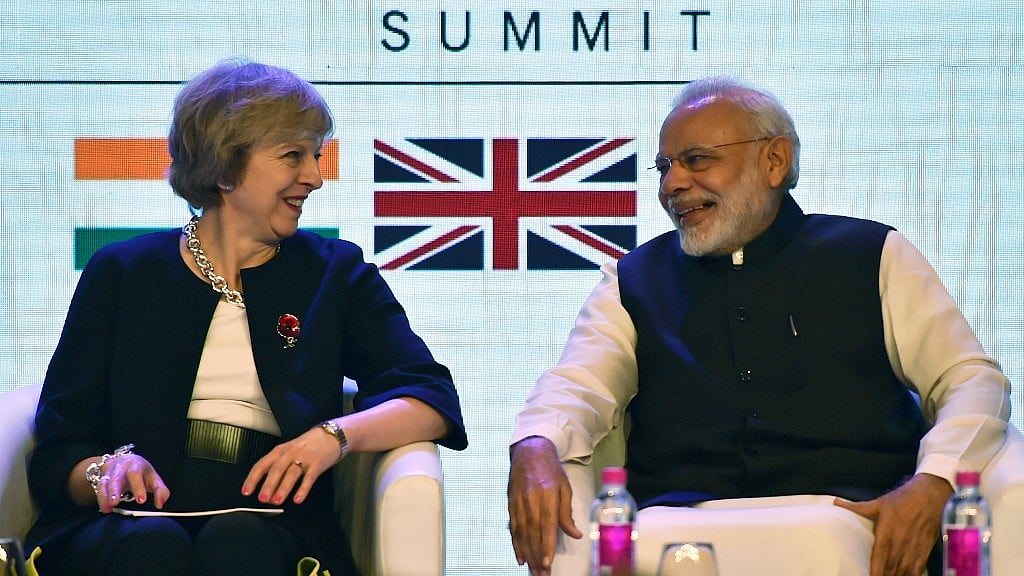
Prime Minister Theresa May’s ongoing three-day visit to India is expected to provide an insight into how Britain seeks to energise its relations with India post Brexit.
Expectations from the summit-level talks between Prime Minister Narendra Modi and Theresa May should be seen in the context of new realities defined by Britain’s shrinking economy. And also in the context of a rising India predicted to be the largest global economy in purchasing power parity terms by 2050, having finally embraced the argument of power.
For both countries, May’s visit is a moment to seize for forging a mutually reinforcing relationship rooted in a realistic appreciation of future challenges. The ties must also be anchored to a historic bond informed by the realities of the present.
Economic Potential
The full ramifications of Brexit on the potential of Indo-UK engagement cannot be predicted as yet. But the vote does not augur well for optimising the economic potential of the relationship.
The requisite legal regime overhaul in the UK would lead to uncertainty, thereby freezing future investments. Further scrutiny of students visas and work-related restrictions on students have resulted in a fall in the number of Indian students studying in British universities. The number has gone down from 22,385 in 2012-13 to 18,320 in 2014-15, according to the UK Council for International Affairs.
Future Investments
On the positive side, post-Brexit depreciation of the pound is expected to spur Indian investments in the UK. Besides, British businesses can explore increased possibilities for major investments in the Indian defence, security and nuclear energy sectors.
The depth of Indo-UK business relationship is reflected in the finalisation of deals totaling £9.2 billion between India and the UK in 2015. Besides, over 1,10,000 people are direct employed by Indian companies in the UK. And British companies invested an estimated £22 billion investment in India in 2015, generating 6,91,000 jobs.
While Britain is the third-largest investor in India, Indian investments in the UK currently exceed all its investments in the European Union.
Brexit is indeed a compelling circumstance for Britain to build upon its special relationship with India. And also to begin work on a mutually reinforcing preferential bilateral trade and investment agreement for the future.
Challenges For Both Economies
The Indo-British partnership must look beyond economic engagement.
The very survival of humanity faces unprecedented threats emanating from the challenges of climate change, terrorism, genocide, proliferation of weapons of mass destruction and pandemics.
The world is also grappling with dehumanising poverty, malnutrition and competition for natural resources. Besides, the blatant violation of human rights, extremism, the suborning of civilised political discourse, and the rise of fascist sentiments also challenge our way of life.
In fighting off these challenges and the assault on freedom, India and the UK must stand on the same side of history. They must work together to make globalisation a “force for hope and progress for people from Birmingham to Bangalore”.
India-UK Ties Cannot Be Held Hostage To The Past
Recognition by PM May of the need to revisit Britain’s relationship with India both from the prism of the past and consistent with present realities could ensure a mutually beneficial outcome of her first visit to India as Britain’s Prime Minister.
For starters, she could signal an expanded visa regime for academicians and Indian students wishing to pursue higher education in the UK. Besides, special economic engagement with India should also be considered. May could also signal requisite concessions to Indian manufacturers on the lines extended to the Japanese automobile companies so that Indian investments continue to remain viable despite Brexit.
The values enshrined in the Magna Carta and the world view espoused in India’s cultural heritage of Vasudhaiva Kutumbakam (the world is one family) must naturally inspire the India-UK joint enterprise as an exercise in “ bringing reason to the world.
(The writer is a former Union Minister for Law & Justice. You can follow him on Twitter @DrAshwani_Kumar. This is an opinion piece and the views expressed above are the author’s own. The Quint neither endorses nor is responsible for the same.)
- Access to all paywalled content on site
- Ad-free experience across The Quint
- Early previews of our Special Projects
Published: undefined