
US F-35 Takes its First Blow: How Iran’s Strategy Shattered the 'Stealth' Myth
It is now apparent that, contrary to the propagated myths, the F-35 is not invincible.
advertisement
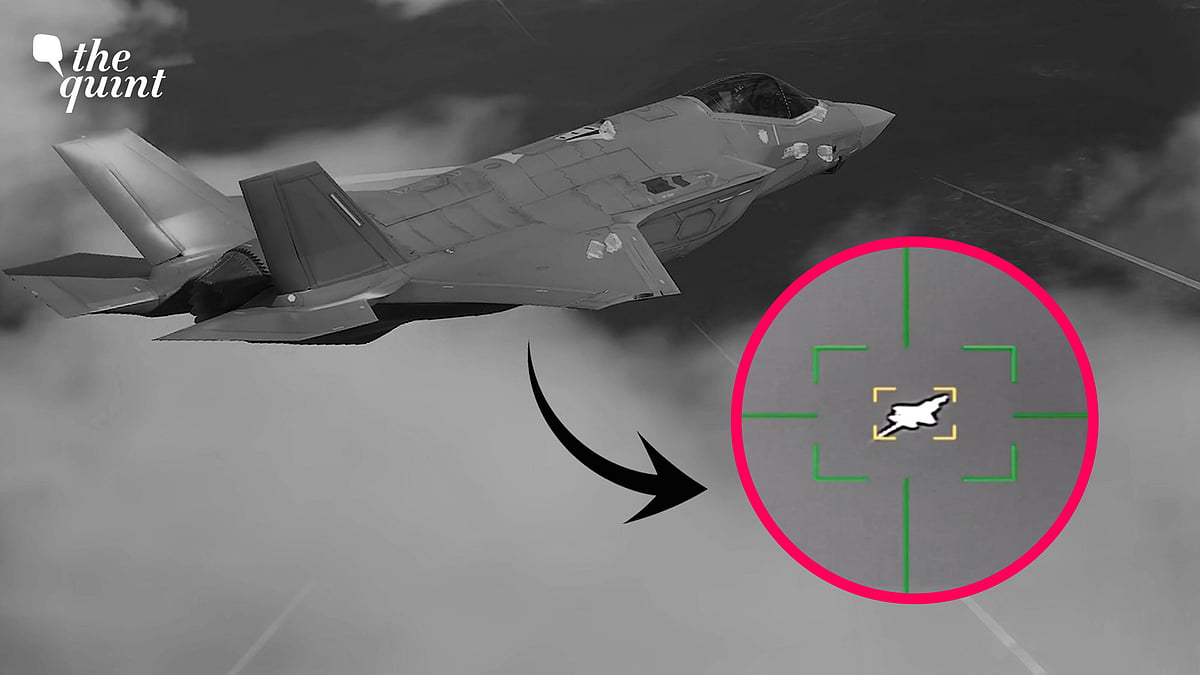
After Iran claimed that it had attacked and damaged an F-35 fighter aircraft of the US Air Force, Capt Tim Hawkins, spokesperson for the US Central Command, admitted that the fifth-generation ‘stealth’ jet was “flying a combat mission over Iran” when it was forced to make an emergency landing. He added that the jet “landed safely" and that "...pilot is in stable condition”.
Although the F-35 had never been hit in combat till now, it had also not been deployed in serious operations until the June 2025 Israel-Iran war.
Declared combat-ready in August 2016, it has been used by the US Air Force and the Israel Air Force in Afghanistan and in West Asia (including Gaza and Yemen) for ground strikes, and interception of missiles and drones. In February 2026, it scored its first air-to-air kill of a manned aircraft when an Israeli F-35 shot down an Iranian Yak-130 aircraft over Tehran.
How Modern Aircraft Stay Alive in Combat
A combat aircraft can be shot down through two primary mechanisms:
Guns using visual observation or radar guidance
Ground- and aircraft-based missiles which home in on an aircraft’s electromagnetic signature (heat or infrared radiations)
Modern aircraft, therefore, use two processes for improving survivability:
1. Reduced radar cross-section
The radar cross-section is a quantitative measurement of how much energy an aircraft reflects back to a radar emitter. Hence, reduced radar aims merely to reduce the radar reflection. The US’ F-16 C/D, and the Russian Tu-160 strategic bomber and Mig-29K fighter are examples of that.
2. Incorporating ‘stealth’
This is more holistic as a full range of ‘stealth’ technologies are used to reduce the aircraft’s visibility in the radar.
For example, radar-absorbent materials like special paints and ceramics, complex low-observable design features, shaping and sealing the seams of access panels, weapon bays, and landing gear doors, are used for reducing visibility to radar.
The CIA's SR-71 Blackbird, introduced in the 1960s, was the first operational airplane to use stealth materials and shape. This was followed in 1981 by the F-117 NightHawk strike aircraft, the B-2 Spirit bomber, the F-22 Raptor, and the F-35.
Stealth Technology Meets Its Countermeasure
Launched in the 1990s by the US and eight allies to field a common, affordable, fifth-generation aircraft for different branches of their armed forces, the F-35 Joint Strike Fighter programme is the most expensive weapon system in human history.
The F-35 Joint Strike Fighter programme is the most expensive weapon system in human history.
(Table: Vibhushita Singh/The Quint)
While the US expended billions of dollars over decades in research & development to develop stealth aircraft, the Soviets/Russians relied upon quantitative superiority against the US-Europe’s small numbers of complex, advanced systems, and importantly, on air defence.
Passive detection or emitter-locater systems by the Russians, and similar Chinese radars can detect stealth aircraft and are integrable with strategic air defence systems like the Russian S-400 and the Chinese HQ-9.
China also claims it has a new infrared sensor-carrying airship drone that can detect F-35 type aircraft from 2,000 km.
Therefore, ‘stealth’ aircraft, with their low observable profiles, might be difficult to ‘spot’, but aren’t totally invisible to modern systems.
Three Possible Scenarios in Iran
This leads to a question: was this F-35 engaged by such Russian and Chinese radars in Iran? Well, there are three distinct possibilities:
1. Although Iran reportedly has few Russian S-400 and Chinese HQ-9B systems, both can track stealth fighters only at shorter ranges (around 50-90 km). The F-35 is, however, designed to operate outside that detection window using long-range weapons or beyond-visual-range missiles.
2. Earlier, hi-tech was the privileged domain of just a handful of nations. But after proliferation of the internet and knowledge across the globe, even some third-world nations are excelling in hi-tech. Hence, it’s well possible that Iran may have, with inputs from Russia and China, developed such systems.
3. The US Air Force had reported that in a short-range dogfight, the F-35, with a max speed of Mach-1.6 and far less power than the older F-16D, was simply ‘out-turned’.
Critics contended that its comparatively slow speed posed a problem as it was prone to detection by infrared search and track systems, low-bandwidth radars, and X-band targeting radars at closer ranges. The response of the manufacturers and the US Department of War was that the F-35 is "not optimised for within-visual-range aerial dogfights", but needs to use its ‘stealth’ to remain undiscovered at long distances.
The Three-Step Area Denial Plan
The reality is that Iran is using a sophisticated yet nuanced approach in this war. They seem to have studied (and emulated) China’s “Assassin’s Mace” and A2/AD (anti-access/area denial) strategies.
The former premises that instead of fighting the US aircraft-for-aircraft, ship-for-ship, and tank-for-tank, one should assess the US military’s critical vulnerabilities and target those vulnerabilities with dedicated weapons. For example: hit satellite downlink stations, digital backbone, communication hubs, missile detection-and-guidance radars, and saturate interceptor systems with swarms of missiles or boats.
A2/AD implies using area-denial weapons to disrupt established logistics nodes that support adversarial combat elements formidable, while building a layered coastal defence network along parts of the Persian Gulf. Therefore, the three-step plan:
Step 1: Limit exposure of selected military platforms, conserve them, and accept damage from initial US-Israeli air strikes. Use drones and earlier-generation ballistic missiles to swamp the interceptor systems of the Israel-US combine.
Step 2: Start using missiles with cluster munitions in conjunction with drones to advance the interceptor stock depletion process. Simultaneously, hit US radars, communication hubs, and vital logistics nodes in its periphery.
Step 3: With logistics rendered difficult and chances of interception of its drones and missiles reducing, start using advanced ballistic missiles with heavier warheads along with drones to inflict severe damage on ground in Israel and GCC nations.
(Kuldip Singh is a retired Brigadier from the Indian Army. This is an opinion piece and the views expressed above are the author’s own. The Quint neither endorses nor is responsible for the same.)
- Access to all paywalled content on site
- Ad-free experience across The Quint
- Early previews of our Special Projects
Published: undefined