'Where is Rahul Gandhi?': Why the Standards Aren't Same for BJP and Congress
A generation without fear is breaking India's double standard. That is what democratic renewal looks like.
advertisement
On 25 July, when Union Education Minister Dharmendra Pradhan resigned, something changed in this country. The students at Jantar Mantar had not budged for weeks; a few led a twenty-six-day fast; their march on Parliament was met with lathis, tear gas, and pellet guns. The government did everything an authoritarian state does: it barricaded, detained, ignored a fasting man into his fourth week, then moved him to a hospital in cowardice captured on camera. And then, suddenly, it had to yield: to a tidal wave of the young and reels you could not turn away from. A government built around a leader who does not bend was made to bend by a generation that neither feared it nor revered it.
Punching Back Up
The young ones are doing what twelve years of opposition could not. That opposition came in fits and starts, sometimes organised, sometimes disorganised, sometimes showing verve: exposés in Parliament, press conferences and petitions in court. And it fought with both hands tied, one by the institutions, and the other by the media. But it never abandoned the field. But contestation feeds the cult; every legitimate attack is twisted to embellish the story, built since 2002, of a besieged leader. Irreverence and indifference starve it.
They took an insult flung from a courtroom and wore it as a badge. They turned a fast into a vigil and made the strong state's mystique look like what it was: an unwillingness to answer its young about an examination system choking their promised tryst with destiny.
Delhi Police are likely to withdraw FIRs filed against protesters after the 36-day Cockroach Janta Party agitation at Jantar Mantar ended with the government accepting key demands.
(Photo: X.com/ @CJP_for_India)
Their nonchalance disarms the cult. Where an earlier generation agonised over power, this one giggles; the fifty-six-inch chest of 2014 is now an earworm: ‘chota bandar’. Personalised power runs on reverence, and reverence does not survive being laughed at. Power knows it; hence the vicious backlash on thousands, including a fifteen-year-old girl.
In an environment where party politics that does not serve the ruling party has been delegitimised by the mainstream media, what Gen Z and Gen Alpha are doing matters more. Their anger comes without a party flag. The same generation has confronted the Centre in Delhi, a Congress-allied government in Ranchi and yet another government in Punjab, and they have backed each other. They are applying one standard to everyone in power. Broken democratic norms are repaired not by the perpetually judged demanding the same exemptions, but by extending the standard up until it covers the exalted too. The students are punching back up.
How the Double Standard Was Built
To see what they are punching at, hold two facts together. The first: the Congress is judged more harshly than any other party. Its every lapse is a scandal, its every scandal eternal. The second: the Prime Minister has been exalted to a place beyond judgment: ‘Bhagwan’ for the bhakts, ‘Priest King’ for the incels and, in his own telling, non-biological. We treat them as separate; they are one structure. A cult of the infallible requires a permanently guilty opponent; the endless trial of one makes the exemption of the other feel earned. And it corrodes exactly what it claims to protect. Because a standard enforced on one side alone stops being a standard. It becomes a weapon.
The Congress's side is rooted in history: this is the party that led the freedom movement and forged the Republic's compact with its citizens, and that is why the weapon worked. The Nehru-Gandhi family carries the heaviest share of this expectation: in the public imagination they are the trustees of modern Indian democracy, audited more strictly than anyone else. In 1977 the party of freedom was thrown out for suspending freedom. Indira Gandhi lost her own seat. An inheritance is not an achievement, it is an obligation. Even the anger the party attracts is familial, a cognitive dissonance a millennial would recognise from an old playlist: I hate you, like I love you.
But none of this guilt is left to memory. It is curated. ‘What did the Congress do in seventy years’ is put as a question but lands as a verdict. There is a determined attempt to recast Nehru as the Republic's permanent villain, answerable for everything the present dispensation cannot be bothered to fix. And the man who leads the Congress today has absorbed a decade of it: ridicule on an industrial scale, disqualification from Parliament reversed only by the Supreme Court, days of interrogation by central agencies on bogus grounds. Prosecute the past every day, and the present is never in the dock. But one day the wheel turns, and the present becomes the past. And the future of India reaches for the origin story of the Republic: how we, once subjects, became citizens.
The same machinery had spent five weeks in Delhi delegitimising the students. In Karnataka, where it is not in power, it woke up to cry for justice within hours over one mischievously misquoted sentence. In Vijayapura, candidates at one centre out of eight hundred alleged late papers and mismatched serial numbers; the authority explained the numbers are independent by design and published the answer sheets. Home Minister Priyank Kharge had said that those demanding his resignation should first sit a twenty-five-day hunger strike and suffer a lathi-charge. The jibe, he clarified, was aimed at political opponents demanding his head over a procedural misunderstanding while carrying their own scandal of Himalayan proportions. But what did the rounds was the clip, not the facts. That is a weaponised standard at work: the inherited conscience of the Republic, assembled like a bomb, detonated only to misdirect.
A Party that Answers to the Higher Standard
Which leaves the Congress with a choice. In Jharkhand it has been making the right one. The Ranchi agitation over the state civil services examinations is aimed partly at a government the Congress belongs to as a minority partner. The party could have treated it as an embarrassment to be managed, a distraction to be quelled, or simply looked away. Instead, Ranchi's Congress district president, Kumar Raja, went to the protesters a week in, listened, noted their demands and promised to carry them to the state leadership.
On Rahul Gandhi's instructions, a national delegation led by NSUI president Vinod Jakhar received the students' memorandum and placed it before CM Hemant Soren along with the state unit. The party has repeatedly called the demands legitimate, backed them with a committee of its Jharkhand in-charge, Pradesh president and cabinet ministers, and offered to be the bridge to a government it remains part of. Standing with protesters against your rivals costs nothing. Standing with them against a government you are part of is the social audit accepted voluntarily. The Congress is answering to the higher standard by being answerable.
Where is Rahul Gandhi?
Rahul Gandhi's conduct as Leader of the Opposition answers that decade of ridicule, consistently: put the body where the resistance is. The Bharat Jodo Yatra and the Nyay Yatra carried him thousands of kilometres on a simple premise: a party applies pressure on the system through the gathered power of ordinary people. When the marchers were lathi-charged and tear-gassed by a police force answering to the Union Home Minister, Rahul Gandhi stood beside them, behind them, and lent them his voice. He was dragged and detained outside the Prime Minister's residence while the Opposition pressed the students' case inside the House. He continues to demand accountability from the Home Minister for the assault.
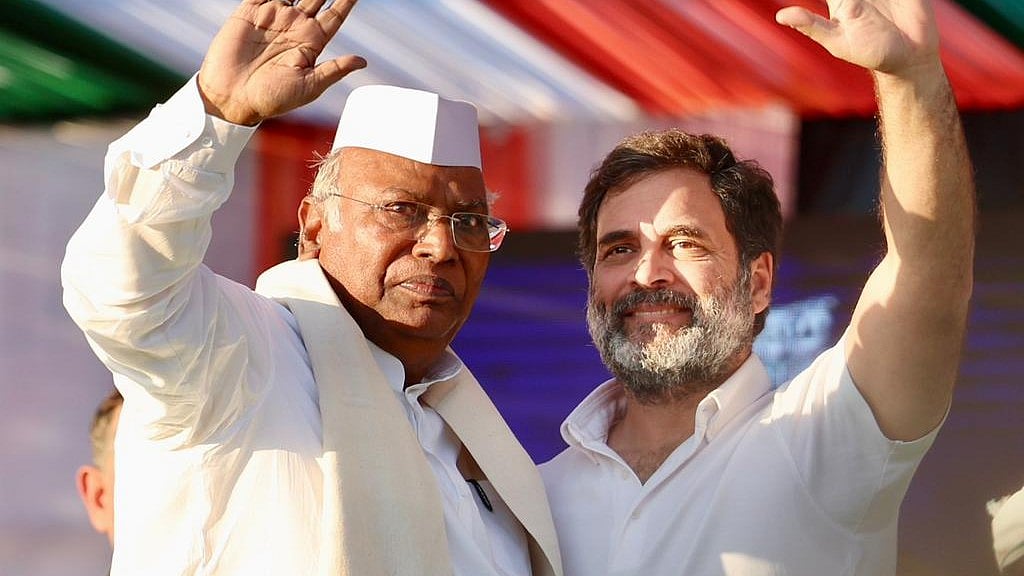
But the clamour is always the same: where is Rahul Gandhi? Why was he not at Jantar Mantar? He stood with the students when it mattered, without appropriating their stage, and was detained for it. Why is he not in Ranchi? He is, as a national leader is anywhere: through the rank and file he sent to listen, respond and engage. And where is the Congress? On record. Party president Mallikarjun Kharge said it today: Jharkhand, Punjab, Delhi, anywhere; ‘whether it is our alliance partner or our opposition’, Rahul Gandhi and the entire party stand with the students, and will keep fighting for them. No one ever asks where the Prime Minister is. No one asks the Home Minister, whose police swung the lathis, to show up. The vilified man is blamed for not being everywhere; the exalted one is excused from being anywhere.
Therefore, is it good for Indian democracy that the Congress is held to a higher standard? Not in the form we witnessed over the last decade. A double standard corrodes: it turned the Republic's conscience into a partisan weapon and placed one man beyond question. What is good for democracy is the standard itself, and the two forces restoring it: a generation enforcing it on everyone, and a party led by a leader willing to submit to it, even when the enforcement is cynical.
A word of caution. What cracked in July was the exemption from criticism, not the dominance built on it. A crack in an aura is not a realignment. Honouring the standard, the Republic's fundamental compact with its citizens, is necessary for the Congress's relevance and not sufficient for its revival, which still needs organisation, candidates, the unglamorous work at the booths.
But politics moves when the mind moves first. A generation has stopped being afraid. And Rahul Gandhi is building the culture that can meet it, one that begins by admitting no government can fix everything, then does what our politics forgot: listen first, stand for the voice of pain, amplify it until a system gone deaf is made to hear, then, slowly, change the system's behaviour, including his own partymen who still swagger as if in power. That is how a democracy is meant to function for its citizens. Between them, a generation and a leader are restoring a single democratic standard, applied to everyone, in service of the end that justifies it: a system that works for everyone.
(Varun Santhosh is a member of the Congress party. Views are personal. X handle - @ santvarun. This is an opinion piece and the views expressed above are the author's own. The Quint neither endorses nor is responsible for the same.
- Access to all paywalled content on site
- Ad-free experience across The Quint
- Early previews of our Special Projects
Published: undefined