
‘Khelega Yuva, Jeetega Bharat,’ Writes Anurag Thakur
BJP MP Anurag Thakur writes about the need to focus more energy on sports in India.
advertisement
It was August of 2008; the world over, people were glued to television screens as the People’s Republic of China hosted Olympics games at a scale seen never before. Not just as a grand host, but the Chinese also won an astonishing 48 gold medals and a total of 100 medals that year. And even as the Olympics was coming to an end, the world knew that a new power had emerged, both in sports as well as in geopolitics.
The importance of sports in today’s age cannot be emphasised enough. Research has found that sports can have a therapeutic effect on many modern-day diseases and psychological disorders. Sport and physical activity can make a substantial contribution to the well-being of people in emerging economies like India.
Exercise, physical activity and sports have long been used in the treatment and rehabilitation of communicable and non-communicable diseases. Moreover, sports is a cost-effective method to improve public health across different demographics. On a geopolitical level, sport has become an important pillar for soft power, which I would like to call ‘sports power’. There are cult-like followings for popular sportspersons such as Sachin Tendulkar, Ronaldo and Michael Schumacher the world over.
The stupendous performance of India at the recently concluded Commonwealth Games at the Gold Coast has reinforced what I have been saying for a long time, at any platform that I found, that India has huge potential to be a sporting giant. India ended up with 66 medals, in what was our third-most successful outing after the 101 in New Delhi (in 2010), and 69 in Manchester (in 2002). We won more gold medals (26) than silver (20) and bronze (20).
However, for us to be a sporting giant, we need to develop a multi-pronged strategy encapsulating the following four critical needs:
- Sports infrastructure
- Sports training
- Career development and tracking of sportspersons and
- Job security of retired sportspersons.
Beginning with sports infrastructure, there’s a need for developing facilities right up to block level. As the athlete rises through each facility, from block to district to state to national, there should be a boost in his/her ability to play the game. However, the fundamentals of the game, basic sports training, and nutrition should be established at the block level. The role of parents here cannot be overemphasised. Parents provide for psychological comfort to the budding legends and this is what pushes them ahead. Hence, parents should understand this and provide the psychological comfort necessary.
We need an army of coaches to train the sportspersons. Every school needs to have a well-trained coach to begin the basics of sports training for children. As Sachin Tendulkar has mentioned, there’s a need for a supply chain of sportspersons and coaches. Each of the retired sportsperson has to give back to society as an able coach. With the creation of the right infrastructure, this addition of new coaches will add impetus to the sports power of India.
The need is to create a culture of sports and ritualise the playing of games. I believe each state should fix a minimum number of coaches to be created in different sports. In this aspect, the states can determine the type of sports they would want to contribute. This is the most beautiful aspect of India’s diversity, which is that we have different sets of states accustomed to different sports and as a result, each state can produce stars in those games.
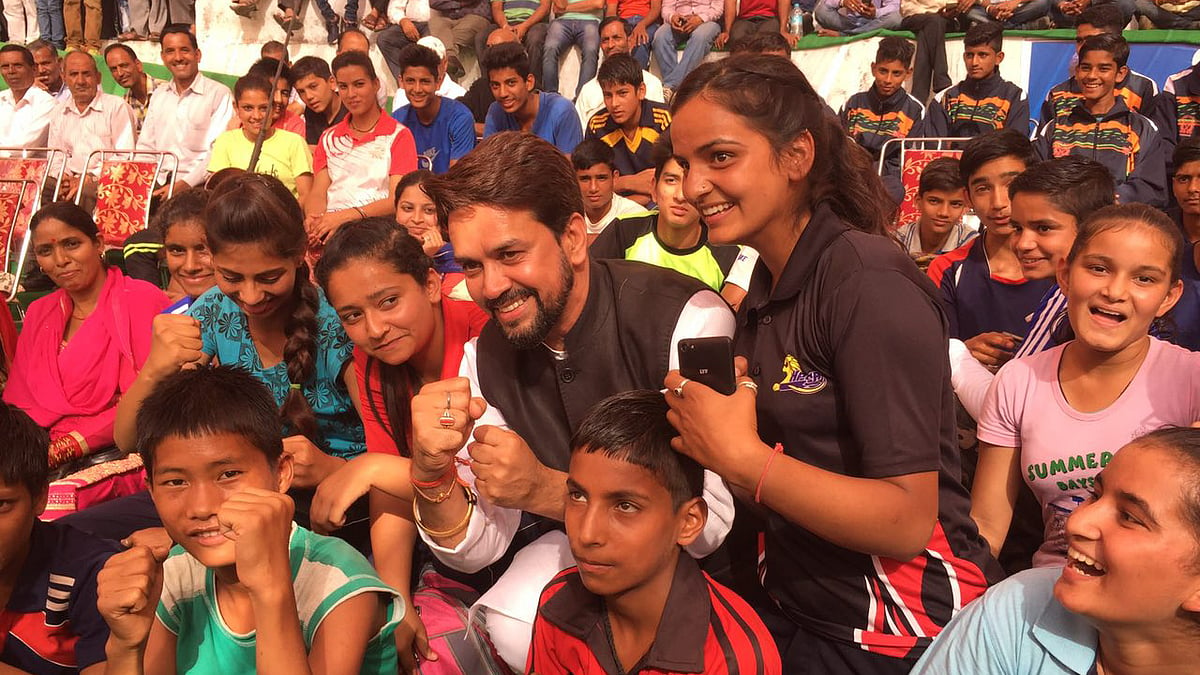
In this respect, I as the president of Himachal Pradesh Olympics Association led a State Olympics Games popularised by the war cry Khelega Yuva, Jeetega Himachal last year.
The State Olympic Games commenced as a four-day event. To ensure widespread awareness of sports amongst the youth, the four-day event witnessed 11 sports disciplines such as Hockey, Athletics, Boxing, Basketball, Judo, Kabaddi, Volleyball, Wrestling, Weight Lifting, Kho-Kho and Shooting. A total of 1,100 athletes across districts participated with 51,000 students actively participating in different capacities.
It’s heartening to see weightlifter Vikas Thakur, who had participated in the state Olympics, win bronze at this Commonwealth Games for the country. This year again, we launched a mega sports initiative called Star Khel Mahakumbh which was kick-started by cricketing legend Sachin Tendulkar in Dharamshala.
This will be a one-of-its-kind sporting initiative where we shall involve all the gram panchayats and reach out to more than a lakh youths. Six different sports will be played all the way from the grassroots and we hope to discover and nurture more Vikas Thakurs this time, making Himachal Pradesh and India proud.
Here I would like to emphasise the need for a uniform rewarding policy in all the states.
Some states provide very high monetary rewards to medal-winning sportspersons. This has obviously led to those states leading in producing some remarkable athletes.
Hence, Union and states should look at creating a uniform rewarding policy and a level-playing field across all states. As a part of the sports policy, states should create a competitive atmosphere amongst sportspersons, right from block level, to encourage excellence and create more sportspersons. This apart, a post-sports career plan has to be made for each of the excelling sportspersons. Apart from inducting them as coaches, they also need to have alternative sources of income. They could also become some wonderful sports managers.
This incentive for excelling sportspersons to have a career continuity in sports as coaches and sports managers, even after retirement, will allow more people to opt for sports as a career.
The Khelo India programme of the Sports Ministry is a welcome step towards creating a sports culture in India. This Pan Indian Sports Scholarship scheme would cover 1,000 of the most talented young athletes each year, across select sports disciplines. These athletes selected under the scheme shall receive an annual scholarship worth Rs 5 lakh for 8 consecutive years. In order to further boost the sports atmosphere, governments, both the centre and states, must earmark a percentage of their GDPs towards development of sports economy.
As governments earmark their budgets for developing backward areas, similarly they need to fix a percentage annually for development of sports economy. I would request the sports ministry to also look at the several ‘adulterated’ sports goods and sports leagues taking place across India. Many fake companies are imitating branded sports products and selling under-quality sports products to the budding sportspersons of the country. This could seriously dampen the performance and needs to be immediately checked. In the same vein, fraudulent gaming leagues wouldn’t lead the players anything much to aspire.
The world over, there’s been lamentation in certain quarters over job losses in manufacturing and services sectors due to the onslaught of artificial intelligence. However, there’s immense possibility of developing new revenue and employment opportunities in several new sectors. In my previous column, I focussed on tourism. Here, I would stress upon the need for developing the sports industry.
There’s a stereotype that views sports as an industry of the first world, but nothing is farther from the truth than this. The sports industry entails creating sports assets, human resources, sports medicines, playing tools, and even sports tourism. Today, electronic sports has become an industry unto itself. The sports industry is estimated to be around $700 million in India. However, this is a very small pie in comparison to the global $500 billion sports industry. There’s a dearth of sports managers in this country who can scale up the industry to global levels. It’s high time that India create an Indian Institute of Sports Economics and Management to create human resources most crucial to develop this industry. I would request governments to come up with a white paper on sports industry policy. On a lighter note, we have to begin with the basic definitions; of the difference between national games and championships!
As public administrators start creating the climate for this budding industry, I would request them to move with the spirit most demanding for any athlete – the spirit of sportsmanship!
(The author is a BJP MP and former BCCI President. Currently, he is the chairman of the Himachal Pradesh Cricket Association.)
- Access to all paywalled content on site
- Ad-free experience across The Quint
- Early previews of our Special Projects
Published: undefined