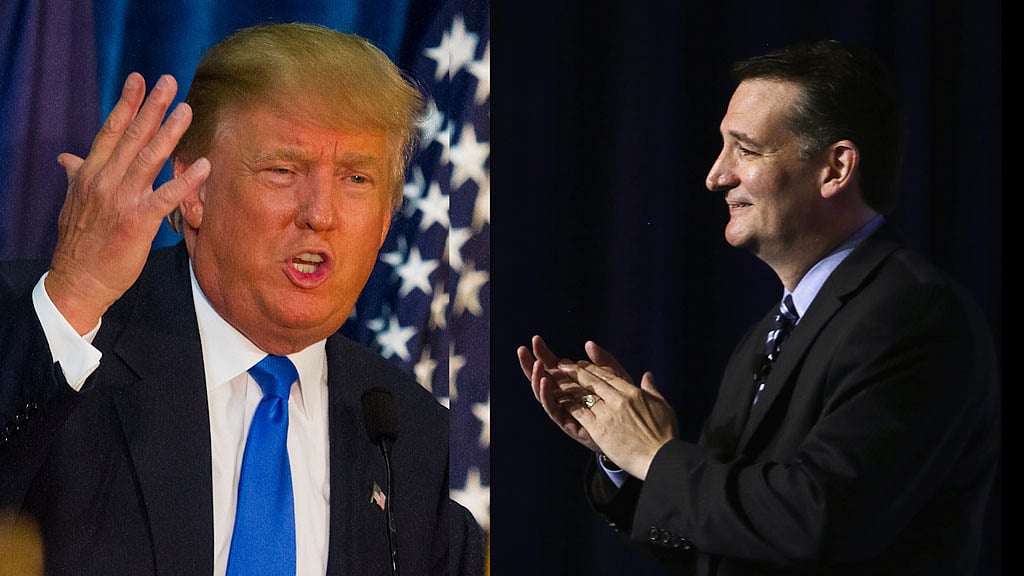
Republican Race to the Primaries: Will It Be Trump or Cruz?
Republicans desperate to stop Trump from capturing the party’s presidential nomination are hoping Cruz can step up.
advertisement
Republicans desperate to stop Donald Trump from capturing the party’s presidential nomination are wrestling with whether to unite behind Ted Cruz, a polarising figure popular with the conservative Tea Party movement.
Cruz, 45, a US senator from Texas, won nominating contests in Kansas and Maine on Saturday, bolstering his argument that he is the leading alternative to Trump, 69, the blunt-spoken billionaire businessman.
Mainstream Republicans are unhappy with Trump’s calls to build a wall on the border with Mexico, deport 11 million illegal immigrants and temporarily bar all Muslims from entering the United States.
Many establishment Republicans are reluctant, however, to rally behind Cruz, whom they see as too conservative for the general electorate in the 8 November election to succeed Democratic President Barack Obama.
Cruz has run as an outsider bent on shaking up the Republican establishment in Washington. A favorite of evangelicals, he has called for the United States to “carpet bomb” the Islamic State militant group and has pledged to eliminate the tax-collecting Internal Revenue Service and four Cabinet agencies.
But he angered many Republican colleagues when he led the call in 2013 for a standoff in the US Congress that led to a 16-day shutdown of the federal government.
Republican pollster Neil Newhouse said Cruz had not yet shown an ability to appeal beyond the most conservative voters.
Kim Reem, a member of the executive committee of the National Federation of Republican Women, said both Trump and Cruz were polarizing figures within their party. She said three factions were emerging among Republicans: those supporting Trump, those backing Cruz, and supporters of the party establishment.
Some Republicans argue Cruz is not polling strongly enough in states such as Florida and Ohio. Both will soon hold nominating contests, leading some in the party to question whether backing Cruz would be the best way to stop Trump.
Unforgiving Math
To win the nomination, 1,237 delegates are needed.
Cruz has won 300
Trump has won 374
Marco Rubio has won 123
John Kasich has won 35
Some establishment Republicans say the best way to stop Trump would be for Rubio to win the 99-delegate Florida contest and Kasich the 66-delegate Ohio primary. Both states award all their delegates to the top vote-getter.
Even if Cruz gets the second-highest vote total, he may have trouble claiming the nomination at the convention over Trump.
Although he has been in the Senate for four years, Cruz has not won a single endorsement from any other senator. He touts that on the campaign trail as evidence he is an outsider.
If nothing else, the internal debate reveals a party still deeply divided about how to move forward with Trump and Cruz leading the primary fight.