
India's 'Third Spaces' Are Shrinking. Who Gets to Decide What We Can Discuss?
Police pressure and informal censorship are shrinking spaces for public debate across India, writes Harsh Mamnani.
advertisement
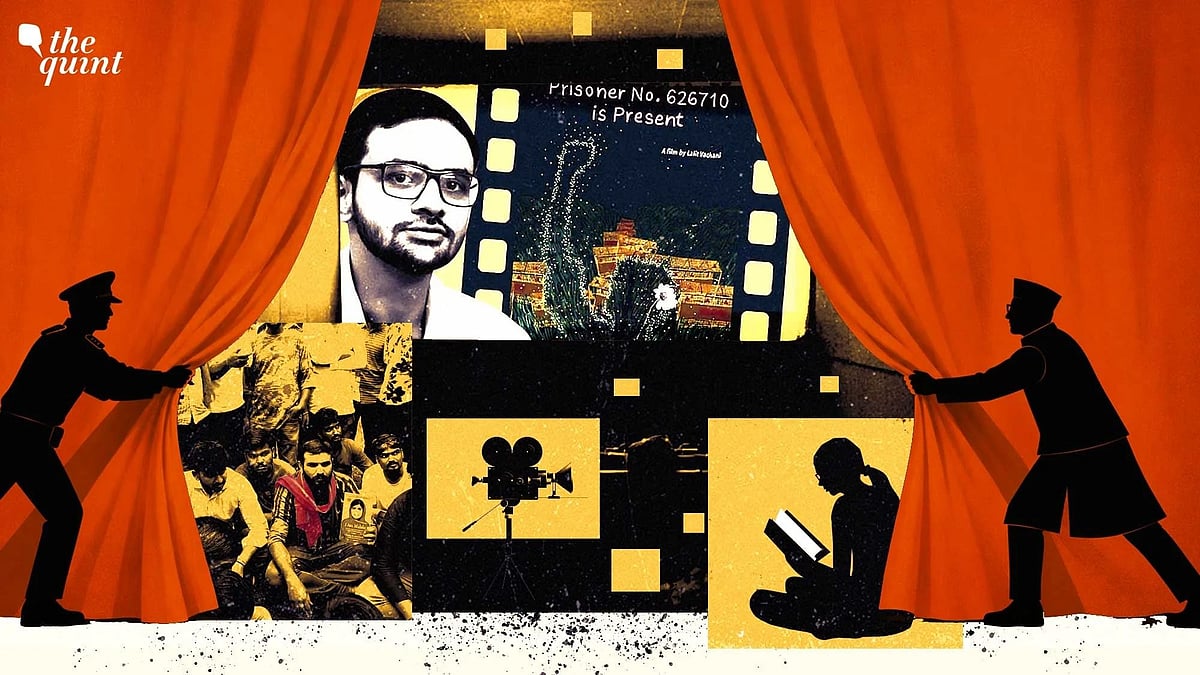
What is common between a reading session at a public park in Ahmedabad, the International Documentary and Short Film Festival of Kerala, a screening of the documentary Prisoner No. 626710 is Present at a private venue in Mumbai, and an art exhibition in Delhi displaying the work of two activists?
All of these are events in "third spaces" that were surveilled and restricted in the last few months.
A third space is a social setting distinct from the first space (home) and the second space (workplace or formal educational institution). Libraries, parks, and art galleries—all constitute third spaces that provide people from different walks of life an opportunity to meet in an informal atmosphere.
‘Requests’ Without Paper Trails
Consider this case, for instance. On 19 September, the Progressive Artists' League decided to display artworks of Srishti Gupta and Akriti Chaudhary at Mool Studio in Delhi, followed by a panel discussion on the theme 'Partisanship of Artists in Our Times'.
Both the activists were arrested in the aftermath of Noida workers’ protest demanding a wage hike. It is worth noting that the Uttar Pradesh government itself acknowledged the workers' grievances and increased the salary of unskilled workers across the state by up to 21 percent after the agitation.
Additionally, an NSA case against Akriti was quashed by the Allahabad High Court by a two-judge Bench comprising Justices Atul Sreedharan and Achal Sachdev, who called the entire case by the Uttar Pradesh police a "concocted story". They also warned that continued conduct of this kind by the state's bureaucracy risked turning Uttar Pradesh into an 'Orwellian dystopia.'
Akriti's NSA detention may have been struck down as baseless, but both Srishti and Akriti continue to be in jail due to multiple criminal cases filed against them by the Uttar Pradesh police. The Supreme Court also upheld the quashing of her NSA but stayed the recovery fine imposed on the local officials by the Allahabad High Court.
According to Vinod, a member of the Progressive Artists' League,
Mool's owner Aarohan alleged to The Quint that two cops from Hauz Khas Police Station had arrived on 18 September at the studio and made this request.
When asked if cops have frequented the place before, they recalled, "Last year too, around 7 October, a fundraiser for Palestine organised by Voices Against Genocide was cancelled when cops arrived at the venue and requested that the event cannot go ahead."
When asked about the effect of these visits, Aarohan remarked, “This does not deter us, but it does force organisers like us to be more cautious and think twice before organising events for our as well the security of participants.”
A Hauz Khas police personnel The Quint reached out to for comment refused to confirm or deny these allegations, asserting he wouldn’t say anything because "he doesn’t know enough about it."
Proxy-Censorship?
A month before the Mool Studio incident, in Ahmedabad, a silent reading session of The Diary of a Young Girl by Holocaust victim Anne Frank and Nobel laureate Malala Yousafzai’s I Am Malala was disrupted by men belonging to Bajrang Dal and Vishwa Hindu Parishad (VHP). On 27 August, students had gathered in AUDA Garden to revisit these books after a private school in Ahmedabad was allegedly forced to drop them from its mandatory reading list after protests from right-wing groups.
Riya, a design student in Ahmedabad and participant of the reading circle, claimed that she saw members of Bajrang Dal marching in with steel rods and saffron flags chanting Jai Shri Ram after the session ended.
Similarly, multiple screenings of Prisoner No. 626710 is Present, a documentary on jailed Muslim activist Umar Khalid whose trial is yet to begin, were cancelled in different parts of India after police intervention. The episode began after students of IIIT Hyderabad planned to screen the documentary. The Central Board for Film Certification (CBFC), in an unprecedented move on X, said, "Public screening of a documentary film that has not yet been certified by the CBFC is a violation of the Cinematograph Act unless a specific exemption has been sought under the Act," urging university authorities at IIIT Hyderabad to take necessary action.
The screening was cancelled soon after. At least five screenings of this film were subsequently cancelled in September.
Writing for The Quint, Mumbai-based activists Shrishti Khanna and Prashant Pundir documented the ordeal of first finding a venue, and how police personnel in plain clothes subsequently visited the Bandra venue where the screening had originally been planned, and pressured them into cancelling. After much struggle, they were subsequently able to find another venue and go ahead with a private screening of the film on 28 September, albeit with a lot of pre-emptive precautions.
All of these cancellations were enforced by referring to the 1952 Cinematograph Act.
Siddhant Gupta, Principal Associate at TMT Law Practice, said,
"By relying on verbal warnings rather than formal written bans or FIRs, authorities can insulate their actions from judicial review. A written order can be challenged in the High Court under Article 19, but a police officer's phone call or request is much more difficult to challenge and which is perhaps why we may have seen increasing application of this,” he explained.
Besides these private screenings, at an institutional level too, the Ministry of Information and Broadcasting has applied extensive censorship to films at festivals. Of the 31 films selected for the 18th edition of the documentary and short films festival in Kerala that were initially denied clearance, 24 were subsequently cleared, while seven remained without permission. An email to the ministry seeking clarification and grounds for withholding did not elicit a response.
Earlier this month, the Ministry of Information and Broadcasting reconstituted the CBFC with 18 new members for a period of three years. Notably, two Bharatiya Janata Party (BJP) politicians, including actor Rupali Ganguly, who joined the party in 2024, and singer Hans Raj Hans, a former BJP MP, were also empanelled.
Additionally, Pallavi Joshi, one of the producers of the 2022 movie The Kashmir Files, was also appointed as a member by the ministry, drawing criticism from civil society regarding political appointments to regulatory bodies.
Venue Guardrails & Commercial Realities
unLecture, a space inspired by New York-style bar lectures, has emerged as popular amongst graduates in urban India. Started in Delhi, it now conducts lectures in multiple states.
Mishka Lepps, co-founder of unLecture, told The Quint, “Some venues, particularly large chains, have guidelines that must be followed, while others are more welcoming, making the experience of organising these conversations a spectrum rather than a fixed rule. By following broad venue guidelines, submitting details of the speaker and an abstract about the session, we are able to sustain discussions on seemingly ‘political’ conversations as well.”
When asked about any hassles faced from venue owners, she recalled,
One thing that stands about these interventions is that none of these arrived as an FIR, a written notice, or a formal order that could be challenged in court. A phone call to a venue owner, a constable's visit to a gallery, a post on X—each is designed to leave nothing behind for a judge to examine, and everything behind for an organiser to remember the next time they consider hosting something "too political".
That is the quieter, more durable achievement of this pattern: not banning a book, a film or an exhibition outright, but making sure fewer people ever try to host one again.
(The author is an independent researcher and reporter.)
- Access to all paywalled content on site
- Ad-free experience across The Quint
- Early previews of our Special Projects
Published: undefined