
Raghav Chadha & BJP Explored 5 Options, Settled for 'TDP Model': What's Next?
BJP wanted Raghav Chadha to split AAP in Punjab and form a new regional party, but that didn't work out.
advertisement
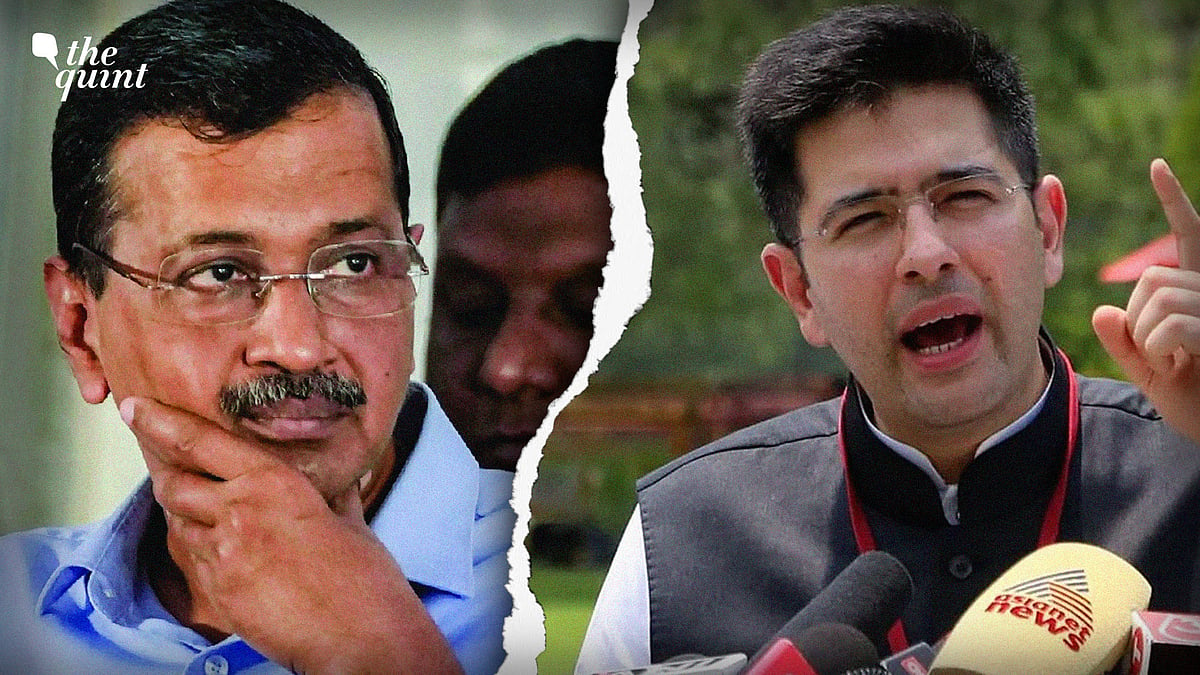
Senior Aam Aadmi Party leader Raghav Chadha's switch to the Bharatiya Janata Party (BJP) with six other AAP Rajya Sabha MPs was the result of months of negotiations, sources in the BJP have revealed.
Chadha's decision to quit was a matter of time and could even have happened earlier, but the BJP is said to have made it clear that his stature in the party will depend greatly on what he manages to accomplish before he switches.
Several options were under discussion and the final result—Chadha splitting the AAP in the Rajya Sabha—wasn't the BJP's first choice.
Five options figured in the discussions.
Option 1: Shinde-Pawar Model
After AAP's landslide win in the 2022 Punjab elections, Chadha emerged as among the top two or three leaders in the party after Arvind Kejriwal.
The BJP's first choice during the discussions with Chadha was the kind of split Eknath Shinde carried out in the Shiv Sena, eventually taking control of the party name and symbol. It involved winning over a majority of party MLAs and national executive members. This was replicated later by Ajit Pawar in the NCP.
This option proved to be a non-starter. AAP's highest-decision making body, the political affairs committee, largely comprises Kejriwal loyalists. Chadha had very little leverage on them.
The BJP's preferred option was the following one: the Arunachal Pradesh Model.
Option 2: Arunachal Pradesh Model
The BJP understands that it can expand in Punjab only if either Congress or AAP collapses in the state. The BJP has managed to win over a large number of Congress leaders, but it has not resulted in any break in the Congress' base or even the party organisation.
This is what happened in Arunachal Pradesh in 2016, when Pema Khandu first formed the People's Party of Arunachal which later merged into the BJP.
However, this proved to be trickier than expected, for two main reasons.
First, no MLA seemed keen to switch sides and go for a bypoll. Every Punjab leader from AAP, Congress, and Akali Dal who defected to the BJP on the eve of the Lok Sabha elections, ended up losing—be it Ravneet Bittu in Ludhiana, Sushil Rinku in Jalandhar, Rana Gurmeet Sodhi in Firozpur or Arvind Khanna in Sangrur. This history also weighed heavily on the MLAs.
Another issue was timing. The BJP's strategists for Punjab wanted this split sooner rather than later. The MLAs who had been approached, on the other hand, wanted to weigh their options and switch 6-8 months before the 2027 Assembly elections, so that they don't have to face a bypoll.
Second, Chadha had been sidelined from Punjab affairs due to his own absence and also because Kejriwal and Sisodia had begun taking active interest in the state after the defeat in Delhi in 2025. This made it tougher for the BJP and Chadha to win over any meaningful number of MLAs.
Option 3: No Split
This was the last preferred option for both the BJP and Chadha.
Chadha is a known face and the BJP would have accommodated him even if he had joined on his own. However, in such a scenario, he would have had no leverage in the party.
Scindia successfully split enough MLAs to bring down the Congress government in Madhya Pradesh in 2020. And he was later rewarded with a ministerial berth.
BJP insiders say that a few other Congress leaders tried to switch sides but failed to carry out the kind of split Scindia managed to accomplish and were, therefore, promised nothing.
Had Chadha joined BJP on his own, he would have been reduced to a talking head, not to mention losing his Rajya Sabha membership.
Option 4: Split in Parliamentary Party
The move to split AAP in Parliament gained momentum in the run-up to the delimitation-linked Women's Reservation Bill being presented. However, AAP's Lok Sabha MPs—Malwinder Singh Kang, Rajkumar Chabbewal and Gurmeet Singh 'Meet' Hayer—proved difficult to split as they have strong roots in Punjab politics. Two out of the three MPs are also from seats where the BJP has traditionally been weak.
As a result, the BJP and Chadha settled on the Telugu Desam Party model.
Option 5: Telugu Desam Party Model
In 2019, four out of six Rajya Sabha MPs belonging to the TDP merged with the BJP. Since they were two thirds of the TDP's total Rajya Sabha strength, they managed to avoid disqualification under the anti-defection law.
Chadha and different BJP pointspersons reached out individually to AAP's Rajya Sabha MPs.
Some, like Swati Maliwal, were easier to convince as she has had a public falling out with the AAP's national leadership. Others like Ashok Mittal, Vikramjeet Sahney and Rajinder Gupta are all businessmen and had no established political ideology, the same holds true for Harbhajan Singh. These were easier to convince and Chadha is said to have acted as a go-between.
Coincidentally, Ashok Mittal, who replaced Chadha as AAP's Deputy Leader in the Rajya Sabha had faced raids by the Enforcement Directorate earlier in April.
Then there was Sandeep Pathak, AAP's General Secretary (Organisation). More on that in the next section.
Sandeep Pathak: Blue-Eyed Boy to 'Defector'
Around 2022, Sandeep Pathak became the most powerful leader in the organisation after Kejriwal, with Sisodia facing legal troubles and Chadha shifting focus to advising the Punjab CM. He was given charge of expanding the party outside its core territories—Delhi and Punjab.
Gradually, Kejriwal began putting checks on Pathak's influence. However, he was still an important person in the AAP organisation.
His downfall is said to have begun after AAP's debacle in the 2024 Haryana election. The party secured only 1.8 percent votes and all but one of its candidates lost their deposits. Pathak was handling the party's campaign in the state.
In fact, AAP's only success in that election cycle came from Doda in Jammu and Kashmir, mainly due to the local connect of its candidate Mehraj Malik.
Pathak's critics became even more vocal after this. After AAP lost Delhi in 2025, Kejriwal took organisational matters in his own hands. More than any other leader, it is Pathak who lost influence as a result of this.
What Happens Next?
Raghav Chadha may not have succeeded in splitting the AAP's Punjab unit, he has given the BJP a tactical win at a crucial juncture. The party had just suffered a defeat in Parliament with the delimitation-linked Women's Reservation Bill being defeated in the Lok Sabha. It is also in the middle of a highly competitive election in Bengal.
AAP may have anticipated Chadha's exit and that of a few others, they probably didn't anticipate that he would split the party in the Rajya Sabha.
It is likely that Chadha might be rewarded by the BJP in the near future, either through a ministerial berth or an organisational position.
Chadha has a strong social media connect and his influence is almost entirely among the youth.
By bringing in Chadha, the BJP is trying to tell this age group that even if they may be dissatisfied, their issues can be addressed only by the BJP.
- Access to all paywalled content on site
- Ad-free experience across The Quint
- Early previews of our Special Projects
Published: undefined