
Who Will Speak for the Marathi Manoos? Inside Mumbai’s High-Stakes BMC Election
The richest municipal corporation in India functioned without an elected civic body or a mayor for four years.
advertisement
When Zohran Mamdani was elected mayor of New York last month, many Indians praised and celebrated the moment on social media. But some were met with a pointed question: Do you even know who Mumbai’s mayor is? Or when the BMC elections are due?
But, how could they? For years, there has been no clear answer.
Repeated delays to the Brihanmumbai Municipal Corporation (BMC) elections meant that India’s financial capital functioned without an elected civic body, or a mayor, while administrators ran the city.
The prolonged delay was driven by litigation over OBC reservation and the redrawing of ward boundaries to reflect population changes. Earlier this year, the Supreme Court directed the Maharashtra State Election Commission (SEC) to notify election dates, observing, "The constitutional mandate of grassroots democracy through periodical elections to local bodies ought to be respected and ensured."
Despite that, there was some further delay over voter lists being finalised.
“If the Thackerays, even after coming together, lose here, it could trigger an existential crisis over who represents the ‘real’ Shiv Sena," political analyst Amitabh Tiwari told The Quint.
Another reason for the spotlight is that the BMC is the richest municipal corporation in India—its expected expenditure for 2025-2026 is Rs 74,427 crore. In contrast, the erstwhile Bruhat Bengaluru Mahanagara Palike’s budget at second place stands at Rs 19,927 crore, followed by the Municipal Corporation of Delhi with Rs 17,002 crore.
A Fractured Political Landscape
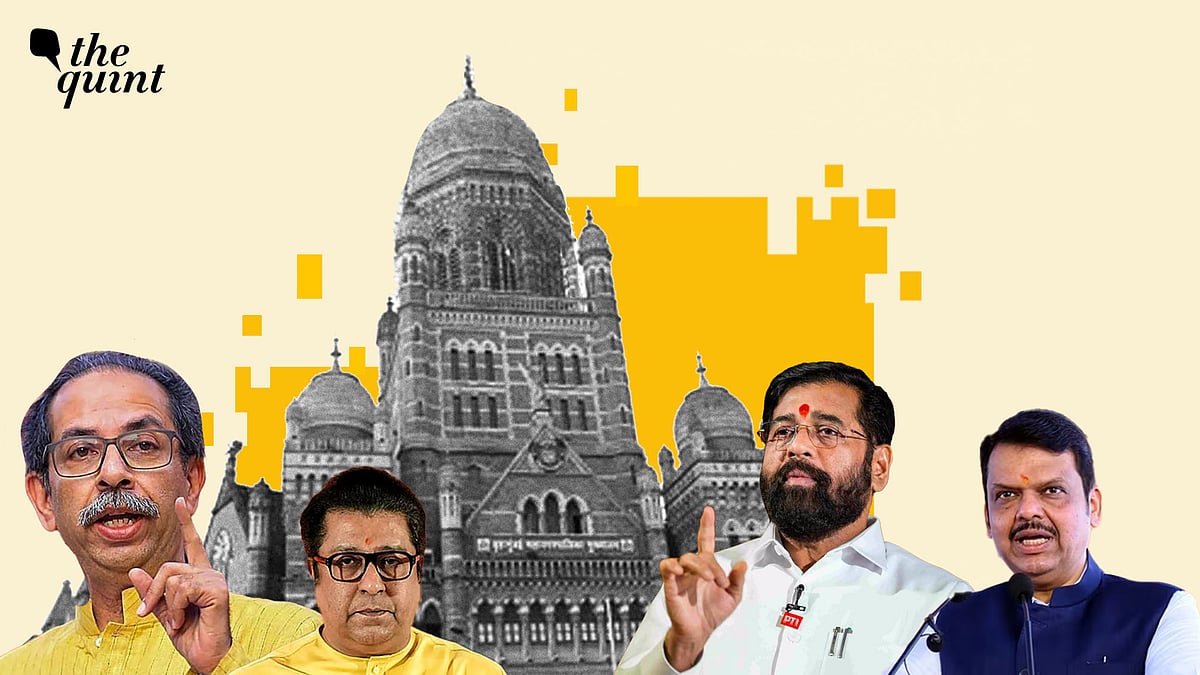
This marks the first BMC election after Maharashtra’s dramatic political fragmentation.
"The Marathi vote will primarily be split between the two Shiv Senas and the Bharatiya Janata Party (BJP). But even within Marathi voters, there are divisions; some prefer the Thackeray legacy, others align with Eknath Shinde," explained Tiwari.
When the last civic polls were held, the political landscape was significantly different. The undivided Shiv Sena and the BJP were in alliance in the state government at the time but contested the polls separately. The Shiv Sena won the most number of seats – 84 out of 227 – while the BJP won 82. The Congress won 31, undivided Nationalist Congress Party (NCP) 9, and SP 6. Much has changed since then.
On the other side, Uddhav Thackeray’s Shiv Sena (UBT) has chosen this election to electorally reunite with his cousin Raj Thackeray, bringing together the Shiv Sena (UBT) and the Maharashtra Navnirman Sena (MNS).
Political analyst Hemant Desai told The Quint that the Congress’ marginal position in Mumbai could limit the damage.
Seat-sharing talks between both alliances, meanwhile, have already seen their share of speed breakers. In the Mahayuti camp, Ajit Pawar's NCP is likely to not be a part of the alliance with the BJP putting its foot down on not wanting to partner with the party owing to the Mumbai unit being led by Nawab Malik, who has money-laundering charges against him. As per reports, while the Shiv Sena and the BJP have still not reached middle ground on number of seats both parties will contest, a pact is likely soon.
Uddhav Thackeray's Shiv Sena, meanwhile, has not yet officially announced the alliance with the MNS, but is expected to do so on the day nominations are filed, 23 December.
Desai said there was a lot riding on the election as losing would be devastating for the Thackeray brothers.
"After the Assembly elections, MVA has not been that aggressive and the Thackeray brothers have also not held many joint public rallies," he said. "They have a narrative of the BJP wanting to sell Mumbai and Adani taking over and also Marathis vs so-called 'outsiders', but now it depends on how well they can sell it. It is possible thay if they lose, many corporators will switch sides."
Desai said that Mahayuti has an edge right now as the BJP had preparing for two years for the election, and had inaugurated a bunch of projects days before it was announced.
The Poster War
While the seat-sharing negotiations continue and parties hurry to decide candidates and strategies, a poster war has already broken out across the streets of Mumbai and posts of social media.
Two unclaimed and unattributed posters have been circulating. One appeals to Marathi identity, urging the Marathi manoos to unite to ‘save Mumbai’ and calling the election a final fight for their existence. The other poster asks how those who could not follow Hindutva would safeguard Marathis. It also carries the hashtag #BMCIsNotFamilyBusiness.
(Photo: Sourced by The Quint)
(Photo: Sourced by The Quint)
While neither carry any party's name, the first is being claimed as put out by the UBT Shiv Sena and MNS, while the other by the BJP and Shinde Shiv Sena alliance.
Anand Dubey, spokesperson for the Shiv Sena (UBT), denied that his party was behind the posters.
Rather than the Shiv Sena split being a disadvantage, Dubey claimed it had showed the people the true colours.
“People have seen how the party was broken using unfair means. Both the BJP and the Congress claim to speak for Maharashtrians, but that has always been our core identity. We will fight till the end, but if the BJP does vote chori in the election, what can we do?”
Tajinder Singh Tiwana, President of BJP Yuva Morcha, Mumbai, meanwhile, said the campaign was aimed at countering identity-based mobilisation by the UBT Sena and the MNS.
Civic Issues Take a Backseat
Beyond political slug fights and blame games, the core purpose of the BMC, civic governance, has so far received less attention. Roads, air pollution, traffic congestion, and public health, remain the city’s most pressing concerns.
Earlier this month, NGO Praja Foundation released its citizens’ manifesto for the election, urging candidates standing for elections and political parties to commit to:
Introducing time-bound targets and AI-driven tools for efficient, responsive civic services
Enhancing financial autonomy and skills of municipal officials
Establishing real-time open data portals for budgets, projects, and services to empower citizens with information
Publishing ward-wise quarterly work performance reports
Creating forums through digital platforms for ongoing citizen involvement in decision-making, participatory budget, etc.
Citizen groups say the prolonged absence of an elected civic body has worsened everyday problems. Advocate Trivenkumar Karnani of the Mumbai North Central District Federation (MNCDF) told The Quint that his organisation will soon release its own charter of demands.
According to Karnani, the four-year delay in civic elections has altered how Mumbai was governed.
“When there were elected municipal corporaters, it aided to maintain checks and balances in the bureaucracy. Today, in their absence, there is high-handedness, unplanned activity, and tyranny of power. Municipal councils were the political medium that kept the bureaucracy in check.”
Voter Fatigue and Civic Cynicism
According to Tiwari, despite the national attention the BMC attracts, voter turnout in civic elections has historically remained modest.
“Ultimately, not many people in Mumbai are bothered about voting. People in buildings don't approach corporators for anything and directly go to MLAs or MPs. But different socio-economic classes of people approach it differently. For poorer and marginalised communities, civic bodies matter deeply as BMC hospitals, schools, certificates, etc are part of everyday survival,” he said.
Still, many voters remain sceptical that the return of corporators will change much. “All the parties are competing with each other on how to make things worse for us,” said Zoru Bhatentha, a prominent activist in the city.
Bhatentha further added that citizens seem to fight over corporates more than they do.
“The politics of corporation elections divides citizens into politics. Political parties use this to keep citizens fighting with each other while no real work actually gets done,” he said.
- Access to all paywalled content on site
- Ad-free experience across The Quint
- Early previews of our Special Projects
Published: undefined