
‘523 Hate Songs Across YouTube, Spotify, Apple Music & Meta Library': Report
Of the 210 songs, 104 (or 49%) directly incite or threaten violence against Muslims," states the CSOH report.
advertisement
(Exposing hate and communalism is a key focus area in The Quint's reportage. Become a member and support our journalism.)
Meta and YouTube, with their large user base especially in India, have been facilitating the dissemination of hate music by hosting, promoting and monetizing hate content, according to a recent report by Washington based think-tank, The Centre for the Study of Organised Hate (CSOH).
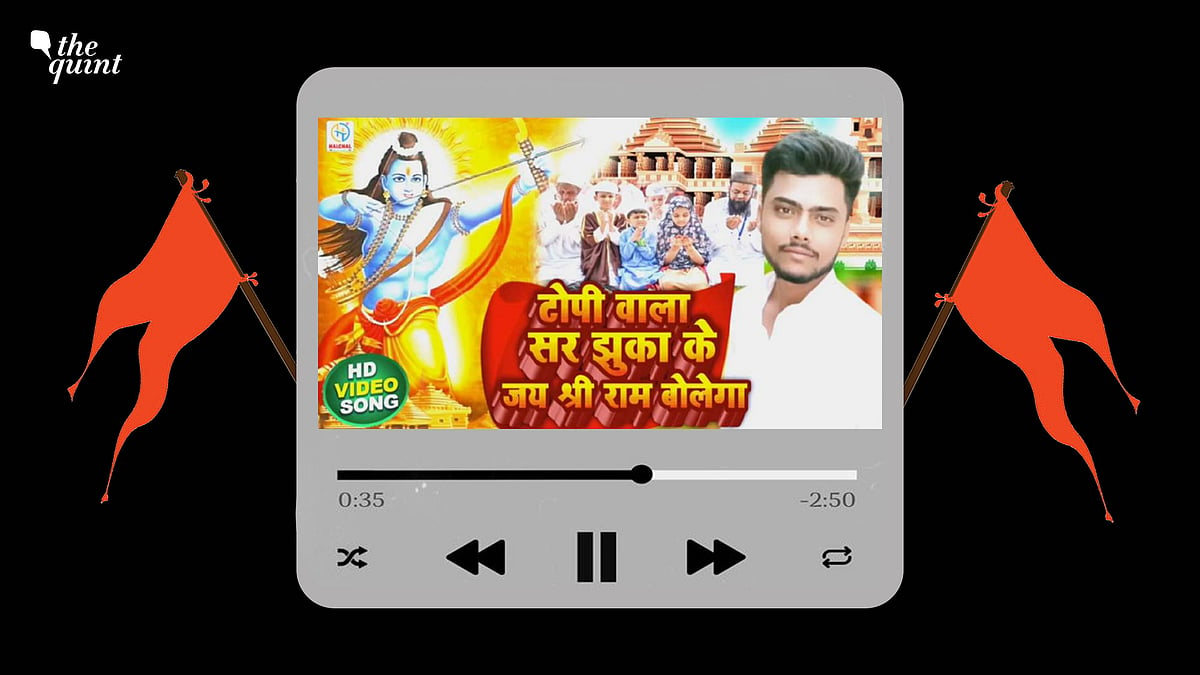
The study, titled “Profiting from Hate Music: The Role of YouTube, Meta, Spotify and Apple Music in Hosting and Monetizing India's Hate Music Industry”, identified more than 500 'Hindutva pop hate songs' over a year (from January 2025 to January 2026) across platforms such as YouTube, Spotify, Apple Music, and Meta’s Music Library.
Hindutva hate music or 'Bhagwa' is not a new phenomenon in itself. What's relatively new is how these songs have been monetised and how an online industry profits from this hate in more ways than one.
The kind of Hindutva music being used on Instagram reels.
(Photo: CSOH report)
YouTube — The Largest Market
Some of these songs explicitly call for violence, while some indirectly incite violence against religious minorities, in direct violation of their own content policies, which are supposed to limit hatred, dehumanization and violence against religious communities, the study found.
Of the 210 songs, 104 (or 49%) directly incite or threaten violence against Muslims and have been viewed at least 97 million times.
Therefore, YouTube comprises most of the share of these hateful videos, followed by Spotify, and subsequently Meta Music Library and Apple Music.
Share of the videos on each platform.
(Photo: CSOH report)
This genre of hate music, known as Hindu nationalist or Hindutva pop music promotes beliefs aligned with Hindu nationalist (Hindutva) ideology, deploying it to vilify and dehumanize Muslims and Christians, and to stoke feelings of anger and fear among the Hindu majority.
Hindutva pop or H-pop, music used in religious and political processions is closely linked to Hindu Right’s cultural, social and political mobilisation, the Quint had reported December 2024.
Back in 2019, The Quint's former reporter Aishwarya Iyer had reported on the how hate was being sold as entertainment, with upbeat Bhojhpuri tunes and amassing millions of views. She also spoke to a few these singers to establish how this kind of music goes viral.
Such songs are seen amassing massive views on YouTube.
(Photo: CSOH report)
"Half of the songs hosted on these platforms explicitly call for violence against religious minorities, while the rest promote or incite hatred through slurs and dehumanization," the report reads.
How The Platforms Reward Hate
Despite the hate content and calls for violence, artists continue to gain subscribers and profit, allegedly with the complicity of these very platforms.
Through this feature, creators can directly receive revenue from viewers who can buy a one-time animation and a stand-out comment. Since this feature is directly visible on the platform, CSOH identified 114 of the 210 videos, or around 54 percent, had this feature enabled, allowing Indian users to contribute sums ranging from 40 rupees ($0.42 USD) to 10,000 rupees ($104.83 USD).
Some of the other key findings from the report are:
210 songs were identified on YouTube, 109 on Spotify by 53 artists, 103 on Meta’s Music Library, and 101 on Apple Music by 59 artists. YouTube songs alone have been viewed over 198 million times; Meta’s Music Library songs were used in more than 5.9 million Instagram Reels.
1 in 2 hate songs hosted on platforms explicitly calls for violence. 263 (50 percent) of the 523 violative songs identified across YouTube, Spotify, Apple Music, and Meta.
Ads for 103 brands appeared on hate music videos, including 78% of violative YouTube videos and 83% of those calling for violence.
On Meta, 20 of 30 prominent Hindutva pop singers studied had monetized Facebook accounts.
“The visibility afforded by the world’s biggest online platforms is central to the survival and growth of the H-Pop industry. Beyond monetization, the genre thrives on the active patronage of music as a driver of hate and polarization by the ruling Bharatiya Janata Party (BJP) and its ideological parent, the Rashtriya Swayamsevak Sangh (RSS)," reads the report.
Moreover, CSOH added, "This political backing, combined with the sheer impunity afforded to H-Pop artists and their entrenched popularity within the broader Hindu nationalist ecosystem, has allowed the industry to flourish unchecked."
The report also documented how Hindutva music has had real-time consequences. In 2024, a Hindu procession in Bahraich, Uttar Pradesh resulted in clashes that ended up claiming a life, after the procession played a song with violent innuendo toward Muslims, despite protests from local Muslim residents.
Such music has now been routinely used in videos where self proclaimed 'cow vigilantes' are seen targeting and harassing labourers and workers transporting meat.
For instance, CSOH stated:
“Gau Mata” (“Mother Cow”) by singers Biru Kataria, Rahul Puthi, and other co-artists is widely used as Reel audio on Instagram by cow vigilantes and their supporters. The song refers to Muslims as “katwe,” an anti-Muslim slur referencing circumcision, and warns that if Hindus take up arms, Muslims will not be left alive and will be "burned alive. The song has been used in over 40,200 Reels, with each Reel multiplying its reach further.
'Gau Mata' songs on Instagram.
(Photo: CSOH report)
Despite violation reports of at least 40 percent of the dataset used by the CSOH, 90% songs remained live.
Spotify and Apple Music lack functional reporting tools, with Spotify’s live chat taking upto 30 minutes to register a complaint, reports CSOH.
“Enforcement is superficial and easily circumvented. Artists whose channels are terminated create new ones. For instance, singer Sandeep Acharya’s accounts have been suspended at least three times, yet 21 of his 26 violative songs remain available across other YouTube channels,” reads the CSOH report.
- Access to all paywalled content on site
- Ad-free experience across The Quint
- Early previews of our Special Projects
Published: undefined