
Justice Mohana's Rise Won't Fix the Judiciary's Gender Skew, But It's a Start
While Justice V Mohana’s rise is historic, women continue to make up just 5.4 percent of SC-sanctioned judges.
advertisement
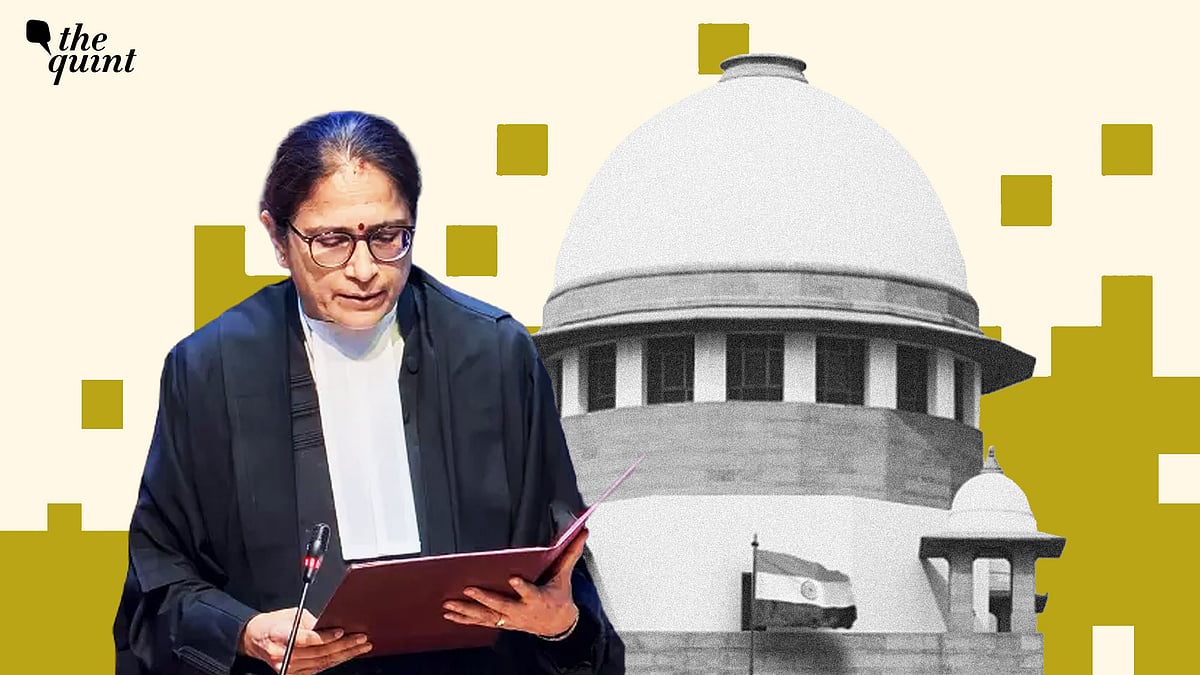
After a gap of over five years, the Supreme Court of India has finally welcomed another woman judge to its bench. On 2 June 2026, Senior Advocate V Mohana took oath as a judge of the apex court, marking only the second instance in history where a woman has been directly elevated from the bar to the Supreme Court.
Her appointment, alongside four High Court Chief Justices, not only ends a prolonged wait for gender diversity in the country’s highest judicial forum but also restores the presence of two women judges on the bench simultaneously—Justice BV Nagarathna being the other. This moment is not merely a statistical addition; it is a symbolic crack in a ceiling that has remained stubbornly intact for far too long.
For five long years—between the retirement of Justice Hima Kohli in September 2024 and the swearing-in of Justice Mohana—only Justice Nagarathna stood as the sole woman among over 30 judges.
In a country that prides itself on its constitutional commitment to equality, such a reality is an embarrassment. Justice Mohana’s elevation, therefore, is not just a personal triumph but an institutional correction—one that raises a larger, uncomfortable question: why does the highest court of the world’s largest democracy remain so male-dominated, and what will it take to truly change that?
Early Career and Professional Path
Justice Mohana’s journey to the Supreme Court is a story of grit, perseverance, and first-generation legal ambition. Born with no legal lineage to fall back upon, she began her practice in 1988 in Coimbatore, Tamil Nadu, at a time when women lawyers were a rare sight in trial courts. In 1992, seeking greater challenges, she shifted to Delhi and joined the chambers of Indu Malhotra, who would herself later become the first woman to be directly elevated from the bar to the Supreme Court.
Her expertise and integrity earned her the designation of Senior Advocate in 2015, a recognition reserved for the most distinguished members of the bar. Over nearly four decades, she has built a reputation not through flamboyance, but through quiet, relentless mastery of the law.
Humility & the Glass Ceiling
What sets Justice Mohana apart from many of her predecessors and peers is her profound, almost old-world humility. In an arena where senior advocates often wield their gowns like armour and their arguments like artillery, Mohana has remained conspicuously understated.
Colleagues describe her as a lawyer who lets her briefs speak, who does not demand deference but earns it through preparation and precision. She is known to wait her turn in corridors, to acknowledge junior counsel’s points with a nod, and to never deploy her senior designation as a weapon of intimidation.
She lived in a working women's hostel and supported herself by giving private tuition. Among her classmates was KV Viswanathan, who would later be directly elevated from the bar to the Supreme Court in 2023. That a first-generation lawyer from a modest, large family in Pollachi now sits on the same bench as her former classmate is not a coincidence, it is a testament to what quiet, relentless determination can achieve when opportunity meets preparation.
Yet, let us not mistake her elevation for a wholesale demolition of that ceiling—it is, at best, a significant crack. Justice Mohana is only the second woman lawyer to be directly elevated from the bar to the Supreme Court, following Justice Indu Malhotra in 2018. That is two in over seven decades. Two. The glass ceiling here is not just thick; it is reinforced by decades of institutional inertia, unconscious bias, and a seniority culture that seldom rewards women who take career breaks or face systemic discrimination at the bar.
Numbers of Women Judges
But one judge, however brilliant, cannot change a systemic imbalance. The numbers across the country tell a sobering story. As of today, the Supreme Court has a sanctioned strength of 38 judges, yet with Justice Mohana’s appointment, the strength stands at 37—and out of these, only two are women: Justice Nagarathna and Justice Mohana. That is a meagre 5.4 percent. In the high courts, the picture is hardly better.
Across all 25 high courts, the proportion of women judges has rarely crossed 15 percent, with several high courts still having no woman judge at all. States with large populations and complex legal needs continue to be adjudicated by benches that look nothing like the diverse society they serve.
It is time to move beyond tokenism and treat gender diversity on the bench as a constitutional imperative, not a charitable concession. Women judges bring not a different set of laws, but a different set of lived experiences, to cases on sexual harassment, matrimonial rights, property inheritance, bodily autonomy, and workplace equality. The government must clear those recommendations without delay. And the bar must encourage its young women to see the bench as a destination, not a mirage. Justice Mohana has shown the way. Now, it is for the institution to build a highway, not leave the next woman to find another crack in the ceiling.
The Road Ahead
Justice Mohana's elevation is undoubtedly a moment of celebration for the bar, for the court, and most of all, for every young woman who has been told that the highest corridors of justice are not built for her. Her journey from a first-generation lawyer in Coimbatore to a direct elevation from the bar to the Supreme Court is a testament to what individual excellence can achieve, even against a system that rarely rewards patience in a woman.
Justice Mohana has done her part. She has earned her robe, her place, and her legacy. The question now is whether the institution she joins will do its part or wait another five years to remember that justice cannot be blind to gender when it sits in judgment.
Ultimately, the presence of women on the bench is not a question of charity or even representation for its own sake. It is a question of legitimacy. A Supreme Court that does not reflect the diversity of the nation it governs risks delivering justice that is, however unintentionally, incomplete.
(Areeb Uddin Ahmed is an advocate practising at the Allahabad High Court. He writes on various legal developments. This is an opinion piece and the views expressed above are the author’s own. The Quint neither endorses nor is responsible for them.)
- Access to all paywalled content on site
- Ad-free experience across The Quint
- Early previews of our Special Projects
Published: undefined