In Stats: India’s Lower-Order Heroes, Virat’s Captaincy and More
Take a look at the third Test between India and England through numbers.
advertisement
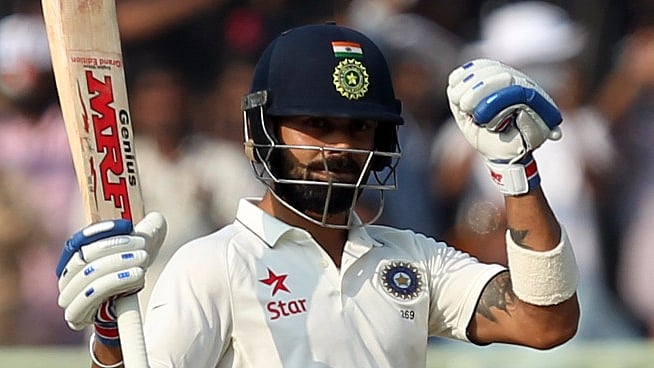
The Virat Kohli-led Indian team ensured that they cannot lose the home series against England after they defeated the visitors in the third Test to go 2-0 up in the five-Test rubber.
The eight-wicket win in Mohali, coming at the back of the 246-run victory in the second Test at Visakhapatnam, means even if the visitors fight back, they can at best only level the series.
England, still trailing India by 56 runs at the start of the fourth day’s play, were bowled out for 236 in their second innings, leaving India to score 103 runs to win the Test match. Though the home team lost opener Murali Vijay in the second over, an 81-run partnership between opener Parthiv Patel and Cheteshwar Pujara almost sealed the deal for India.
Though the latter perished with India within striking distance of victory, the 31-year-old Parthiv ensured he completed the job and struck the winning runs, with captain Virat Kohli looking on from the other end.
Courtesy the commanding win in Mohali, India extended their unbeaten run to 16 consecutive Test matches. India’s longest undefeated streak is 17 Test matches – between September 1985 and March 1987.
Come the Test match in Mumbai that begins on 8 December, and the Chennai Test subsequently, India have the chance to equal that undefeated streak and possibly better it too.
The win in Mohali also meant that India are now undefeated in their last 17 Test matches at home. The last time India lost a Test match at home was against England in December 2012. Since then, India have won 14 Tests and drawn three matches – having played against England, Australia, West Indies, South Africa and New Zealand.
The win also extended Virat Kohli’s superb run as India’s Test captain; he has now led India in 20 Test matches and has 12 Test wins – just as many as MS Dhoni had after his first 20 Test matches. The result in Mohali also means that India are unbeaten (in a series) since Virat Kohli took over as India’s regular Test captain.
Under Virat, India drew a Test series in Bangladesh, have won Test series in Sri Lanka and West Indies, have defeated South Africa and New Zealand at home, and are now sitting with an unassailable 2-0 lead against England.
Not only has Virat Kohli marshalled his troops brilliantly as captain, he has also performed admirably with the bat. In the 20 Test matches he has been captain, he has so far notched 1861 runs – more than any other Indian captain had scored in his first 20 Test matches as the leader of the side.
What makes India’s win in Mohali special was that it came on the back of what turned out to be match-winning contributions from the lower order. It was for the first time in India’s Test history that the batsmen batting at number 7, 8 and 9 had scored half-centuries.
Ravichandran Ashwin made 72, Ravindra Jadeja scored a career-best 90 and Jayant Yadav scored his maiden half-century. The aggregate of 217 runs by India’s spin trio in the first innings is the second-highest runs scored by numbers 7-8-9 in India’s Test history.
One should also realise that it is not often that a team wins a Test match on the back of runs scored by its lower order batsmen. In the Mohali Test, India emerged victorious after Ravindra Jadeja had finished as the team’s top scorer in the match with 90.
It was only the fourth time that India had gone on to win a Test match with the batsman batting at number eight being its highest scorer in the match. The last time one got to see such a feat in Indian cricket was 16 years ago, in Bangladesh’s inaugural Test in November 2000, when Sunil Joshi top scored for India with a patient 92.