
NRI Sabha Was Once a Beacon of Hope for Punjabis Abroad. Now, It Faces Ruin
Failure to hold elections to the NRI Sabha has become a highly contentious issue over the last few months.
advertisement
Mandeep Singh, a resident of Punjab's Mohi Village, had moved to the US in 2005 in search of a better life. Having settled in California's Modesto town, he used to drive a truck for a living and was the sole breadwinner for his family of three: his wife, son, and mother.
His father, who was back home in Punjab, used to look after the family land in the Mand Tihara village, which falls under Ludhiana's Sidhwan Bet tehsil. After his father passed away in 2018, Singh came back to his village and transferred the Power of Attorney (PoA) for his land to another relative before returning to California.
Documents Forged To Illegally Acquire Land
For nine months, from March to December 2023, Singh had no idea that his property had been acquired and sold off without his consent.
"In December 2023, my relative had gone to sort out his own property papers at a municipal office. That's when he came to know that somebody had sold my land illegally, and immediately informed me of the fraud that had taken place," Singh says while speaking to The Quint.
When, despite repeated attempts by his relative there was no change in the land's ownership, Singh decided that the only option he now had was to come back to Punjab and fight the case legally, which he did in November 2024.
"It took me one year to leave everything behind. I'm the only earning member of my family. My son is 35 years old, but he's mentally disabled. And my wife and mother remain unwell," he says.
He has been in Mohi for over a year now, trying to achieve a breakthrough in the case. During his stay, he alleges that he was even attacked by criminals connected to the mafia. While he escaped unhurt, a friend of his sustained a bullet injury.
Currently without a job, he says his family in the US is making do with whatever little savings they have left while he fights to wrest his land from the mafia.
A Beacon of Hope for NRIs
Illegal encroachment of land has become one of the most serious issues facing Punjabi NRIs of late. According to the Punjab State Commission for NRIs, nearly 50 percent of the complaints they receive on average from NRIs relate to illegal land grabbing and property disputes.
This issue isn't new and has been ongoing for years, allegedly enabled by the land mafia in the state, who forge fake documents and PoAs, also known as Vakalatnama.
"The Sabha was started in a small room I had rented just in front of my office in Jalandhar," SK Chopra, one of the people who co-founded the Sabha, tells The Quint.
"Jo NRIs Punjab aate the, koi unhe poochta nahi tha (The NRIs who used to come to Punjab, nobody used to care for them)," says Chopra, now in his 80s and retired.
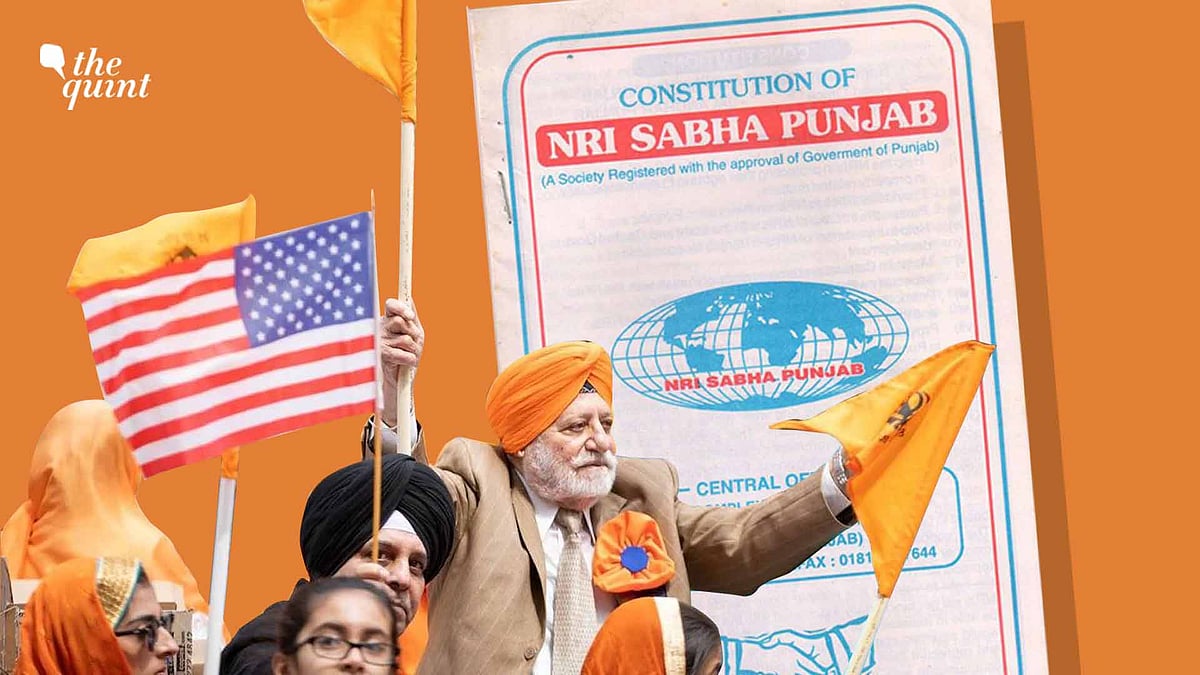
The Sabha, while formed in 1996, came into existence in 1998 after its formal registration when the Akali Dal government headed by Parkash Singh Badal was in power. The Sabha had a proper Constitution and bye-laws, provisions for holding elections to the post of president and different district committees. The Punjab government also got involved, with the chief minister serving as the body's chief patron.
Chopra said that NRIs who wanted to become members just had to give a one-time nominal fee.
"But even apart from that, we received donations from many because they could see the differences on the ground. Our organisation was very active," he adds.
While resolving property disputes made up most of the Sabha's workload, they were also involved in assisting NRIs who wanted to invest in Punjab, pursuing their interests and grievances with the state government, providing legal and other facilities to them if required whenever they visited the state, and helping them maintain cultural ties with Punjab.
The Waning Influence of the Sabha
While the Sabha functioned well for the first 10-15 years after its formation, it gradually started slowing down, multiple people connected with the body told The Quint. The reasons were many: from a lack of interest shown by different parties that came to power in the state to next generation NRIs not willing to come to or invest in properties in Punjab anymore.
Some say that while the Sabha initially received active support from the Badal government upon its formation, that support gradually declined over the years amid frequent changes in power in Punjab.
Moreoever, at one time, the Sabha boasted of a 25,000-strong membership. Now, several have quit, and many of those who are still members aren't active anymore.
When asked whether he approached the Sabha for help regarding his land dispute, Mandeep Singh said that he did ponder upon it, but later felt that it's just a "waste of time".
Jagjit Singh Sodhi, who served as the president of the Sabha's Kapurthala district in 2011, too, feels that the body's relevance has been on the downslide over the years.
"NRIs aren't interested anymore, neither are governments that have successively come to power over the years," Sodhi tells The Quint.
An agricultural business owner, he says that at one time, members of the organisation used to sit with disputing parties and hammer out solutions pertaining to property disputes. "In 80 percent of the cases, we used to be successful in reaching a compromise," he says, remembering the organisation's early days.
Plea Submitted in High Court to Expedite Election Process
In the last few months, elections to the Sabha has become the most contentious issue for multiple stakeholders connected to the body—acting as a deterrent to the organisation's day-to-day functioning.
The last election was held in January 2024. Parvinder Kaur, a former resident of Australia, became the first woman to emerge victorious and assume the body's presidency. However, her tenure has not been free of controversy.
According to the organisation's bye-laws, elections for the post of president need to be held every two years, and the process to elect the new president needs to begin at least 90 days before the expiry of the two-year term.
"The Sabha's relevance is reducing because it's not being run properly," says Karan Randhawa, a member of the organisation who has submitted a petition in the Punjab and Haryana High Court calling for polls to be held at the soonest.
Randhawa, a former resident of Australia who served as a coordinator for NRI affairs with the country's government, has accused the Kaur committee of "constitutional violations" and "unilateral functioning".
As per the Sabha's bye-laws, the president needs to convene an Annual General Meeting (AGM) every year and form a Central Executive Committee, among other smaller committees. However, Randhawa alleges, Kaur failed to uphold any of those requirements.
"During her tenure, no AGM was held and no Executive Committee constituted, despite constitutional provisions mandating annual meetings," he tells The Quint.
Randhawa had submitted his plea in court on 1 December 2025 calling for elections to take place. On 23 December, the Divisional Commissioner of Jalandhar, who is an IAS officer and de facto chairman of the Sabha, said that the election process had already been initiated and the election schedule had been sent to Chief Minister Bhagwant Mann for approval.
Based on the Divisional Commissioner's affidavit, the court observed that the relief sought by the petitioner, Randhawa, was no longer valid, and ruled that the plea is now incongruous.
"The chief patron of the NRI Sabha is the chief minister. Without his permission we cannot conduct the elections," says Mandeep Kaur, Executive Director of the Sabha and a Provincial Civil Service (PCS) officer.
"The procedure to start the election hasn't been put into effect yet, which takes place 3-4 months. Parvinder Kaur's term ended on 4 January. At that time the election procedure, which is mentioned in the by-laws, wasn't initiated," she tells The Quint.
Kaur had taken up the post of Executive Director in December last year. She said that upon assuming the post she had written to the chief minister for approval regarding the election process through the Secretary, NRI Affairs. However, she hasn't heard back yet.
"As soon as we get permission, we will issue a notification and start the process. Once the president is elected, work will start full-fledged," she says.
The Quint has reached out to Punjab NRI Affairs Minister Ravtoj Singh, but did not hear back.
Allegations of Wrongdoing Against Kaur
Apart from the alleged failure to conduct an AGM and form committees, Randhawa levelled several other allegations against Kaur while speaking to The Quint.
He says that former Punjab NRI Affairs Minister Kuldeep Singh Dhaliwal had issued an order in January 2024, asking for five office-bearers to be appointed in various positions in the Sabha. This included Randhawa in the post of Secretary as well. However, Randhawa says, he wasn't even informed about it.
A letter written by former Punjab NRI Affairs Minister on 31 January 2024 directing the appointment of Randhawa and four others as office bearers in the NRI Sabha.
(Photo: Accessed by The Quint)
Further, the bye-laws require monthly income and expenditure statements to be prepared and placed before the Executive Committee to ensure transparency. Randhawa alleges that these disclosures weren't made available to members, raising concerns of "financial accountability".
"I even sought financial information under the RTI (Right to Information) Act. However, the information was not furnished," he adds.
When asked whether he would stand for elections for the post of president whenever they are held, Randhawa says that while he had initially planned to, he will now support Peter Sandhu, an NRI from Canada, for the post.
Sandhu, who has been in Canadian politics since 1986 and also served as a former MLA of Alberta, says that he has returned to Punjab for good to fight the NRI Sabha polls.
Seconding the allegations levelled by Randhawa against Kaur, Sandhu says that the latter didn't have a team in place during her tenure, including district committees, and only appointed a district president in Moga— "unconstitutionally" and "without holding any election for the post".
As per a letter dated 7 January 2024, a woman named Harcharnjit Kaur Gill was appointed Provisional President of the Sabha's Moga district until fresh elections are held. The reason given was that since there are no committees in place in the districts, the units "are not functioning properly".
The letter appointing Harcharnjit Kaur Gill as Provisional President of the NRI Sabha's Moga district unit.
(Photo: Accessed by The Quint)
'This is Personal Vendetta, Harassment': Parvinder Kaur
Meanwhile, Kaur said that the allegations raised by Randhawa were "personal vendettas" and "harassment".
"He is not only defaming me, but the society as well," Kaur said while speaking to The Quint, adding, "He can't level allegations without due diligence."
Kaur says that the allegations raised by Randhawa were in the petition submitted by him in the Punjab and Haryana High Court and were "disposed of". She further said that the allegations he made were "investigated" and "found baseless".
When asked to respond to specific allegations levelled by Randhawa, such as alleged failure to furnish income and expenditure statements, and not informing him of Dhaliwal's letter appointing him as an office bearer, Kaur was non-responsive.
When prompted about whether she had held an AGM during her term, she said, "All proposals were sent to the CMO [Chief Minister's Office] for the holding of an AGM and district elections." However, she did not respond when asked to share a copy of the same.
Amid all the legal turmoil, administrative paralysis, and war of words over the leadership, veterans who have been associated with the Sabha since the time of its founding are growing apprehensive of the body's revival.
The North American Punjabi Association on 2 January also termed the Sabha a "non-performer" and called for its performance report to be made public before any fresh elections are conducted.
Similarly, Jagjit Singh Sodhi, another old hand, remains optimistic about the organisation getting back on its feet. When asked why he hasn't left the Sabha despite the body's drawbacks, he says:
- Access to all paywalled content on site
- Ad-free experience across The Quint
- Early previews of our Special Projects
Published: undefined