Hola Mohalla: Where the Colour of Oneness Subdues All in Punjab's Anandpur Sahib
I have come to witness Hola Mohalla — the three-day Sikh festival that coincides with the festival of colours, Holi.
advertisement
It’s a sunny day in Anandpur Sahib, the ‘holy city of bliss’ nestled in the Shivaliks, along the banks of the Satluj river in Punjab.
Usually white, the city is decked with colours. Saffron, yellow and blue Nishan Sahib flags flutter from rooftops and gurdwaras, while colourful clouds of gulaal drift through the air. The roads are overflowing with thousands of cars, tractors, buses, trolleys and pedestrians — inching forward in long lines. Hundreds of horses trot past the crowds, and somewhere in the distance, a few camels and elephants grace the procession. Lakhs of people have gathered here from across Punjab and beyond.
At the centre of it all stands tall the Takht Sri Kesgarh Sahib, one of the five temporal thrones of Sikhism, where the Khalsa Panth (literally: pure order, or the one belonging to the Sovereign) was inaugurated.
I have come to witness Hola Mohalla — the three-day Sikh festival that coincides with the festival of colours, Holi. Started in 1701 by the tenth Sikh guru, Guru Gobind Singh, Hola Mohalla was envisioned as a wartime celebration. Mohalla literally translates to a place of attack or fictitious battle whereas, Hola is the masculine derivative of the word Holi. Together, they express the idea of a grand mock attack on Holi.
Even today, the celebrations unfold through displays of the Sikh martial art Gatka, mock battle drills, sword-fighting, horseriding, tent-pegging, and other equestrian games. As red gulaal shrouds the air above, the colour evoking not just the joy of spring but also the memory of battle.
(Photo: Jaspreet Singh)
(Photo: Jaspreet Singh)
(Photo: Jaspreet Singh)
A Visit to Remember
This is not the first time I’m witnessing the festival here. I had once attended it as a child in 2014, but my memory offers little recollection of the day.
As I deboard the train on 4 March, the day of Holi, I am joined by my friend, Balpreet Singh, and two more of his companions – all from Delhi. They have been attending the festival for many years now, and were willing to show me around. Upon exiting the station, we are greeted with the warcries of Bole So Nihaal and devotional hymns playing on loudspeakers mounted atop slow-moving vehicles. We walk.
Langar or free community kitchens are being organised every few metres. Countless stalls in a special market offer everything from handcrafted swords and religious texts to toys, kitchenware, and lemonade to beat the heat.
(Photo: Jaspreet Singh)
One stall stands out: Muslim perfume traders selling ittar beside the Sikh shrine, surrounded by customers testing fragrances. At a time when some religious towns have tried to exclude Muslim vendors, the scene here feels quietly defiant. Punjab has a long history of Sufi Islam, with the hymns of one Baba Sheikh Farid recorded in the Guru Granth Sahib — the central text, considered to be the ‘eternal guru,’ of the Sikhs.
Free Kitchens, Open Homes: The Anandpuri Spirit
We climb uphill to the fort city and pray to the Takht on our right. We are headed to the other side of the town where a local family has kindly agreed to host us and dozens of other devotees visiting the city for Hola Mohalla. This is a common practice in town.
(Photo: Jaspreet Singh)
(Photo: Jaspreet Singh)
This is the house of Simardeep Singh, a part-time photographer who is currently working at a factory in Italy. Our host is his wife, Ishmeet Kaur, and their family. There are scores of mattresses and blankets spread across their house — in the bedrooms, living room, verandah and terrace.
Devotees from across the country, many from Delhi-NCR, are staying at their home. Many of them are also Nihang Sikhs. The family has opened up their kitchen – everyone is free to walk in and grab whatever they like. Ishmeet is also preparing fresh, hot meals at the request of the sangat, the holy congregation.
The house is bustling with activity, just as the streets outside. In one corner, someone’s napping after a long journey while in another, a group of devotees is chatting. The two mirrors in the corridor are thronged by Sikh men and women who are tying their dastars and dumallas, the traditional round turbans.
Ishmeet also ties a dastar, many Sikh women do. This represents not just commitment towards the Guru but also the egalitarian principles of Sikhism — a turban is traditionally worn only by the male heir but the Sikh school of thought extends it to everyone.
“Whenever sangat comes here, either for Hola Mohalla or for any other religious programme, we host them at our house. Everything we have is given by the Guru, even this seva is being carried out by his blessings,” Ishmeet tells me. Seva is the Sikh concept of selfless service.
“I was born into a Hindu family in Sonipat, Haryana but had always been influenced by the Sikh way of life. I formally converted to Sikhism in 2014 after taking part in the Amrit (baptism) ceremony at Gurdwara Sis Ganj Sahib in Delhi. While my family initially resisted when I shared my feelings with them, they were very happy after I chose this path.” Ishmeet married Simardeep in 2017 and has since been living in Anandpur Sahib.
After changing clothes, we head up to the terrace, where the family has arranged langar. Even the visitors joined them in preparing and serving the food, cleaning utensils, and so on. The langar here starts as early as 6 am and goes on well after midnight. We treat ourselves with hot rotis, kadhi rice, dal, curd and sweet jalebis. Milk, tea and coffee are served multiple times a day. All, completely free of cost.
Nihang Singhs: The Guru’s Blue Army
It is midday now. We say our thanks, leave behind our bags, and rush towards Gurdwara Shahidi Bagh Sahib, a historical site where Sikhs who attained martyrdom during the multiple battles of Anandpur Sahib were cremated. The Gurdwara is run by the Nihang Sikhs, an organised warrior order within the larger Sikh community, devoted to the school of thought of leading a saint-soldier life. The lineage was started by the tenth Guru, a few years after the formation of the Khalsa order in 1699 CE. There are two main factions of Nihang Sikhs — the Buddha Dal or the order of the elders, and the Taruna Dal or the order of the youth — both formed by the Dal Khalsa in the 18th Century as formal armies of the Sikhs. The Buddha Dal is the primary group that acts as a guiding force for the latter as well as some other outfits which were later formed.
(Photo: Jaspreet Singh)
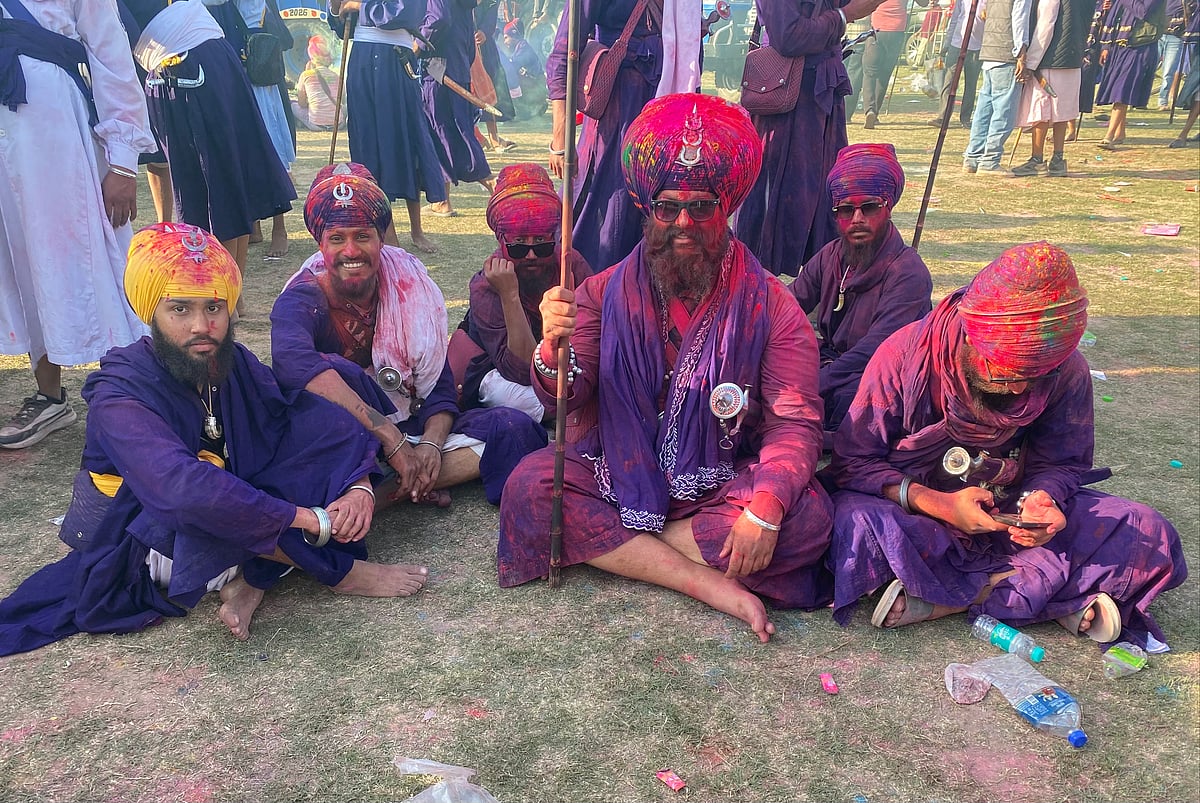
This Gurdwara marks the formal start of the mock attack. Nihang Sikhs clad in blue martial attire — chola or a long-flowing blue tunic, paired with kachhera or a white knee-length knickershorts, and big blue turbans adorned with small swords and chakkars (disc-shaped throw weapons) —lead the procession on horses. Multiple swords, spears, bow-and-arrows and other traditional weapons shine bright on the xanthic blue under the glaring sun. A few rifles and pellet guns are also seen in the crowd.
While every Nihang Sikh wears blue, not everyone draped in the traditional attire is a full-time member of the order. Many Sikhs occasionally wear the attire simply to represent their heritage and culture, while leading a professional life as corporate employees, engineers, doctors, business owners, etc. Contrary to popular belief, many Nihang Sikhs today are well-educated, speak English as fluently as Punjabi, and lead modern lifestyles while keeping their heritage alive. That includes my friend Balpreet, who owns a dairy equipment manufacturing unit in Delhi.
Mohalla: The Mock War Games
After offering prayers at the Gurdwara, the Mohalla starts with beating of the nagara war-drums and sounding the giant war bugle, narsingha. One by one, the blue-clad armoured armymen of the Guru charge into the streets, their horses galloping forward, carving a way into the clamouring crowds. A sea of colourful turbans and scarfs greet them with cheers of "Bole so nihaal". The Sikh jaikara is answered by the crowd with “Sat Sri Akal.” Literally, the victory call translates to: “Whoever says so shall be exalted: True is the Timeless Lord”.
The warriors march past the Takht, seeking blessings of the Guru, and head towards the Charan Ganga Stadium, where the war games have been held since the time of the tenth Guru. They visit a few other historical sites on the way, making it a roughly three-kilometres-long stretch. As the armies charge on their horses, the devotees follow them into the stadium on foot or on tractors, trolleys and vehicles. But given the traffic, walking is ideal. We are also on foot. We take another route to reach the stadium. There’s plenty of drinking water available along the route to give respite from scorching heat.
The stadium is located on an open ground on the northern outskirts of the city. The peak of the Naina Devi Temple, now in Himachal Pradesh, is as perfectly visible from here as from the top of the many forts of the city. There are seating areas only on the south and west sides. The other two sides are surrounded by open fields, where many visitors have parked their jeeps and tractor-trolleys. Some are also sitting on the ground. Some are lucky enough to sit on the rooftops of the nearby homes; others have climbed up the trees, gaining an aerial view of the Khalsa valour.
Through the loudspeakers, the organisers pleaded to the Bhagwant Mann-led Punjab government and the Rupnagar district administration to expand the stadium and provide better seating to accommodate such a large gathering. Punjab is an election-bound state, but apart from some civic calls, the celebrations remained largely apolitical. The administration had also given its annual pledge to keep the festival single-use-plastic-free. But the arrangements made were far from reality. In the absence of dustbins, the city streets and drains were littered with disposable plastic water bottles and cutlery.
Within an hour, various Sikh groups enter the stadium, one by one. Leading the procession was the Buddha Dal – Nihang Sikhs on horses, elephants and camels, with many flying their pet falcons. The tenth Guru also had a goshawk, and is hence lovingly called Baajaan Wala. So the royal sport of falconry is famous among Sikhs.
(Photo: Jaspreet Singh)
(Photo: Jaspreet Singh)
(Photo: Jaspreet Singh)
(Photo: Jaspreet Singh)
Here, they performed various mock drills, and displayed skills beyond excellence. The most famous one being a single horseman riding up to two or three horses at once. They sang war ballads, beat war drums, and threw gulaal into the air and on each other.
As the sun inched towards the horizon, the armies headed back to Gurdwara Shahidi Bagh Sahib. It’s now time for evening prayers, to thank the Guru for an uneventful day of bliss. The Nihang Sikhs also worship their weapons, in line with the Sikh scriptures, revering them as metaphors for the Divine’s power and justice.
At night, we head out to the festival market alongside the Gurdwara. Sikligar Sikhs, the traditional forgers, have come from as far as Madhya Pradesh and Maharashtra to sell handcrafted swords, spears and other weapons. This is where I saw yet another stall of Muslim ittar sellers, standing out among a sea of Sikh traders and devotees.
A Journey Back to Long-Lost Home
That Punjab welcomes all is what I’ve often heard, but witnessed firsthand in Anandpur Sahib.
As a Sikh living outside of Punjab, my relationship with the motherland is largely shaped by its memory – both of my own visits and the collective memory of the Sikhs and Punjabis around me. We are a Partition family, uprooted from the Northwest Frontier Province in 1947-48 and resettled in Faridabad in 1952.
While discussing the pain of the Partition of Punjab (and Bengal), a community elder once made a remark that has stayed with me to this day. “We were uprooted from that fag end of Punjab and resettled to this very end, only to be again separated from our homeland.”
He was referring to the reorganisation of Punjab in 1966, when Haryana and Himachal Pradesh were carved out as separate states.
Naturally, the descendants of the resettlers grew up speaking the dominant native tongue, Hindi. Learning one’s own mother tongue became a mammoth task — one often facilitated by free Gurmukhi classes in gurdwaras for many like me.
Yet the moment I arrived in Anandpur Sahib, that distance dissolved quickly. Despite coming from outside Punjab and dressed in western clothing — looking like what many might jokingly call a bhapa (traders from West Punjab) — I was welcomed without question.
Guru’s Message of Oneness
Mainstream media often portrays Nihang Sikhs as fierce, rigid or intimidating figures. Even many Sikhs in Delhi would often call them orthodox and trigger-happy.
But walking among them here, and spending a night with many of them at Simardeep’s residence, I found something entirely else – they are simple, loving people, devoted to the Sikh cause of oneness.
There was a sense of loving openness in which devotion mattered more than appearance, love mattered more than religion, and any outsider would feel completely at home.
Devotion mattered more than appearance. No one asked who you were, where you were from, or why you were here. Here, you had just one identity — someone who had come to seek the blessings of Guru Gobind Singh Sahib.
Just like the many colours of gulaal blend into one another while playing Holi, the many sects, identities and outward differences within the society seem to blur into a shared Khalsa spirit during Hola Mohalla.
This is the forever rising spirit of bliss, Chardikala. And this is the holy city of bliss: Sri Anandpur Sahib.