Dear Modi Ji, Your ‘Surgical Strike’ Brought the Nation to a Halt
“What led to this suicidal move is beyond explanation,” says The Quint’s reader Deepak Jha.
advertisement
Dear Modi Ji,
The central government, without applying mind as observed by Kolkata High court during the hearing of a PIL filed against demonetisation, launched a disastrous scheme, scrapping Rs 500 and Rs 1,000 notes in a surprise announcement dated 8 November 2016.
The move being hailed as a ‘surgical strike’ against black money sent the public into celebration. However, the catastrophic consequences after the drive started are quite evident from the observation of Supreme Court when it said, “the situation is serious and there may be riots”.
What led to this suicidal move is beyond explanation as of now, but what has been said is that it would tackle the menace of black money, counterfeit notes in circulation and bring an end to the terror funding through Pakistan. The move being highlighted as a ‘little’ inconvenience for the larger good finds no place when one realises that there have been 60 deaths within 12 days of its introduction.
‘Testament to Bad Preparation’
The resulting chaos is enormous, and an excessive impact has been felt by the poor, workers from unorganised sectors, farmers, MSMEs, etc.
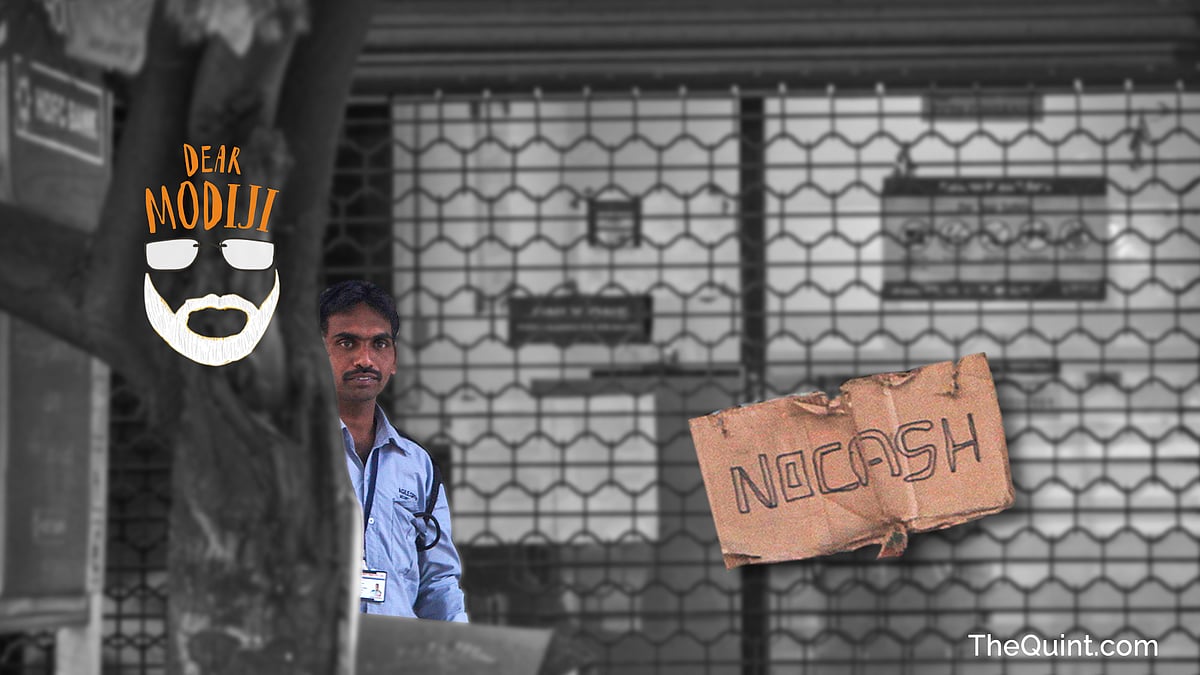
Business has been brought to a halt, a large amount of productive man-hours is being wasted by standing in unending queues. The impact has been further worsened by ineptitude in implementation. ATMs were not fit to dispense the new notes and a recalibration is going on – just an example how inefficient and badly planned this has been. Not enough cash has been made available and banks are stretched beyond capacity.
The policy change on withdrawal limits every second day is another testament to bad preparation. The new Rs 2,000 notes are turning out to be unhelpful for small daily needs. Moreover, the lack of cash has reduced demand and consumption, and is effecting sales, production and employment.
Let’s discuss the rationale given in support of the move one by one:
‘Surgical Strike’ Against Black Money
A very small portion of cash being received from tax evading machinery, which we call ‘black activities’, is in the form of cash, almost never with big players. Black money is not a stock but a flow, a flow that may go through many channels like gold, real estate, shares, and foreign currencies and finally into tax heavens.
A rough calculation according to sources says that less than six percent of the total budget outlaid money is in cash and well, that may or may not be recovered though demonetisation. Cash recovery has been only six percent of the undisclosed income seized from income tax evaders, according to data from tax raids from 2012-13 onwards.
This move will, however, touch a very tiny fraction of such money, while it does not address the source of it that includes bribery/corruption, inaccurate sales data, over-reporting cost and non-existing transactions. Even if it does, recovering such a tiny fraction does not deserve such a step, which has had a severe impact on the poor.
Plastic Economy - A Distant Dream
India is a cash economy with more than 80 percent of the deals going through cash transactions. Less than three percent of the working class actually pays income tax. But a larger section of people transact through cash because of habit, poverty or less access to banking sectors, and they constitute largely those whose yearly income varies less than that of the permissible tax exemption level.
The inadequacy of bank branches is one primary reason why cash dominates small businesses. Many rural branches are open for just a day or two in a week. Even if they are made to transact through plastic currency, there is not much infrastructure to support this as we have 14 lakhs card swap machines for a population of 1.30 crore.
The cashless economy is still a distant dream, courtesy limited banking penetration, internet, and most importantly, power facilities.
Countering Counterfeit Notes
Counterfeit notes are the fake notes being pushed into circulation and hampering the economy of the country. As per the latest data from India Statistical Institute, there are around 250 counterfeit notes in circulation for every 10 lakh notes. This corresponds to 0.025 percent of the total money currently into circulation. Although that number is not negligible, such a huge step to weed out such a small percentage is overkill.
KC Chakrabarty, ex-deputy governor of RBI, recently said that if you buy 1 kilo of rice and there are a countable number of pebbles in it, you weed out the pebbles and don’t through away all the rice. There is no guarantee that the new notes will not be counterfeited; their features are the same and it’s even easy to print fake ones, if we talk about the new Rs 2,000 denomination. Again, the source of the problem has not been targeted but the notes have been destroyed.
Targeting Terror Financing
This rationale is just like stopping the counterfeit notes. Off-course, the cash accumulated in Rs 500 and Rs 1,000 denomination (if any) will cease to exist and might even halt the financing till the new notes are out. But the financing happening through foreign banks will clearly escape the trap.
Any Political Motive?
This indeed raises doubts over whether this move has any political motive. There are elections schedule in many of the states and the ruling party seems to be losing the plot in many of them. The ignorance of the ruling dispensation over critical matters like black money had started to bring the government down in the eyes of the people. So, it looks largely like earning brownie points and maintaining the headlines of the country to gain political mileage, showing the prospective voters that they are quite serious about tackling black money.
UPA Said ‘No’
The RBI’s ex-deputy governor KC Chakrabarty, when asked whether there was any such proposal from the previous UPA government, replied in the affirmative. He said that they said a clear NO to this as it was perceived to bring more chaos those benefit. The proceedings did not come to the media then and the plan was disposed of.
A flourishing black market has emerged for the old notes, trading at a 20 percent discount. Big players can get away with small losses and plan on restarting their illegal activities once the new notes are fully in circulation.
“It is unclear whether this exercise will achieve any lasting results other than having created a national economic crisis, destroying confidence in the national currency and unleashing tremendous suffering for ordinary Indian citizens,” Rajiv Biswas, Asia-Pacific chief economist at HIS Global Insight, said.
Regards,
Deepak Jha
(The author is a software engineer from Hyderabad. This is a personal blog and the views expressed above are the author’s own. The Quint neither endorses nor is responsible for the same.)