Mann Purana Papi Hai: Iqbal’s Disputed Religious Beliefs & More
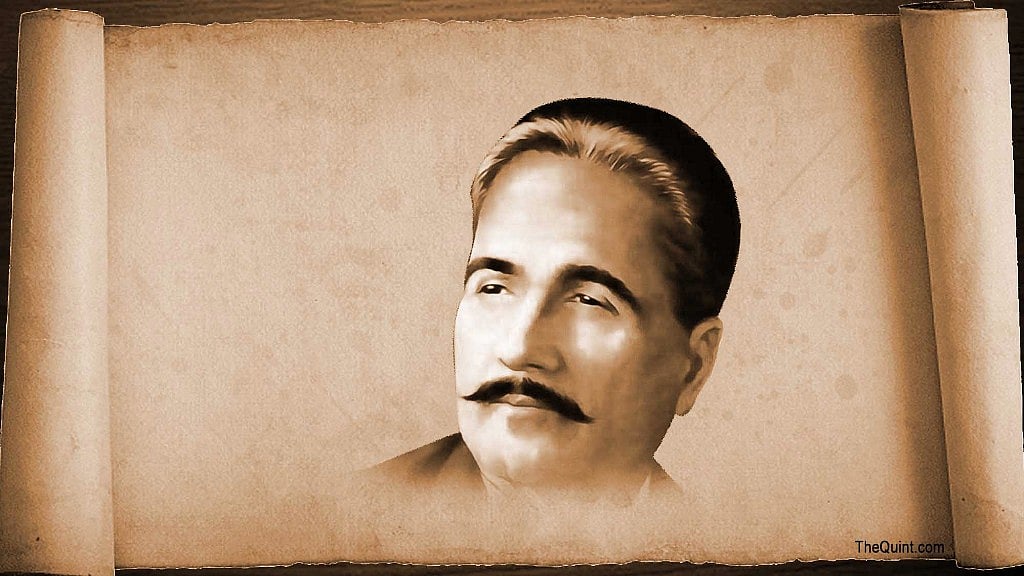
9 November marks the 140th birth anniversary of the Urdu poet, Allama Iqbal.
advertisement
One of the most well known (and perhaps abused) Urdu couplet by Allama Iqbal is:
Khudi ko kar buland itna ke har taqdeer se pehle
Khuda bande se khud puchei bata teri raza kya hai.
(Hoist yourself so high that even God asks you for consent before deciding your fate.)
The couplet is specially relevant today not simply because of its sense of hope and determination, but also because 9 November marks the 139 birth-anniversary of Iqbal.
Influence of Western Thought on Iqbal
During his life of a little over six decades, Iqbal wrote copiously on politics, religion, philosophy, and often borrowed from Western European thought. Commenting on his Western influences, activist Sohail Hashmi says:
Iqbal’s Contribution to ‘Nazm’
In the same thread as Hashmi, former Jamia professor and current Senior Advisor for Rekhta, Anisur Rehman calls Iqbal a ‘pioneer’ of the Urdu nazm.
Use of Religion in Iqbal’s Poetry
The religious undertone in Iqbal’s poetry often called out on the hypocrisy of institutionalised faith.
Masjid to bana di shab bhar mei iman ki harart walon ne
Mann apna puraana papi hai barso mei namazi ban na saka
(Those with the illusion of a character have erected a mosque within a night
But the heart is an age-old sinner, incapable of becoming pious over the years.)
However, Iqbal did not simply stop there, but also used religion to draw attention to how it was being employed to divide people.
Haram-e-paak bhi Allah bhi Quran bhi ek
Kuch baari baat thi hote jo Musalman bhi ek
(God is one, the Quran is one,
It would have been relevant if all Muslims could be one too.)
These comments on religion were often tied with the nationalist identity.
Mazhab nahin sikhata aapas mei bair rakhna,
Hindi hai ham vatan hai Hindustan hamara
(Religion doesn’t teach divisiveness.
I am an Indian, my country is India.)
However, thinkers like Shashi Tharoor see a gradual shift in Iqbal’s poetry towards what he calls religious chauvinism.
Iqbal’s Complicated National Identity
The religious essence of his poetry is one of the factors that also complicates the national identity associated with Iqbal.
An active member of the Muslim League and seen as a semantic inspiration for the Pakistani movement. Additionally, his apprehensions regarding the Indian National Congress, based primarily on the Hindu majority in the political party according to historical records further adds to the convolution.
However, Sudheendra Kulkarni differs from this strain of thought when he says Iqbal should not be confined to geographical boundaries.
On the other hand, author Saba Naqvi asserts that Iqbal stands for the “contradictions and dilemmas” of the Indian Muslims.
Sense of Disillusionment
The contradictions in Iqbal’s poetry reach a culmination of sorts with a feeling of disenchantment with the world around him towards the end of his life.
Aankh jo kuch dekhti hai lab pe aa sakta nahi
Mahv-e-Hairat hun ki duniya kya se kya ho jaegi
(What I witness cannot be expressed,
I am only shocked at what the world is headed towards.)
Over time, a sense of disillusionment becomes increasingly palpable in the poetry.
Duniya ki mehfilon se ukta gaya hu ya rab
Kya lutf anjuman ka jab dil hi bujh gaya ho
(I am tired of the world’s gatherings, dear Lord
There is no pleasure in company when the heart has lost its light.)
The works of philosophers, thinkers and poets often reflect their artistic and intellectual progression.
A similar journey can be traced in Iqbal’s work: Initial romance and idealism, followed by conflict and indecisiveness about his milieu, and finally, a suggestion of disappointment.
(On Allama Iqbal’s birth anniversary, The Quint is republishing this story from its archives. It was originally published on 9 November 2016.)