In the Climate Change Debate, Voices of South Asian Women Missing
Unlike their counterparts from other countries. South Asian women are underrepresented at climate change talks.
advertisement
There has been a shift in the way women are looked at in climate change discussions. We are being urged to stop thinking of women as victims of climate change, but as a valuable resource, capable of contributing to local, national, regional and global efforts to counter climate change.
There is probably no better example of this than Christiana Figueres, the former Executive Secretary of the United Nations Framework Convention on Climate Change.
“Empowerment of women strengthens climate action; we can make it a reality. Each member state must have gender-sensitive policies, which are more effective in making sure that they focus on climate change mitigation and adaptation,” she said during the Bonn Climate Talks in May 2016.
However, there appears to be a huge disconnect between the ‘discussions’ on gender mainstreaming, and the actual inclusion of women as meaningful contributors in climate negotiations and conferences. Even by many of the so-called “mainstreamers”.
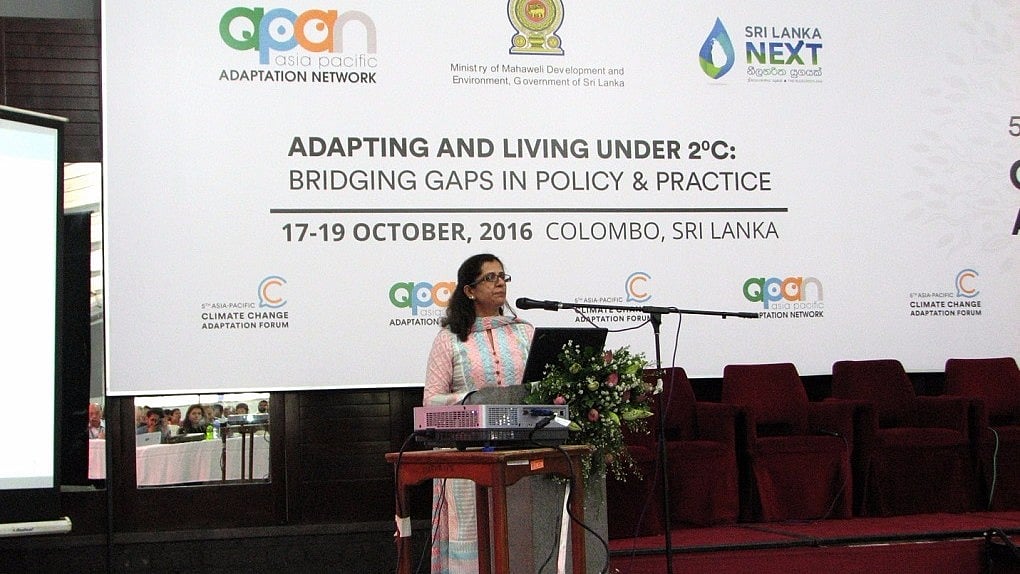
One of the few women invited was Khrienuo Metha, Nagaland’s Women Resource Development secretary. She was there for “gender representation”, one woman among five men during a high-level plenary on ‘Environment and Climate Authorities’.
Her participation was upheld for its role in ensuring ‘gender balance’ -- perhaps more for the sake of maintaining this balance, rather than adding anything from her experience.
In fact, we later learned from Metha that initially “they had invited the chief minister of Nagaland”. But “because he could not come, he had requested his environment minister to come”.
Metha may not have been the only woman to be there by accident.
While gender came up as a discussion point in these sessions, it is indicative to note that only one session out of 35 explicitly referenced gender at the APAN conference.
But it wasn’t that there were no women there. The stage was filled with women from other Asian countries. Japan, for instance, was fairly well-represented. Women also led some sessions or were part of high-level panels. But the same cannot be said for women from South Asia.
Hina Lotia, director of programmes at LEAD Pakistan, was one of the few women presenters from South Asia at the conference. “I feel that it’s not that women are less in number. It’s just that they are not active in speaking up,” she pointed out. Looking around at the hall, she said, “It’s not about women as a symbol of gender mainstreaming. It’s also about men highlighting the vulnerabilities of women.”
Is part of the problem that there are no women in top positions in South Asian countries?
Looking back at the various climate change forums in the past, Lotia observed a definite gender bias. “Policymakers and experts who we see at high-level forums and plenaries today are those who have climbed up the ladder over time. And if we look 25-30 years back, women were less represented in this group,” she pointed out.
Harjeet Singh, from Action Aid India, said structural reasons may also be to blame for this. While the sessions were going on, Singh, in response to a question on what the barriers to South Asian women’s participation in the conference could be, responded in a tweet:
For now, gender and female representation is more an ‘add-on’ rather than an integral part of inclusive climate debate.
This can only be countered if women start recognising the need to put other promising women forward. In addition, for governments, conference organisers and the entire climate change experts’ community, promoting gender participation, particularly from countries whose women are facing the greatest challenges due to climate change, should be given due consideration.
All is not lost, though, if you ask Lotia. “People who lead research are invited as speakers. Women as principal investigators for research projects are a rare commodity. Now, donors and funders are encouraging women lead research.”
“Also, the number of women going into research and specialised degrees is also increasing. The challenge would be for these women to come into the workforce,” she added.
And on the second day of the conference, Saleemul Haq tweeted this picture, showing improvement in the representation of women:
(This story was originally published in www.thethirdpole.net)