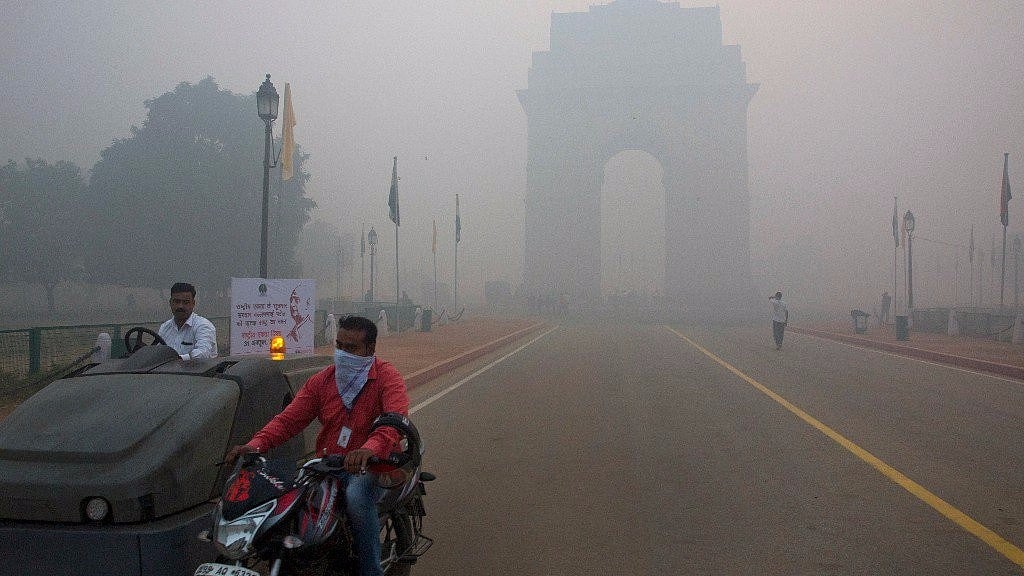
Air Quality Severe in Most of Delhi, Faridabad 25 Times Polluted
16 out of 36 regions in Delhi, where air pollution is monitored, had a “severe or severe-plus” air quality.
advertisement
With more than half of the national capital suffering a "severe or severe-plus" air quality, Delhi and the regions around it saw a sudden spike in effluents on Sunday, 28 October, with Faridabad's air 25 times more polluted than safety standards.
According to the data from the Central Pollution Control Board's (CPCB) monitoring station, the major effluent PM2.5 or particles with diameter less than 2.5mm was 1,515 microgrammes per cubic metres at 10 am, which dropped to 1,295 units by 3 pm.
The safe limit for PM2.5, the finer particles which penetrate deeper into the lungs, are 60 units as per national standards and 25 units according to the international standards.
The officials, however, believed that the data during the morning hours must be "some kind of a technical glitch".
Meanwhile, 16 out of 36 regions in Delhi, where air pollution is monitored, had a "severe or severe-plus" air quality, consistent since Sunday morning to 3 pm.
A total 18 areas of Delhi had a "very-poor" air-quality. Only two out of 36 areas monitored had "moderate to poor" air quality.
Out of 48 monitored station across NCR (including Delhi), only four had "moderate to poor" air quality while 23 stations has "severe or severe-plus" air quality and 21 were "very-poor".
In NCR, Bagpat, Bulandshahr, Ghaziabad and Sector 125 Noida in Uttar Pradesh as well as Faridabad and Gurugram in Haryana had "severe-plus" air quality.
According to CPCB, the situation may continue till Diwali, after which pollution may only get worse.