Clouds of Uncertainty: Climate Change in Leh and Ladakh
Climate change is affecting vegetation and lifestyles of people in the Turtuk village near the LOC.
advertisement
“The apricots taste different now.”
“I remember having snow up to my knee.”
“We always had rain, but never this much damage. We are afraid.”
“It’s getting hotter earlier now.”
“We don’t know why it’s happening – and we are unprepared.”
“The glaciers have receded by at least a kilometre.”
“There is no doubt that climate change is happening.”
From the city of Leh to the villages of Nubra Valley and across generations and occupations, these are voices desperate to be heard. The damage that the people here have seen over the past six years because of flash floods, mudslides, landslides and severe rains adds up to many millions of rupees.
Gulam Mohammed, owner of Shayok Guesthouse, knows about the problems due to climate changes in his village Turtuk, and in the neighbouring village of Chulungkha. He says, “The problem is that we were, and still are, unprepared for the changes that will come.”
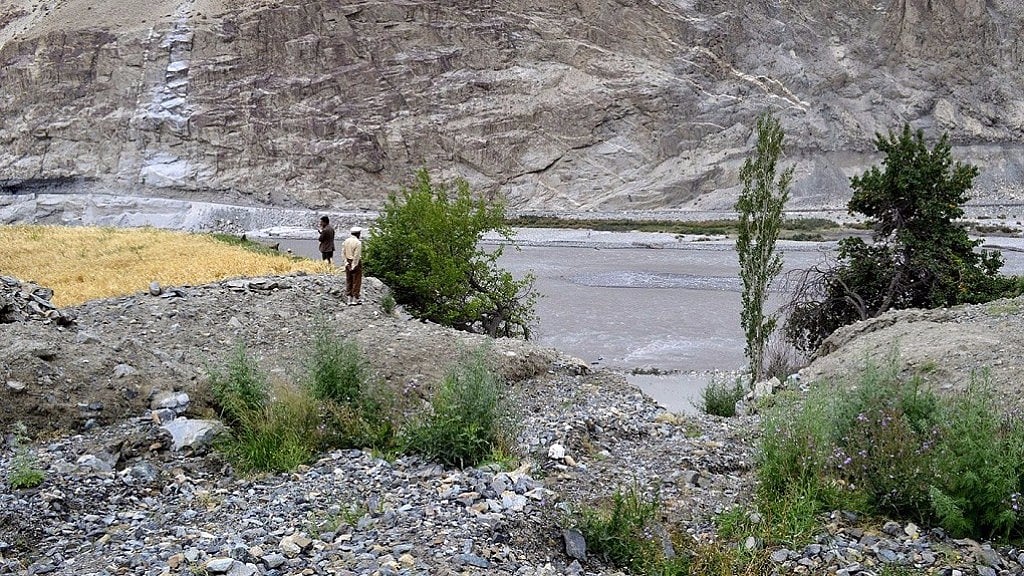
Nubra is a high altitude cold desert with bitingly low temperatures, scanty rainfall and massive glaciers. Turtuk sits on a hilltop in this region, surrounded by mighty mountains and green fields along the grand Shayok River. Located 3,000 metres above sea level, this village was once a stop-over on the ancient Silk Route.
The village is also 10 kilometres from the Line of Control (LoC), which runs across the former princely state of Jammu and Kashmir, divided between India and Pakistan since after the first India-Pakistan war of 1947-48.
The area’s proximity to the LoC means it was closed to tourism until sustained lobbying by locals changed that in 2010. This was the same year that a sudden cloudburst caused widespread destruction in Leh, killing approximately 125 people. Turtuk too received heavy rainfall that year, and has had unusual rain since then, leading to all kinds of damage.
From Traditional Roofs to Tin Roofs
Old houses in Turtuk are built using layers of, successively, wood, stone, mud, brush, grass and clay. They are not designed for heavy rain.
According to Ibrahim Ashoor, an extension officer at the department of agriculture in a nearby town called Diskit, and one of the owners of Ashoor Guesthouse in Turtuk, there are other signs of change too.
“There is no doubt about climate change,” says Sonam Lotus, Director of the India Meteorological Department in Srinagar, Kashmir. “There is an imbalance between nature and human activity. The small changes that policymakers are implementing are coming too late. We need bigger actions – from new laws on managing resources to conservation.”
Jayaraman Srinivasan of the Indian Institute of Science, Bangalore, and one of the authors of the periodic reports of the Intergovernmental Panel on Climate Change confirms, “It is the rate of change that is concerning.
Data shows that between 1973 and 2008, the temperature in Ladakh rose by 3 degrees Celsius, while in the rest of India it rose by only one degree. This is impacting the snow and rain cycles. When it rains in the desert – short but extreme spells – it is catastrophic. These places are not equipped to handle it.”
Turtuk, ceded to India after the India-Pakistan war in 1971, is made up of three parts – Farol, Yul and Chutang. It is home to the Balti community, whose territory – Baltistan – extends into Pakistan. Around 400 families live in Turtuk, according to the 2011 Indian census.
To conserve the fragile mountain environment, the Balti people have evolved intricate ecological systems such as canal water-sharing complete with a chunpa, or water watchman, whose job is to ensure equal distribution of water.
Every year, the chunpa alternates the field that receives water first during the sowing season. They have also evolved a food storage system, a cattle grazing schedule and a milk sharing system, waste systems and even a polo team selection system.
But the old ways are under siege. In recent years, along with shifts in the environment, there have been shifts in the economy and culture too. Zakir Hussain, the chunpa for Farol, is worried about the future of Turtuk.
Now, as visitors go by, Balti children shout out greetings in English or Ladakhi, a sign that they will know a very different Turtuk than their parents, who speak the Balti language.
But Kulsam Banu Bangchupa, a member of the panchayat, or local council, is adamant about building more guesthouses. “We don’t make money from our land. We need cash for illness or education, or our homes and other things.”
Gulam Mohammed adds:
Future Tense
The elders in Turtuk know how much things have changed. “When we were young men going up into the mountains, the glaciers were much closer,” says Mohammed Ishupa, “They have receded at least a kilometre.” Another elder, Mohammed Ibrahim adds, “There is no snow now, so how can we have glaciers?”
Dr Shakil Romshoo, glaciologist and head of the Department of Earth Sciences at the University of Kashmir in Srinagar, says:
Disparate Treatment
The locals are bitter that people in Leh have got help during calamities, but this small village in a corner of the world gets little attention. When sudden rainstorms caused landslides in 2014 and 2015, houses and fields were ruined, in villages like Bogdong, Chulungkha, Tiger and Sumur. The people in Chulungkha say that local officials have visited but they are still awaiting financial help.
In Diskit, Habibullah Girdawar of the state revenue department in Nubra tells us the extent of the loss.
“I have never seen damage like this,” said Zulika Bano, the goba of Tiger village.
Walking through Turtuk, Gulam Mohammed points to places where the area is vulnerable, like the bridge that connects both sides of the village. If a landslide were to occur, it would block the water from the Turtuk nala (canal) and flood the entire village.
“We have faced these problems before, but we still don’t know what to do. Maybe it won’t get so bad in my lifetime, but who can say about later?”
This article was written as part of a media fellowship awarded to the author by the environment news website The Third Pole and Earth Journalism Network, a voluntary, international group of journalists. It was first published here.
Special thanks to Gulam Mohammed, the Ashoor family, and the communities in the Nubra Valley.
Sweta Daga is a Bangalore-based writer and photographer. She is working on several multi-media projects, including fellowships with the People’s Archive of Rural India, and the Centre for Science and Environment