A Degree That Never Ends: Inside the Crisis at Jharkhand's Kolhan University
Students at Jharkhand's Kolhan University protest against exam delays which caused loss of an entire academic year.
advertisement
"Most students have given up, they don't care, they take it as their destiny. People say even if we get a job that pays Rs 10,000 we will be grateful. If you are born in Jharkhand, or live here, that is your main fault, that you are a victim of this state's education, on top of everything else." said a student from Kolhan's first graduating batch, 2009.
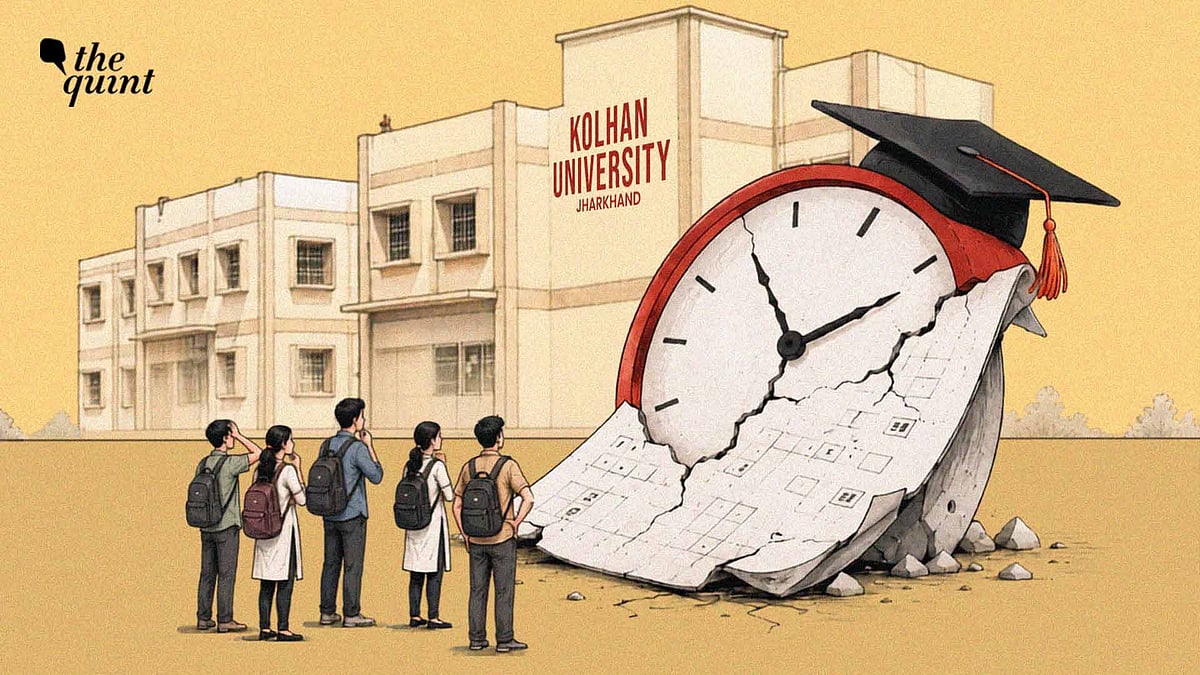
As of August 2026, the university's 2022-admitted batch, which was suppose to complete eight semesters by now, has only just attempted its sixth semester exams, a full graduating class behind schedule, a delay students attribute squarely to administrative failure.
Kolhan University got a permanent Vice-Chancellor only in February 2025, after almost two years of temporary in-charge administrators running the place. Since then, the university has cancelled or postponed exams three separate times in 2026 alone.
As stated by then Governor Ramesh Bias in a public statement to the Higher Education department in 2022, Kolhan University had 719 of its 994 sanctioned teaching posts vacant, worse than Ranchi University and Vinoba Bhave University, both in the same state.
Kumar Satyam, secretary of BDSL Mahila College, put the dysfunction in context: "Three systems have gone by, right? The first was the annual/part system. After that came the CBCS (Choice Based Credit System), and then this NEP (New Education Policy, 2020) came. So Kolhan University conducted all three of these systems. In all three, not even once was a degree given on time — not even once."
Years Behind, Semester by Semester
A student admitted in 2022 for a four-year, eight-semester degree meant to end in 2026, on condition of anonymity, told The Quint: "Our session should already have ended now, with eight semesters completed. Two semesters are still left even though our session period is already over. There is still a very long process left to go. We are so behind, it is impossible for anyone from our batch to graduate on time."
Various students even shared examination sheets with officially sited session years exposing the delay.
Kolhan University's academic calender for Fourth Year Undergraduate Students citing the year (2026-2027) for a session meant to be finished in 2026, showcasing delay.
(Photo: The Quint)
Neelu Kumari, a B.Com student in the 2023-27 batch, described the same pattern: her batch should be entering its seventh semester but is only just finishing its fourth. "Classes are absolutely nothing. We are not getting education. This is Jharkhand, people here cannot go to amazing private schools at any point. If our university also doesn't teach us, where do we go?"
She added: "I have to work part-time to support my education, because every year my degree becomes longer. I don't know when I can start working and earning. Anyway, what will I do going to college — there are no classes, no professors, no infrastructure."
The gap starts earlier: Jharkhand's literacy rate stood at 66.4 percent at the 2011 Census, nearly eight points below the national figure, and 2024-25 government schooling data puts its Higher Secondary enrolment ratio at 48.6 percent against a national 58.4 percent, with a secondary-level pupil-teacher ratio double the national average.
The Larger Effect on Students
Universities in India require final-year result documents and completion certificates to confirm enrolment in degree sessions. Students at Kolhan University unanimously say their biggest struggle is exactly this — the delay in exams knocking over into a delay in everything that comes after.
"What happened is that I myself had qualified IIT JAM, CUET PG, all of them in 2026. And I missed the IIT JAM counselling because I didn't have the results document, I couldn't fill it in during counselling. For that I had to submit a course completion certificate that clearly states the exam should be conducted before August. But they're not even in a position to conduct the exam by August, because they can't even conduct two semesters' worth of exams." a student leader told The Quint.
As Nilu Kumari put it: "Most students here, if you go and walk up to anyone, will tell you that their one or the other document is stuck, or their exam is cancelled. That's why they can't take their PG offer or a job. It is not new or rare. This is the norm."
One student put the profiling in plainer terms: "They think of us in a certain way. That we are just kids coming to a small college in Jharkhand, from that type of background, who don't care about our education. Teachers here are so rude. There is that thing, ‘why will anyone help you?’ mindset.”
Another student, on the condition of anonymity told The Quint, "We all know where the money is going, exams, classes or not they have food to eat. This is the problem everywhere, everything here has a top up added price: bribery."
This is not the first time students of Kohlan University have raised concerns around heavy corruption, as reported by The Avenue Mail, a local Jharkhand based newspaper.
In 2018 students from Jamshedpur Workers College marched across campus burning an effigy of their then VC and performed symbolic last rites, campaigning against corruption.
In 2023 students filed official complain and met with the Chief Secretary to the governor for the same. Similarly, in 2025 students took to the street five times, as reported by a representative, each time the protest trigged by a different instance, but against the same root rupture in the system: Corruption.
The Lack of Teaching Staff
Students across campuses report that Kolhan hasn’t had regular classes for years, with a single professor running entire departments and no resources, education is not on the agenda most days. “There is not one student who can say they are attending even 4 classes a day. NEP says there should be 9. Education is zero here, and there are barely any placements. I think most graduates from Kolhan University stay unemployed the year after they graduate — it is that bad." says a third year student.
Dr. Meenakshi Munda, Kohlan University's Public Information Officer, speaking on the university's behalf, told The Quint, " The university currently has 224 permanent faculty members in total, of whom only 126 are NET-qualified. Since 2024, she said, "Kolhan doesn't even have the authority to hire NET-qualified faculty on its own anymore, that now sits with the Jharkhand Public Service Commission, the JPSC."
"A lot of colleges don't have faculty at all, Tata College's undergraduate Anthropology department is run by a single faculty member. How can one faculty member handle everything, from classes to question papers to correction?" says the University, stating that the real problem lies in the system above.
A teacher at one of Kolhan's affiliated colleges, who spoke to The Quint on condition of complete anonymity. They have been teaching at Kolhan as what the university officially designates a "need-based teacher," or NBT. The category exists, they said, because there aren't any permanent vacancies to appoint teachers even during a shortage so acute that the university can barely run classes. "I am paid per class, I don’t have any security or job benefits and can be replaced overnight if they hire someone ever permanently. This is done through the state commission, not the university, so you see there are problems everywhere."
Asked whether there's a real solution, they said, “all the things are being controlled from there only, from the centre only. It is not just Kohlan, it is the same for all seven universities in Jharkhand.”
A New VC, and a Resolve That Didn't Quite Reach
Students at Kolhan University have been mobilising and protesting at the Chaibasa main campus, presenting demands to the new Vice Chancellor, Dr Anjila Gupta, who has now filled a seat left vacant for years. She has since published an expedited examination calendar stating that for the 2022-2026 batch, semester 7 exams will be held in September and semester 8 in December, to make up for the delay. Students say the calendar doesn't address the actual problem — the loss of an entire academic year.
Under UGC Postgraduate Admission Guidelines, October is the final cutoff for PG admissions across Indian universities. Any delay beyond October effectively closes admission opportunities nationwide, causing irreparable academic loss to students, including those who've cleared national-level entrance exams. As one student leading the protests explained: "Even a single day's delay past October — if they publish the result on 1st November, my admission for that academic session will already be closed. So whether they give it in November or next August, it's the same for me."
Student groups are demanding that Kolhan University make up for the lost academic year, and have handed the administration a blueprint for doing it. As one student representative explained, holding two semesters' worth of pen-and-paper exams within three months is logistically infeasible, so the student body has proposed an alternative evaluation model for semester seven, using assignments, projects, and vivas, while semester eight would still be held in the conventional pen-and-paper format, in September.
A student who had first pitched a written blueprint, added, "We looked into the Jharkhand State University Act that came in 2026, we went through the New Education Policy, we went through the UGC guidelines, and we put forward our demand, a legally valid demand. Yesterday we submitted a letter at the DC's office, in which all our demands are laid out with all the relevant sections given too, so our argument is airtight. They just need to agree."
Students have been finding whatever way they can to help their graduating class. "I cannot travel to the main campus for a protest, it is 12 kms from my college," one student said, "so I make reels, I share online, so I am doing something." Others have mapped out the legal route, opened lines of dialogue with the administration, and generally stepped into the vacuum left by a Students' Union that hasn't existed at Kolhan in eight years.
Students Protest: 'This is Our Fight'
Students of Kohlan University, alongside AJSU protest against exam delays causing the loss of an entire academic year outside the Collectorate's Office in Jamshedpur.
(Photo accessed by: The Quint)
AJSU (All Jharkhand Student Union), taking a cue from the ongoing Ranchi protests, has led the mobilisation on the ground. Sonu Kumar, an AJSU representative, said: "We have been talking about these problems from day one even delays in PhD scholarships. We have had more than three protests in just the past month." AJSU held its first "student meet" on 5 August 2026, briefing students on the range of issues at Kolhan and what they could do together. One student who attended said: "That was good, I wouldn't usually go to an AJSU event, but they brought people together. They are always raising this issue, so they are helping, at the end of the day."
The politics around Kolhan, both inside the university and among the students, suffers from an absence on one whole side of the spectrum. Satyam Kumar expressed,"This is basically a problem with the left in general. They haven't been active enough on student issues that are actually student issues. I agree with the spirit that students should be protesting central policies and should be aware of everything happening around the world. But the left has failed to do what ABVP does best — to be there locally, and care. So of course, whether they agree with their politics or not, people will support in a situation like this."
Another AJSU representative was blunter about the left's absence: "NSUI were active about CJP, NEET — why? Because it was a viral topic, everyone jumped in for fame. If they were really working for students, they would raise their voices on Jamshedpur, on Punjab, on Kerala, because that is their real duty."
Asked about the much larger protests in Ranchi, one student drew a clear line: "Their issue is a bit different. It is fully, properly about corruption. That is also an issue here, but for us it is much simpler, we just want to finish our degree. This is our fight, within our university, but it is important to us. Most people here can only dream of NEET or JSSC even. As for CJP or AJSU, I personally don't care."
Student representatives met with the Kolhan University Vice Chancellor and other officials on 6 August, presenting their demands directly. AJSU leader Sonu Kumar said the authorities called it "impossible," citing a lack of time and procedural delays in getting approval from the university's governing bodies.
The Quint reached out to the university for a comment. When asked the reasons behind all these admin failures, Dr.Meenakshi Munda speaking for the university said, "Right from Covid, the whole session has been delayed — Covid has been a very big reason for that too. After that, the arrival of NEP 2020. In NEP, there have been changes happening all the time, then we did not have a vice chancellor, there have been many challenges. So none of this should be ignored, and the blame shouldn't be pinned entirely on any one thing” signaling to the larger problems outside the scope of the university administration.
When asked about The University’s response to student’s demand for alternative modes of assessment, they said “ Their point is also entirely valid, there's substance to what they're saying — that if they adopt this method, it will have to be approved by the university's board, and it'll have to be approved by a lot of different people, and it's a whole system. Until it's passed by all the governing bodies, this can't happen, and it can't change in this short a time. So now, the only thing you can do is get the Governor of Jharkhand to approve it.”
However students continue to cite reasons that are beyond just governance and administration for the university's response to the student demands, as one representative said, "This is exactly where the whole corruption angle comes in. Once the fund comes in for conducting one exam, they'll all sit and eat it up. If they accept my proposal and adopt an assignment-based evaluation model for one semester, then a whole fund of theirs would go away, they want to pocket the money, nothing else."
The students continue to engage in dialogue with the university with the coming days being crucial to their demands being “accepted as valid and admissible by law.” The students are now lobbying to meet the Governor of Jharkhand, the Chancellor of Kohlan University to get his approval on the expedited process.
Kolhan University has been failing its students for years — colleges that barely function, teacher-to-student ratios stretched past reason, classes that don't happen, exams delayed by a full academic year, with no little explanation for the failures. As a teacher taking to The Quint rightly summarised, " It is a whole mess. It is rotten from top to bottom. The problem is so deep and complex, wherever you go they will point fingers elsewhere, and rightfully so that too, then you don't know who to blame."