Unseasonal Storms Leave 111 Dead, Dozens Injured Across Uttar Pradesh
The storm’s impact was particularly severe in rural and semi-urban areas, where many homes had temporary structures.
advertisement
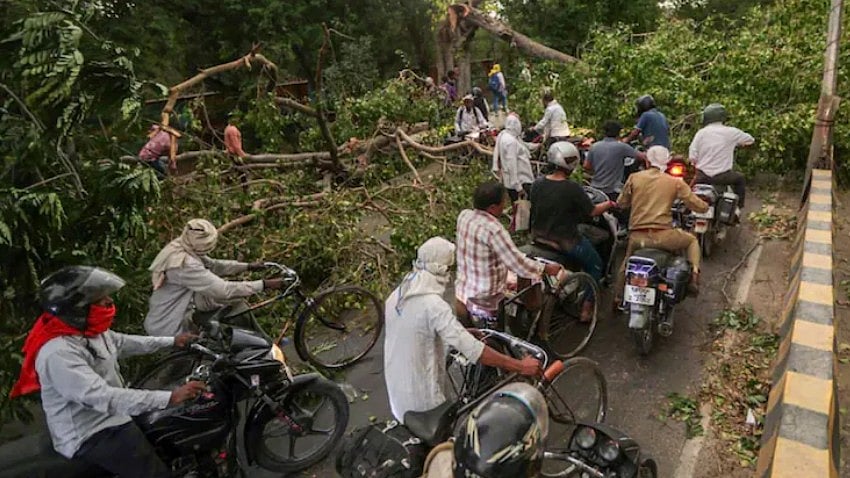
Unseasonal storms accompanied by heavy rain, hail, and winds exceeding 100 kmph struck Uttar Pradesh between 13 and 14 May, resulting in at least 111 deaths and 72 injuries across 26 districts.
The severe weather event caused extensive damage to homes, infrastructure, and livestock, with authorities confirming the loss of 170 animals and the destruction of 227 houses. Relief and rescue operations were initiated immediately following the disaster.
According to Hindustan Times, wind speeds ranged from 74 to 130 kmph, with the highest recorded in Bareilly and Prayagraj. The meteorological office attributed the storm to western disturbances over Jammu and Kashmir and cyclonic circulations over western Central Uttar Pradesh.
“Due to bad weather on 13 May, including storms, rain, hailstorm and lightning, reports of 111 deaths were received from 26 districts; 72 persons were injured, 170 livestock losses and damage to 227 houses have been reported in the state,” stated the relief commissioner’s office.
As highlighted by The Hindu, the Uttar Pradesh Relief Commissioner’s office has been monitoring the situation and coordinating with district magistrates to ensure timely relief.
Chief Minister Yogi Adityanath directed officials to expedite relief efforts, restore essential services, and provide compensation to affected families.
As noted in an article by The Indian Express, the state government’s response included high-level coordination and directives for immediate assistance. District authorities were instructed to conduct surveys and release compensation in coordination with relevant departments. The relief commissioner’s office also sent over 346 million warning messages to the public through the Sachet portal prior to the storm’s arrival.
Coverage revealed that the India Meteorological Department had issued warnings for severe weather, and the control room was placed on high alert. The storm’s timing, coinciding with evening activity in marketplaces and outdoor areas, contributed to the high casualty rate, as many people were caught in structurally unsafe locations.
District-level reports indicated that Prayagraj recorded 21 deaths, Mirzapur 19, Sant Ravidas Nagar 16, and Fatehpur 11. Other districts such as Barabanki, Bahraich, Kanpur Dehat, Basti, Sambhal, Hardoi, and Unnao each reported at least four fatalities as details emerged. In Sonbhadra, three deaths and damage to 81 houses were confirmed, while Badaun district reported five deaths, including two children, due to collapsing walls and uprooted trees.
The storm’s impact was particularly severe in rural and semi-urban areas, where many homes had temporary or fragile structures.
Political leaders, including Samajwadi Party president Akhilesh Yadav, called for comprehensive relief and urged the government to ensure free treatment for the injured, provide food and water, arrange temporary accommodation, and expedite compensation for losses at the end of the official statement. Viral videos on social media documented the storm’s intensity, including incidents of people being injured by collapsing structures and flying debris.
“The government should immediately carry out relief and rescue work on a war footing, immediate arrangements should be made for the best possible free treatment for the injured, food and water should be made available as soon as possible, temporary accommodation should be arranged, the dead should be cremated with respect,” Akhilesh Yadav stated.
Analysis showed that meteorological experts linked the destructive squall to intense heat build-up in the days preceding the storm, which created unstable atmospheric conditions. The relief commissioner’s office continues to monitor the situation, with helpline services active for affected residents.
Note: This article is produced using AI-assisted tools and is based on publicly available information. It has been reviewed by The Quint's editorial team before publishing.