Trump Revokes Canada’s Board of Peace Invitation After Davos Clash With Carney
Donald Trump revoked Canada’s Board of Peace invitation after a public exchange with Prime Minister Mark Carney.
advertisement
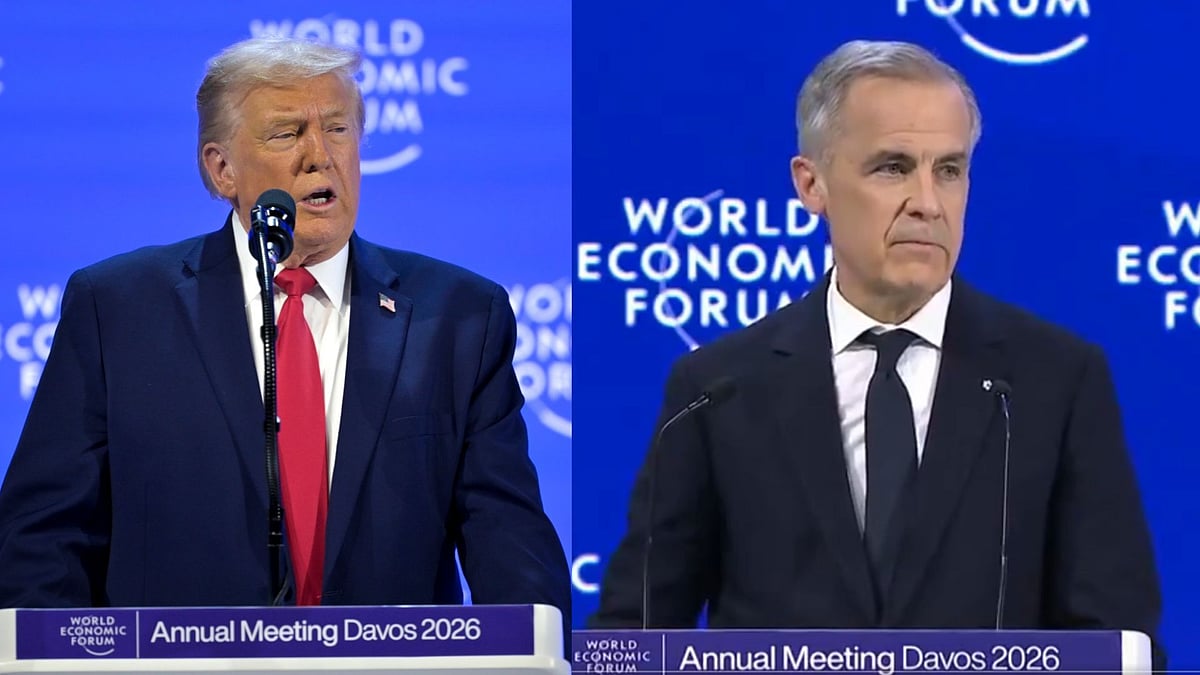
United States President Donald Trump withdrew Canada’s invitation to join the newly formed Board of Peace on 22 January 2026, following a public disagreement with Canadian Prime Minister Mark Carney at the World Economic Forum in Davos. The decision was announced after Carney criticised the current global order and Trump’s approach to international relations. Canada had not formally accepted the invitation before it was rescinded, and no official reason for the withdrawal was provided by the White House or Trump.
According to The Hindu, the dispute began when Donald Trump stated at Davos that “Canada lives because of the United States,” directly addressing Mark Carney. In response, Carney asserted, “Canada doesn’t live because of the United States. Canada thrives because we are Canadian,” during a national address in Quebec City. Carney’s remarks followed his speech at Davos, where he received a standing ovation for highlighting a “rupture” in the U.S.-led global order.
As reported by The Indian Express, Trump’s Board of Peace was launched at Davos as an initiative to mediate global conflicts, initially focusing on the Gaza ceasefire and reconstruction. Trump, who serves as chairman, announced the withdrawal of Canada’s invitation via a post on his Truth Social platform. The Canadian Prime Minister’s Office did not immediately comment, and Canada’s finance minister had previously indicated reluctance to pay the $1 billion required for permanent board membership.
As highlighted by BBC, the Board of Peace is being positioned as a new international conflict-resolution body, with about 60 nations invited and 35 having signed up. The board’s charter does not specifically mention Gaza, and its scope appears broader than initially described. Trump did not provide a specific explanation for rescinding Canada’s invitation, and Carney’s office did not issue an immediate response.
As noted in an article by The Hindu, Carney’s Davos speech criticised the use of economic integration and tariffs as tools of coercion by powerful nations. Trump’s subsequent remarks at Davos included a direct admonition to Carney, stating, “Remember that, Mark, the next time you make your statements.” The Board of Peace, according to Trump, requires permanent members to contribute $1 billion each, and its establishment was endorsed by a United Nations Security Council resolution as part of Trump’s Gaza peace plan.
Coverage revealed that Carney’s comments at Davos were part of a broader critique of the breakdown in the rules-based international order. He warned that middle powers like Canada must not rely on compliance for safety, as global power dynamics shift. The editorial context also noted Trump’s confrontational approach with other allied nations, including France and Switzerland, during the same period.
“Canada can't solve all the world's problems, but we can show that another way is possible, that the arc of history isn't destined to be warped towards authoritarianism and exclusion,” Carney stated in his address, as cited in the coverage.
Analysis showed that Trump’s recent international actions, including the Board of Peace and new tariffs, have contributed to economic uncertainty. The IMF’s latest report did not directly address these developments, but the effective tariff rate for U.S. imports has risen significantly, impacting global economic stability. Trump’s approach has included threats of high tariffs on countries declining participation in his initiatives.
Diplomatic tensions between the U.S. and Canada were further highlighted following reports of Trump’s broader nationalist policies, including new visa bans affecting multiple countries. The U.S. is set to co-host the 2026 FIFA World Cup with Canada and Mexico, but recent policy moves have strained relations with several allies, including Canada.
The sequence of events at Davos and the subsequent withdrawal of Canada’s invitation to the Board of Peace underscore ongoing shifts in North American diplomatic relations as details emerged. Trump’s rhetoric and policy decisions continue to generate significant international debate regarding the future of multilateral cooperation and the role of middle powers like Canada.
Note: This article is produced using AI-assisted tools and is based on publicly available information. It has been reviewed by The Quint's editorial team before publishing.