'Europe Not Headed in Right Direction': Trump Addresses WEF Summit in Davos
Donald Trump’s 2026 Davos visit draws global scrutiny amid Greenland tensions, economic threats, and elite backlash.
advertisement
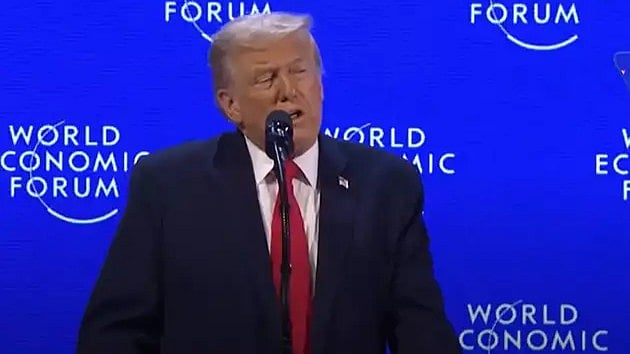
United States President Donald Trump addressed the World Economic Forum in Davos on 21 January 2026.
His visit was delayed due to a minor electrical issue on Air Force One. His visit coincided with heightened tensions between the US and European allies over his push to acquire Greenland, as well as concerns about new tariffs and global economic uncertainty. The summit featured over 3,000 leaders, including heads of state, ministers, and prominent business executives from around the world.
“When America booms, entire world booms, you follow us up and you follow us down," Trump said. "I love Europe and I want to see Europe do good but it’s not heading in the right direction," he added.
According to Financial Express, Trump’s delegation is the largest ever sent by the US to Davos, including Secretary of State Marco Rubio and Treasury Secretary Scott Bessent. The event’s theme, “A Spirit of Dialogue,” was overshadowed by Trump’s remarks on Greenland and his administration’s economic threats, which unsettled several US allies. India’s significant presence at the summit included multiple Union Ministers and Chief Ministers, reflecting the country’s growing global engagement.
As reported by The Guardian, Canadian Prime Minister Mark Carney addressed the forum, warning that the old US-led world order was “not coming back.” Carney described the current era as a “rupture, not a transition,” and urged middle powers to unite in response to the use of economic integration as coercion by major nations. Trump’s push for Greenland and threats of tariffs on European countries supporting Denmark intensified the rift between Washington and Europe.
As highlighted by The Indian Express, Trump was scheduled to speak at the forum and hold meetings regarding Greenland. He stated, “We need it for security purposes. We need it for national security,” emphasizing the strategic importance of the territory. European leaders, including Swedish Prime Minister Ulf Kristersson, rejected any form of blackmail and reaffirmed their commitment to Arctic security, while Carney reiterated support for Greenland’s autonomy.
Coverage revealed that Trump’s presence at Davos included a reception for global business leaders, with seven prominent Indian CEOs invited. These included Natarajan Chandrasekaran of Tata Sons, Sunil Bharti Mittal of Bharti Enterprises, and Salil S Parekh of Infosys. The agenda of the meeting was not disclosed, but the invitations underscored India’s increasing influence in global economic discussions.
“Middle powers must act together because if we’re not at the table, we’re on the menu,” Carney said at Davos, highlighting the need for collective action in a changing world order.
Analysis showed that a “No Kings” sign illuminated the mountainside in Davos ahead of Trump’s speech, sparking widespread discussion on social media. The sign, interpreted as a protest against perceived authoritarianism, became a focal point for critics of Trump’s approach to international law and governance. Supporters and detractors debated its symbolism, with some referencing Europe’s own monarchical traditions.
Reporting indicated that world leaders at Davos faced calls to publicly oppose Trump’s actions, including his threats to NATO and international institutions. The forum’s attendees, including CEOs and heads of state, were urged to denounce any undermining of global rules and to defend the principles of international cooperation.
The summit’s agenda was further shaped by discussions on technology and artificial intelligence, with Indian IT companies and global tech leaders participating. However, the dominant narrative remained Trump’s Greenland ambitions, the resulting diplomatic standoff, and the visible protests that marked his 2026 Davos appearance as details emerged.
Note: This article is produced using AI-assisted tools and is based on publicly available information. It has been reviewed by The Quint's editorial team before publishing.