Over 60 Tibetans Detained In Delhi During Protest Against Xi Jinping Visit
Visuals from the scene showed some protesters being physically restrained and taken into custody.
advertisement
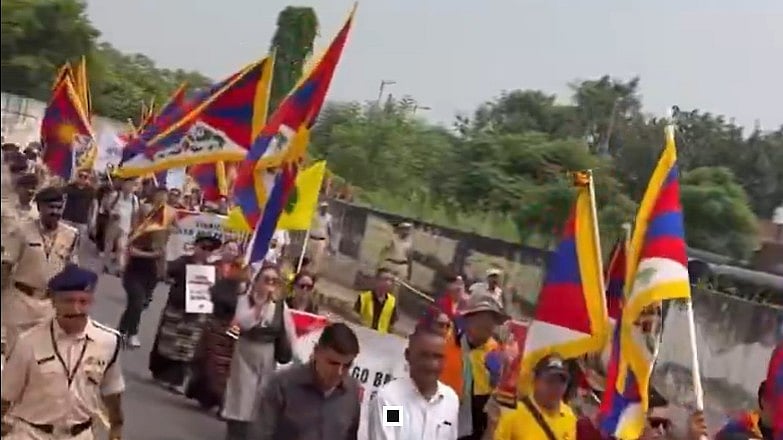
On the night of 12 September, Delhi Police detained 64 members of the Tibetan Youth Congress near Bhairon Marg, close to Bharat Mandapam, as they protested against the visit of Chinese President Xi Jinping to India.
The protesters carried Tibetan national flags and attempted to approach the BRICS Summit venue before being stopped and detained by police officials.
Visuals from the scene showed some protesters being physically restrained and taken into custody.
The detainees were subsequently transported to four different police stations: Mandawali, Ashok Vihar, Madhu Vihar, and Gazipur. No injuries were reported during the detentions.
According to The Hindu, the protest was organised under the banner of the Tibetan Youth Congress (TYC), which stated that its demonstration was aimed at highlighting alleged human rights violations, systemic violence, and suppression of Tibetan language, religion, and culture by the Chinese Communist Party.
The TYC clarified that their protest was not against India’s hosting of the BRICS Summit but was intended to draw attention to the situation in Tibet.
Protesters demanded the release of Tibetan political prisoners in China, a halt to construction activities on the Tibetan plateau, and an end to Chinese interference in Tibetan religious matters as coverage revealed.
Tenzin Lobsang, General Secretary of the Tibetan Youth Congress, stated, “China has been continuously violating human rights of Tibetans and suppressing Tibetan culture and religion. We demand that Tibetan political prisoners in China be released, mindless construction on the Tibetan plateau be stopped, and there be no interference of China in Tibet’s religious matters.”
Detentions also occurred on 11 September, when three students affiliated with Students for Free Tibet were apprehended after climbing poles inside an underpass near Pragati Maidan and displaying anti-Xi flags following reports.
These students were later remanded to Tihar Jail under preventive detention orders until 14 September. The police also placed the national director of Students for Free Tibet, Tenzin Passang, under house arrest, and detained an accountant, a media person from Tibet Radio, and an Indian student.
The Tibetan Youth Congress emphasised that the “question of Tibet remains directly connected to India’s national security and regional stability” as details emerged. Those detained on 12 September were expected to be released by the evening of 13 September, according to statements from the organisation.
“The question of Tibet remains directly connected to India’s national security and regional stability,” said Tenzin Lobsang, General Secretary, Tibetan Youth Congress.
Security measures around Bharat Mandapam were heightened during the BRICS Summit, with road closures and diversions implemented in the area as analysis showed. The police response to the Tibetan protests was part of broader efforts to maintain order during the high-profile international event attended by world leaders, including Prime Minister Narendra Modi and President Xi Jinping.
In addition to the main protest, the police detained several individuals associated with Tibetan advocacy groups in the days leading up to and during the summit as reporting indicated. The preventive detentions and house arrests were carried out to preempt further demonstrations near the summit venue.
The detained protesters were held at multiple police stations and, according to the Tibetan Youth Congress, were expected to be released after the conclusion of the summit as further information confirmed.
Note: This article is produced using AI-assisted tools and is based on publicly available information. It has been reviewed by The Quint's editorial team before publishing.