NSA Invoked Against Activist, Journalist Over Noida Workers' Protests
Two activists charged under NSA for alleged role in Noida workers’ protest violence.
advertisement
On 13 May 2026, Uttar Pradesh Police invoked the National Security Act (NSA) against two individuals accused of inciting violence during the Noida workers’ protest that turned violent on 13 April. The two accused, identified as Satyam Verma, a 60-year-old former journalist, and Aakriti Chaudhary, a 25-year-old history graduate, were detained following the protest, which saw property damage and multiple arrests.
According to Scroll, the NSA allows authorities to detain individuals without trial for up to a year. Police allege that Verma and Chaudhary played a significant role in instigating violence, arson, and public disorder during the protest. Both are reportedly members of the Mazdoor Bigul Dasta, a workers’ organisation, and are accused of provoking people in different areas to disturb public order.
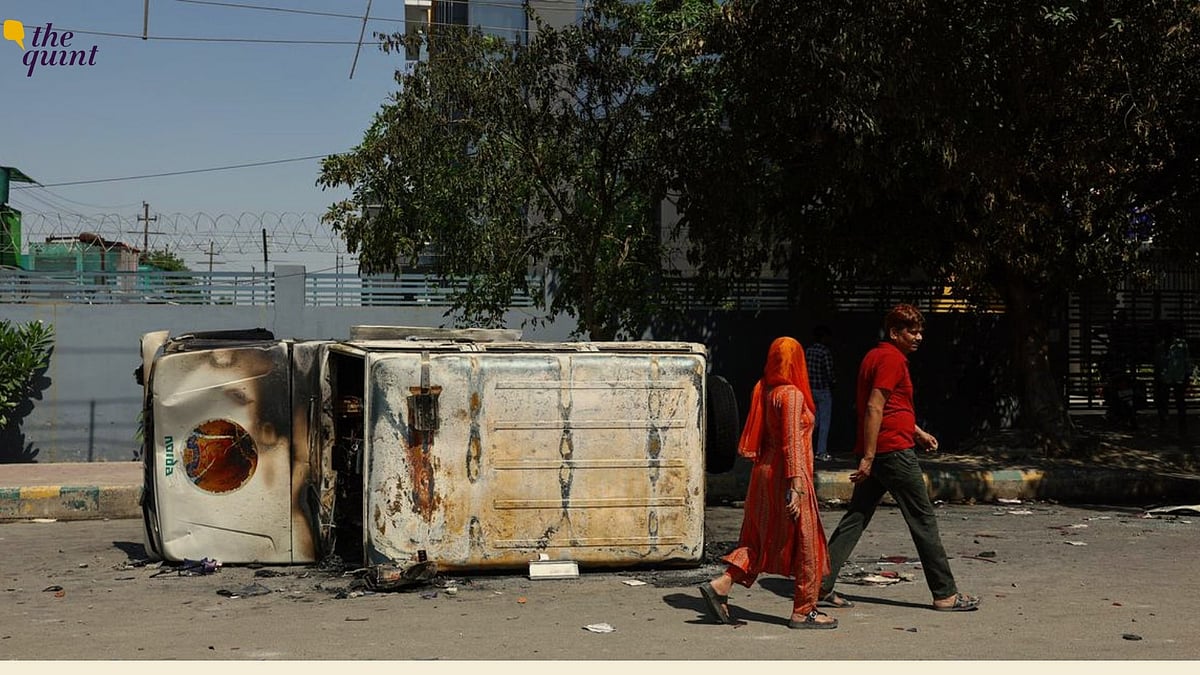
As reported by Hindustan Times, the protest began on 10 April as workers demanded higher wages. The situation escalated on 13 April, resulting in vandalism of over 100 factories, torching of vehicles, and injuries to police personnel. More than 350 people were arrested in connection with the violence, and Verma and Chaudhary were charged in three separate cases.
As highlighted by The Indian Express, police claim the violence was premeditated and orchestrated by an organised group of outsiders. The families of the accused, however, dispute these allegations. Chaudhary’s family stated she was detained on 11 April, two days before the violence occurred, raising questions about the charges. Her father, Arun Chaudhary, asked, “How can a person who had been picked up on April 11 be charged with violence that took place on April 13?”
Legal representatives for Verma and Chaudhary have announced plans to challenge the NSA charges in the Allahabad High Court. Advocate Chaudhary Ali Zia Kabir, representing Verma, stated that the government is using the NSA to prolong detention, alleging insufficient evidence against the accused. “They are invoking the NSA only to keep them in jail for six to seven months,” Kabir said.
“They do not have a single piece of evidence. It was a genuine protest by people earning barely ₹11,000 a month. The government also acknowledged the issue and held multiple meetings,” a lawyer representing one of the accused stated.
In the bail hearings, defence lawyers argued that the prosecution presented only WhatsApp chats and photographs as evidence against Verma, despite no direct link to the protest groups. For Chaudhary, the prosecution cited a book recovered from her residence, claiming it reflected her ideological leanings.
Further details emerged as families described the impact of the arrests. Chaudhary’s father expressed pride in his daughter’s activism, while Verma’s associates highlighted his background in journalism and social work. The court has reserved orders on multiple bail applications, and police have sought additional custody for some accused, with hearings scheduled for 15 May.
“She’s still bold, and whenever we meet her in jail, she tells me not to lose hope. There is such heavy police deployment whenever I meet her, as if our children are terrorists,” Arun Chaudhary said regarding his daughter.
At the end of the proceedings, coverage revealed that both Verma and Chaudhary face additional charges, including attempted murder, intent to cause death or grievous harm, endangering life or personal safety, and criminal conspiracy. The legal process is ongoing, with further hearings and potential challenges to the NSA invocation expected in the coming weeks.
Note: This article is produced using AI-assisted tools and is based on publicly available information. It has been reviewed by The Quint's editorial team before publishing.